A ground-breaking study published in Nature Climate Change reveals a persistent psychological divide at the heart of global climate action: the general public systematically underestimates how strongly their peers support climate-friendly policies, while simultaneously overestimating the actual real-world actions those peers take to reduce emissions.
Led by Dr. Kevin Tiede and a team of researchers from the Institute for Planetary Health Behaviour at the University of Erfurt, the comprehensive investigation analyzed the responses of more than 5,000 participants across Germany and the United States. The findings expose a profound disconnect between climate intentions and concrete actions—a phenomenon known as the "attitude-behaviour gap"—and challenge long-held assumptions among policymakers that simply informing the public about high consensus levels will automatically unlock widespread engagement.
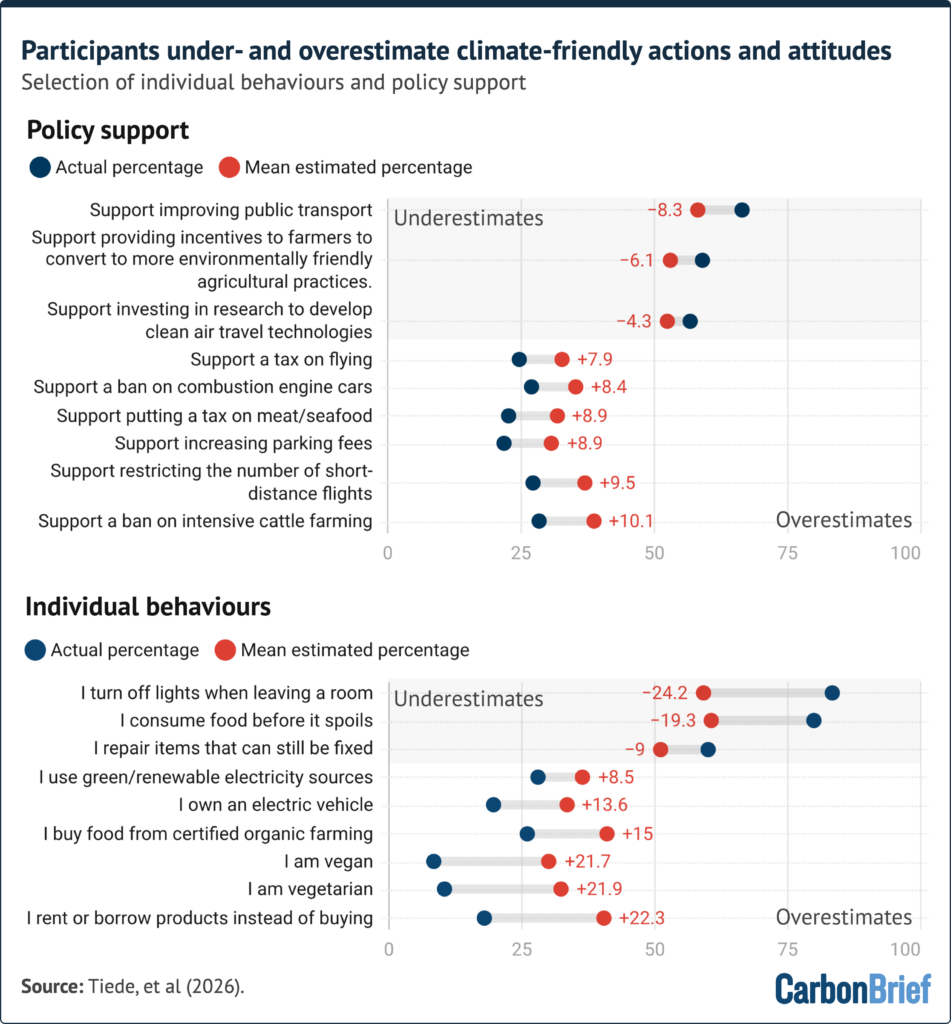
The study demonstrates that while public endorsement for pro-environmental policies is widespread, actual individual follow-through remains startlingly low. Furthermore, when individuals are asked to estimate what others think and do, human cognitive biases routinely distort their judgments. Respondents systematically project extreme consensus toward a moderate baseline—a statistical effect known as "regression to the mean." Consequently, public support for highly popular climate policies is heavily underestimated, whereas support for unpopular or restrictive measures is overestimated.
Understanding these psychological dynamics is essential for world leaders, environmental agencies, and communicators. As top-emitting nations struggle to meet net-zero obligations, the research indicates that social proof nudges alone are insufficient; closing the gap requires removing structural barriers, enhancing fairness in policy design, and designing targeted communication strategies that translate passive public agreement into tangible, verifiable collective action.
Detailed Chronology
To move beyond self-reported surveys and capture verifiable human behavior, the research team structured a multi-stage empirical study conducted across Germany and the United States between 2024 and 2025. The methodology encompassed five targeted experimental phases designed to measure attitudes, actual choices, and second-order predictions regarding peer behavior.
       RESEARCH EXPERIMENTAL TIMELINE (2024–2025)
 ┌──────────────────────────────────────────────────────────┐
 │ EXPERIMENT 1: Financial Action vs. Stated Intention      │
 │  • Stated Willingness to Donate: 37%                     │
 │  • Actual Real-World Donations Made: 4%                 │
 └────────────────────────────┬─────────────────────────────┘
                              │
 ┌────────────────────────────▼─────────────────────────────┐
 │ EXPERIMENT 2: High-Stakes Civic Engagement             │
 │  • Assessment of Greenpeace Legal Action Participation    │
 │  • Direct comparison of intent vs. binding commitment   │
 └────────────────────────────┬─────────────────────────────┘
                              │
 ┌────────────────────────────▼─────────────────────────────┐
 │ EXPERIMENT 3: Cognitive Mapping & Estimation Biases      │
 │  • Micro-tasking for climate funding                     │
 │  • Evaluation of 8 policy measures and personal habits   │
 └────────────────────────────┬─────────────────────────────┘
                              │
 ┌────────────────────────────▼─────────────────────────────┐
 │ EXPERIMENTS 4 & 5: Social Proof Interventions            │
 │  • Group A: Informed of high consensus (68% intention)   │
 │  • Group B: Informed of low real action (4% donation)    │
 │  • Group C: Control (no feedback provided)             │
 └──────────────────────────────────────────────────────────┘
Experiment 1: Measuring Stated Intent Versus Real-World Financial Sacrifice
In the initial survey phase, researchers asked participants whether they would be willing to donate 1% of their household income to the World Wide Fund for Nature (WWF). Immediately following their response, participants were provided a direct, secure mechanism to execute the donation. In follow-up assessments, subjects were asked to estimate what percentage of their peers agreed to donate and what percentage actually transferred the funds.
The results underscored a drastic disparity: 37% of respondents stated they were willing to donate, but only 4% actually carried out the financial transaction. When predicting peer activity, participants underestimated peer willingness (predicting 34%) while drastically overestimating actual peer donations (predicting 23%).
Experiment 2: Legal Action and Civic Support
The second experiment examined civil engagement by presenting participants with a real-world legal action—a constitutional complaint against the German federal government organized by Greenpeace demanding stricter climate policies. Participants indicated whether they were willing to join as co-complainants or financially support the litigation, and were then given immediate avenues to formalize their participation. Peer estimates were subsequently collected to evaluate how civic action is perceived versus performed.
Experiment 3: Effort Tasks and Multi-Policy Predictions
In the third experiment, subjects performed an online labor task ("work for environmental protection"), where completing additional web pages directly triggered institutional donations to WWF. Participants then estimated the work output of their peers. Additionally, respondents evaluated eight distinct personal climate habits and eight specific public climate policies, predicting how the broader population would respond to the exact same metrics.
Experiments 4 & 5: Testing the Efficacy of Social Nudges
The final two experimental phases tested whether correcting misperceptions actively alters behavior. Participants were partitioned into three distinct experimental groups:
High-Intention Context Group: Explicitly informed that 68% of past participants expressed willingness to contribute.
Low-Action Context Group: Explicitly informed that only 4% of past participants completed an actual financial donation.
Control Group: Provided no benchmark information.
All participants were then evaluated on their willingness to sign petitions, participate in climate discussions, and donate real funds.
Supporting Context & Metrics
The quantitative findings derived from the 5,000-person dataset highlight two distinct psychological phenomena: the Attitude-Behaviour Gap and systemic Statistical Estimation Bias.
    ACTUAL VS. PERCEIVED ENGAGEMENT METRICS

    [Public Intention vs. Real Action]
    Willing to Donate (Intent):    [=================== 37%]
    Actual Donations (Action):     [== 4%]

    [Peer Predictions for Actual Donations]
    Predicted by Peers:           [============ 23%]  <-- Massive Overestimation
    Actual Baseline:              [== 4%]
The Attitude-Behaviour Gap
Across all experimental cohorts, stated willingness to address climate change far exceeded actual engagement when participants faced immediate real-world trade-offs (such as allocating personal income or committing effort).
While over a third of respondents endorsed climate contributions in principle, less than one-tenth of those willing individuals took action when presented with an immediate opportunity.
       REGRESSION TO THE MEAN IN PUBLIC ESTIMATION

  100% ┤
       │  High Actual Support
       │  (e.g., Popular Policy)
       │           ● Actual (High)
  50%  ┼ - - - - - -  - - - - - - - - - - - -  Mean Cognitive Anchor
       │              ▼ Estimated (Lower)
       │              ▲ Estimated (Higher)
       │           ● Actual (Low)
    0% ┤  Low Actual Support
       │  (e.g., Unpopular Policy)
       └──────────────────────────────────────
Perception Gap and "Regression to the Mean"
When estimating the choices and views of others, human reasoning relies heavily on cognitive heuristics. The study revealed that peer estimates consistently regress toward a 50/50 midpoint:
Popular Climate Policies: Public measures enjoying high actual endorsement (e.g., expanding renewable energy subsidies) were systematically underestimated by respondents.
Restrictive Policies: Measures with low public support (e.g., heavy carbon taxation or severe consumption limits) were systematically overestimated.
Common Personal Choices: High-frequency sustainable actions were estimated as occurring less often than they actually do.
Uncommon Personal Choices: Rare personal lifestyle sacrifices were estimated as occurring far more frequently than the real-world data demonstrated.
Contextual Factors Influencing Perceptions
The degree to which an individual misjudges public sentiment depends on personal exposure and engagement:
Climate-Engaged Citizens: Individuals who frequently consume climate news, discuss environmental issues, or participate in activism consistently estimate higher levels of peer climate commitment across the board.
Geographic Scope: The study focused on Germany and the United States—two of the world’s top ten gross greenhouse gas emitters. While representative of high-income, high-emission democratic societies, the authors caution that these results may not fully translate to developing economies or alternative political systems.
Official Statements & Expert Analysis
Lead Researcher Perspective
Dr. Kevin Tiede, scientific managing director of the Institute for Planetary Health Behaviour at the University of Erfurt and lead author of the study, emphasized that misestimations should not be attributed to widespread denialism or malice:
"This perception gap is not due to ignorance or bias, but because people are just not good at making accurate estimations about large populations. The human brain naturally compresses extremes toward the middle when attempting to calculate complex group dynamics."
Addressing the policy implications of the experimental interventions, Dr. Tiede noted:
"Our findings suggest that just telling people how many people support climate action is likely not enough to really change something. Direct comparability between people saying they would donate and actually donating is limited. Giving people more time, greater convenience, and increased autonomy over how they participate yields far more meaningful results."
┌──────────────────────────────────────────────────────────────────────────┐
│                             EXPERT VERDICTS                              │
├──────────────────────────────────────────────────────────────────────────┤
│ "People are just not good at making accurate estimations about large    │
│  groups. Just telling people how many support climate action is not      │
│  enough."                                                                │
│  — DR. KEVIN TIEDE, Lead Author, University of Erfurt                    │
├──────────────────────────────────────────────────────────────────────────┤
│ "Observable behaviours, such as identity signalling—like protesting or   │
│  dietary choices—have more impact on encouraging climate action among    │
│  peers than private behaviours like financial donations."                │
│  — PROF. MADALINA VLASCEANU, Stanford University                         │
├──────────────────────────────────────────────────────────────────────────┤
│ "Experimental environments come with assumptions and expectations that   │
│  might not fully replicate the complex process people go through in      │
│  real-life donation decisions."                                          │
│  — PROF. MAURO BERTOLOTTI, Università Cattolica del Sacro Cuore          │
└──────────────────────────────────────────────────────────────────────────┘
Independent Scientific Commentary
Prof. Madalina Vlasceanu, an assistant professor at Stanford University’s Doerr School of Sustainability who was not involved in the study, highlighted the importance of these findings for climate communications:
"This study is a great addition to the literature because it proves that simply ‘correcting’ the perception gap does not automatically drive climate-friendly behavior, as scholars had previously assumed. Encouraging action is far more complex. It requires repeated exposure and tangible experiences of the norm."
Prof. Vlasceanu expanded on the difference between private acts and public visibility:
"Observable behaviours—such as identity signalling through public protesting or dietary modifications—might have a significantly stronger impact on encouraging climate action among peers than private behaviours like anonymous donations. When people actually see others acting, the social norm becomes undeniable."
Taking a critical methodological perspective, Prof. Mauro Bertolotti, associate professor of social psychology at the Università Cattolica del Sacro Cuore, noted that while the attitude-behaviour gap is well-established, experimental settings have inherent limitations:
"I am cautious regarding simplified and abstract experimental measures. Laboratory or survey environments come with built-in assumptions and expectations that differ significantly from daily life. As a result, micro-tasks may not fully replicate the cognitive and emotional processes people experience when deciding to make real financial or personal commitments."
Future Outlook & Policy Implications
The findings of this study call for a shift in climate policy and communication strategy. For years, environmental campaigns have operated under the assumption that highlighting high public support would create a tipping point of social proof, motivating silent majorities to act. The data demonstrates that while high-consensus messaging can boost intent, it fails to bridge the gap to actual behavior.
Rather than devoting substantial resources to persuading vocal climate skeptics, campaigns should focus on the overwhelming majority of citizens who already support climate solutions in principle. The primary challenge is not overcoming denial, but removing the friction that prevents supporters from acting.
2. Lower Structural Barriers
To convert stated willingness into action, governments and organizations must reduce financial and logistical hurdles:
Subsidies and Financial Assistance: Mitigate the immediate out-of-pocket costs of sustainable choices (e.g., heat pump installations, public transit passes, residential solar adoption).
Choice Architecture and Convenience: Default options should be redesigned to make pro-environmental decisions the easiest path (e.g., opt-out clean energy tariffs).
3. Emphasize Policy Fairness and Transparency
Public policy support drops precipitously when citizens perceive that environmental measures disproportionately burden low- or middle-income households. Policies engineered with explicit revenue-recycling mechanisms—such as carbon dividend payouts—build sustained public backing by combining climate goals with tangible economic fairness.
4. Leverage High-Visibility "Identity Signalling"
Because private acts (like monetary donations) remain largely invisible to the public eye, they do little to shift collective perceptions. Policy initiatives should foster highly visible community-level actions—such as municipal greening programs, rooftop solar installations, and public transit infrastructure—that visually reinforce climate action as an active, widespread societal norm.
Conclusion
Correcting public misperceptions is an important step, but it is not a standalone solution. Achieving deep decarbonization requires moving beyond passive information campaigns. By pairing clear social norms with accessible infrastructure, financial incentives, and transparent policy design, leaders can effectively bridge the attitude-behaviour gap and turn silent consensus into meaningful climate action.