Executive Overview
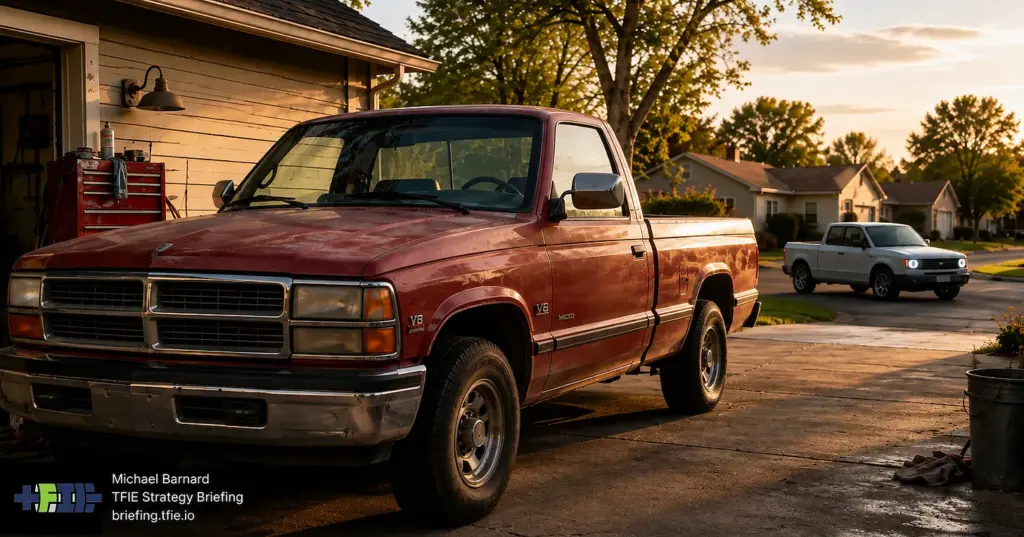
For millions of motorists worldwide, keeping an aging, paid-off vehicle on the road is not merely a lifestyle choice; it is a vital, rational fiscal strategy. Consider the owner of a well-worn 1995 Dodge Ram 1500. Every month the truck avoids the showroom floor is a month its owner bypasses a burdensome five-figure auto loan or a steep monthly lease payment. From a household budgeting perspective, handling occasional repair bills—even those running into hundreds or a few thousand dollars—is drastically more manageable than absorbing the $50,000 to $80,000 price tag typical of modern electric pickups.
Yet, when viewed through the cold, stark lens of global climate arithmetic, that same vehicle presents a profound challenge. Emitting roughly 7 to 9 tonnes of carbon dioxide annually from gasoline combustion alone, a heavily driven 14-mpg truck acts as a concentrated source of greenhouse gases.
This creates a glaring policy paradox: the individual household’s economic rationalism directly conflicts with broader environmental imperatives. Nationally, the United States vehicle fleet does not transform via a single, top-down legislative switch. Instead, it evolves through millions of hyper-localized, individual choices—decisions made at kitchen tables regarding whether to repair, sell, scrap, or replace aging automobiles.
Resolving this conflict requires a fundamental restructuring of vehicle replacement economics. As emerging low-cost electric trucks threaten to disrupt the traditional automotive landscape, policymakers have a unique opportunity to rewrite the rules. By aligning targeted vehicle scrappage programs with affordable electric vehicle (EV) availability, the public sector can finally make the climate-friendly choice the most economically rewarding choice for everyday drivers.
Detailed Chronology: How the Fleet Turnover Dilemma Evolved
To understand how the modern automotive market reached this policy impasse, it is necessary to examine the historical trajectory of vehicle manufacturing, fleet turnover, and environmental legislation in the United States.
The Era of Longevity and the Used Car Cascade (Late 20th Century)
For decades, internal combustion engine (ICE) vehicles steadily improved in build quality, allowing cars and trucks to easily surpass 150,000—and eventually 200,000—miles. This mechanical durability gave rise to the traditional "used car cascade." When a vehicle became too expensive or inefficient for its original buyer, it was sold down-market to a secondary buyer, and eventually to a third or fourth. While this market efficiency kept transportation accessible for lower-income households, it also meant that high-emitting, poorly maintained legacy vehicles remained active on public roadways for decades longer than originally intended.
The Rise of the Premium EV Market (2010–2024)
As battery technology matured, the automotive industry launched its long-awaited electrification wave. However, initial market forces dictated that manufacturers prioritize high-margin luxury vehicles to recoup massive research and development expenditures. Electric SUVs, luxury sedans, and large-battery pickups routinely commanded prices exceeding $60,000 to $80,000.
While these early models successfully proved that EVs could match or outperform ICE vehicles in performance and technology, they inadvertently created a massive economic chasm. Working-class families and rural drivers dependent on utility vehicles found themselves completely priced out of the clean energy transition. Federal and state tax credits largely subsidized affluent buyers purchasing brand-new luxury EVs, doing little to address the millions of high-emitting work trucks anchored to modest household budgets.
The Inflection Point: The Arrival of Sub-$30,000 Electric Trucks (2025–Present)
The landscape is shifting rapidly. Automakers are finally turning their attention to the mass-market, utility segment.

- The Slate Pickup: Market entrants like Slate have begun outlining deliberately stripped-down, utility-focused electric pickups starting at an accessible $24,950, promising practical day-to-day ranges of over 200 miles.
- The Ford Universal EV Platform: Industry stalwarts are following suit. Ford has signaled the rollout of its dedicated Universal EV Platform, targeting a midsize electric truck slated for release around 2027 with a projected starting price near $30,000.
These disruptive pricing models fundamentally alter the comparison. For the first time, vehicle owners evaluating a looming repair bill are no longer forced to weigh their paid-off truck against an exorbitantly expensive luxury EV. Instead, they face a viable, cost-competitive alternative in the sub-$30,000 price bracket.
Supporting Context & Metrics: Emissions, Economics, and Fleet Dynamics
To properly evaluate the trade-offs between retaining a legacy vehicle and transitioning to an electric alternative, policymakers and analysts must examine hard data spanning carbon emissions, household budgets, and market dynamics.
Emissions Arithmetic: The Carbon Footprint of Legacy Trucks
Let us return to the 1995 Dodge Ram 1500. Under normal operating conditions, depending on its specific engine configuration and drivetrain, this vehicle achieves roughly 12 to 16 miles per gallon (mpg). Driven near the American annual average of roughly 12,000 to 15,000 miles, the sheer volume of gasoline combusted generates between 7 and 9 tonnes of carbon dioxide ($textCO_2$) every single year.
In contrast, consider an efficient, modern electric pickup operating on the average United States electrical grid mix. Factoring in current power plant emissions profiles, the equivalent annual grid emissions for driving that same distance hover closer to 2 tonnes of $textCO_2$.
Critics of rapid fleet turnover often point out that manufacturing a brand-new electric vehicle carries a significant upfront carbon debt due to the energy-intensive process of mining and refining lithium, nickel, and cobalt for battery packs. However, because the operational emissions gap between a 14-mpg gas truck and an efficient EV is so massive—saving upwards of 5 to 7 tonnes of $textCO_2$ annually—the lifecycle emissions deficit of the new EV is typically erased within its first few years on the road. Retiring a heavily used, low-efficiency vehicle yields net-positive climate benefits over its lifecycle.
Household Economics and Operating Cost Savings
The decision to retain a legacy vehicle is rarely based on environmental indifference; it is grounded in immediate capital preservation. A paid-off vehicle has a capital cost of zero. When a transmission slips or an alternator fails, paying $1,500 for repairs feels far less threatening to a monthly household budget than signing up for a 72-month auto loan featuring high interest rates and monthly payments exceeding $700.
However, once the purchase price of an electric truck drops into the $25,000 to $30,000 range, operating costs step in to tilt the scales:
- Fuel Savings: Pumping gasoline into a 14-mpg truck running on $3.50-per-gallon fuel accumulates thousands of dollars in annual expenses. Charging an EV at home, particularly during off-peak hours, translates to a dramatic reduction in energy expenditures.
- Maintenance Savings: Electric vehicles feature significantly fewer moving parts than internal combustion engine vehicles. Oil changes, spark plug replacements, exhaust system repairs, and timing belt changes vanish entirely.
Conservative estimates factoring in typical mileage show that transitioning from an old gas-guzzling pickup to an efficient electric alternative yields combined fuel and maintenance savings of roughly $220 a month, equating to approximately $2,600 in annual savings. While these operational savings do not instantly overcome the lack of a car payment on a paid-off vehicle, they heavily subsidize the financing costs of an affordable replacement vehicle once its sticker price drops low enough.
Official Perspectives and Policy Reform: Moving Beyond Generic Tax Credits
Analyzing fleet turnover through the framework developed by the TFIE Strategy Briefing reveals a glaring disconnect in current legislative incentives.

The Flaws of Generic EV Purchase Subsidies
Historically, government intervention in the clean transportation sector relied heavily on broad-based tax credits applied uniformly to new EV purchases. While these incentives played an essential role in kickstarting early market adoption, they suffered from structural inefficiencies:
- The Free-Rider Problem: Subsidizing a consumer who was already planning to purchase a new luxury EV does little to accelerate true fleet decarbonization.
- Failure to Target High-Emitters: Offering the same financial support to a household replacing an already-efficient, five-year-old hybrid as a household retiring a heavily driven, 14-mpg utility truck squanders public capital.
- The Down-Market Filter: Without aggressive scrappage policies, old, high-emitting vehicles aren’t retired; they are simply sold down the used-car market, continuing to pollute for years under new owners.
The Case for Targeted Scrappage and Point-of-Sale Incentives
Future policy design must pivot away from blunt instruments and embrace surgical, high-impact interventions. With federal new- and used-clean-vehicle purchase credits evolving rapidly, future incentive frameworks should be directly tied to environmental remediation.
Experts advocate for a restructured policy model featuring targeted scrappage payments combined with point-of-sale EV incentives:
- Sliding-Scale Support: Incentives should scale dynamically based on the vehicle being retired. A consumer trading in a high-mileage, exceptionally low-mpg work truck with years of dirty emissions ahead of it should qualify for significantly higher public support than someone retiring an efficient modern sedan.
- Income-Graduated Assistance: To ensure equity, lower- and middle-income households—who are disproportionately impacted by rising fuel costs and mechanical unreliability—should receive enhanced direct financial assistance, ensuring that used and affordable new EVs qualify fully for maximum benefits.
- The $10,000 to $15,000 Sweet Spot: For high-value retirements involving commercial-grade or heavy-duty legacy trucks, a combined point-of-sale incentive and targeted scrappage payment in the $10,000 to $15,000 range becomes entirely defensible. Rather than subsidizing a luxury purchase, the public sector is effectively buying years of avoided high emissions, permanently scrubbing thousands of tonnes of carbon from the atmosphere.
When paired with a $25,000 to $30,000 electric truck and bolstered by $2,600 in annual operating savings, these targeted financial tools finally align household economic self-interest with global climate arithmetic.
Future Outlook: The Road Ahead for Fleet Decarbonization
The decarbonization of the United States vehicle fleet will not be achieved overnight, nor will it be accomplished via a single, sweeping federal mandate. Instead, it will unfold exactly the way the automotive landscape was originally built: through millions of independent, localized, kitchen-table decisions.
Every single day, vehicle owners weigh the mounting costs of mechanical repairs against the intimidating barrier of modern car prices. For the owner of a vintage Dodge Ram or any other aging workhorse, keeping that truck running today is a completely rational household survival strategy. Demonizing these motorists accomplishes nothing.
Instead, the ultimate objective of forward-thinking climate and transportation policy must be to rewrite the economic realities at the next natural replacement point. By combining the imminent arrival of sub-$30,000 electric pickups with intelligent, aggressive scrappage policies that reward the retirement of high-emitting vehicles, society can change the outcome of those individual decisions.
When the affordable electric truck emerges as the undeniably smarter financial choice, consumers will embrace it willingly. By ensuring that the high-emitting old vehicle is permanently scrapped—rather than cascaded down the used market—policymakers can finally ensure that cleaner choices win the vast majority of fleet turnover decisions, paving the way for a rapid, pragmatic, and economically resilient transportation future.