

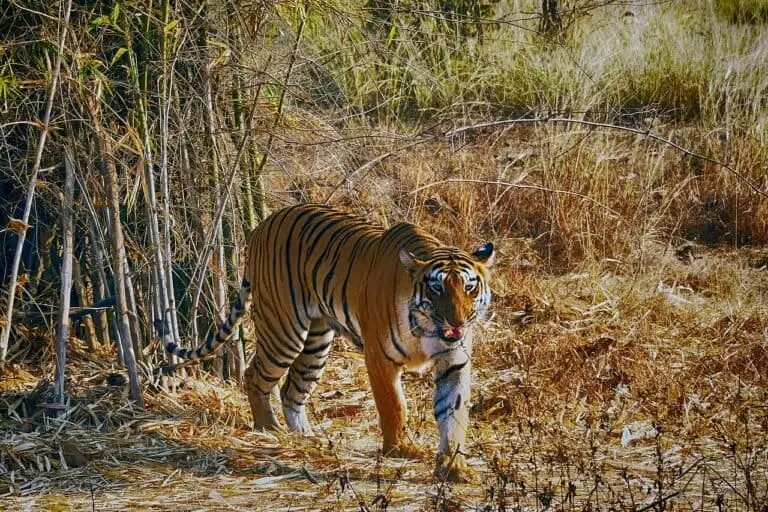
Executive Overview
Deep within the deciduous forests of southern India lies a profound ecological paradox. The Kawal Tiger Reserve, situated in the state of Telangana, boasts a flourishing understory teeming with life. Its verdant expanses support a robust and thriving population of spotted deer, sambar deer, nilgai antelopes, and wild pigs—a veritable buffet of ideal prey species specifically evolved to sustain apex predators. Yet, despite this ecological bounty, Kawal possesses a glaring and disheartening absence: it has no resident tigers.
As detailed in recent reporting by contributor Nivedhika Krishnan for Mongabay India, this phenomenon highlights a critical failure in contemporary conservation strategy. Kawal is not a degraded wasteland devoid of life; rather, it is a fully functioning habitat trapped in a state of arrested ecological succession. Geographically, the reserve serves as a vital linchpin connecting major tiger strongholds across central India—bridging the Tadoba-Andhari Tiger Reserve in Maharashtra to the west with the Indravati Tiger Reserve in Chhattisgarh to the east.
However, structural fragmentation, intense anthropogenic pressures, and a historical disconnect between state-mandated conservation goals and the rights of Indigenous communities have turned this ecological bridge into a perilous gauntlet. Since 2015, monitoring data reveals a trickle rather than a flow of wildlife: only 15 tigers have successfully crossed into Kawal from Maharashtra. More alarmingly, just two of those arrivals were females.
Without a resident female population, Kawal’s majestic forests remain perpetually empty of cubs, unable to transition from a temporary transit corridor into a self-sustaining breeding ecosystem. This in-depth investigative report examines the multifaceted barriers strangling Kawal Tiger Reserve, exploring the lethal mosaic of infrastructure threatening dispersing big cats, the unfulfilled promises fracturing human-wildlife relations, and the contentious debates surrounding proposed quick-fixes like assisted translocations.
Detailed Chronology and Historical Context
To understand how Kawal arrived at its current predicament, one must look back at its trajectory through time, administrative shifts, and the escalating encroachment of human enterprise over the last few decades.
- Pre-2012 (The Forest Division Era): Long before its official elevation to reserve status, the forests of Kawal functioned as a relatively continuous wildlife corridor, albeit one steadily fragmented by logging trails, grazing livestock, and burgeoning local settlements. While tigers occasionally roamed the landscape, human-wildlife coexistence was managed under standard territorial forest division protocols, lacking the focused funding, strict protections, and inviolate zones characteristic of modern tiger reserves.
- 2012 (The Reserve Designation): In a bid to secure the northern frontier of Telangana’s wildlife landscape and revive dwindling big cat populations, the Indian government officially declared Kawal a Tiger Reserve. This elevation brought high hopes among conservationists that the area would be purged of debilitating pressures and transformed into a premier breeding habitat. However, the designation immediately triggered complex socio-ecological challenges. Authorities made sweeping promises to the Indigenous Adivasi communities residing within the forest boundaries, pledging that their traditional rights, livelihoods, and access to resources would remain uncompromised.
- Post-2012 to 2015 (The Fracturing Consensus): Shortly after the official notification, the administrative stance shifted dramatically. Conservation mandates took precedence, leading to plans for clearing human settlements from the core zones of the reserve. Families relocated from these areas quickly discovered that the official rehabilitation packages were drastically mismanaged. Promised model villages featuring sustainable housing, reliable water sources, and productive agricultural land materialized instead as hastily constructed settlements with crumbling infrastructure and withheld property titles. This generated deep-seated resentment among local communities.
- 2015 Onward (The Dispersal Window & Baseline Monitoring): Conservation researchers began systematically tracking the movement of tigers entering Kawal from neighboring Maharashtra. Over the ensuing decade, empirical data confirmed that while male tigers occasionally braved the perilous transit to enter the reserve, female dispersers almost universally turned back. By the mid-2020s, the demographic imbalance rendered Kawal a "ghost reserve"—rich in ungulates, completely devoid of maternal roars.
- 2023–Present (The Current Stalemate): Recent comprehensive assessments revealed that despite years of protective management, an astonishing 37 villages and 67 small settlements remain entrenched inside Kawal’s core tiger habitat. As discussions around "assisted dispersal"—such as airlifting female tigers from dense populations—gain traction among certain wildlife managers, local leaders and veteran conservationists alike have pushed back, arguing that structural, social, and infrastructural root causes must be addressed before any biological interventions can succeed.
Supporting Context & Metrics: The Anatomy of a Fragmented Corridor
The plight of Kawal Tiger Reserve cannot be separated from the broader regional landscape of central India. Dispersing tigers—particularly young males seeking to establish new territories—frequently travel vast distances, stepping out of high-density source populations like Tadoba-Andhari. These journeys, however, have grown increasingly lethal due to an accumulation of linear infrastructure and industrial expansion.
The Linear Infrastructure Trap
Lead researcher Imran Siddiqui, speaking with Mongabay India, painted a vivid picture of the hazards awaiting tigers attempting the journey from Maharashtra to Kawal. Rather than a single obstacle, these big cats face a "cumulative mosaic of risks."
Key fragmenting elements include:
- Open-Cast Coal Mines: Massive industrial extraction sites that completely alter the topography, stripping away forest cover, generating heavy machinery noise, and creating impassable industrial zones.
- Water Management Projects: Large-scale initiatives like the Ada irrigation project, which slice through natural drainage lines and dry-season migration routes, altering local ecosystems and human settlement patterns.
- Agricultural Electrification: Poorly regulated, high-voltage electric fencing deployed by farmers to protect crops from wild herbivores inadvertently creates a lethal grid across traditional wildlife paths, electrocuting unsuspecting fauna.
- High-Speed Transportation Networks: The main Hyderabad-Nagpur railway line acts as a persistent nocturnal hazard, while National Highway 44 stands out as the most formidable physical barrier of all. Characterized by unyielding traffic density and high-security fencing, the highway effectively splits the landscape in two.
The Behavioral Divide: Bolder Males vs. Risk-Averse Females
The crux of Kawal’s demographic crisis lies in the behavioral differences between male and female tigers regarding risk assessment during dispersal.
- Male Dispersal: Young males are biologically driven to seek out new territory and breeding opportunities. Driven by these evolutionary imperatives, they are often "bolder risk-setters" willing to navigate human-dominated matrices, slip past railway tracks under the cover of darkness, and cross multi-lane highways.
- Female Dispersal: Conversely, female tigers are inherently risk-averse. A female’s reproductive success depends entirely on securing a safe, quiet, and undisturbed habitat capable of supporting vulnerable cubs over extended periods.
Siddiqui emphasizes this stark reality: "Crossing busy highways, railways, and mines poses a massive perceived threat to females. That is why males occasionally dodge traffic to reach Kawal, but females turn back. Without females, you simply cannot build a breeding population."
Internal Pressures: The Core Zone Dilemma
While external transit corridors represent the gateway problem, internal pressures represent the sanctuary problem. According to Anish Andheria, president and CEO of the Wildlife Conservation Trust, a functional tiger reserve requires an inviolate core area entirely free from human habitation and intense anthropogenic activity—a standard successfully implemented in premier reserves across India.
However, Kawal falls far short of this standard. As of 2023, data indicates that 37 villages and 67 small settlements remain nestled directly inside the core of the Kawal Tiger Reserve. This pervasive human footprint generates persistent low-level friction: livestock grazing competes with wild ungulates for forage, non-timber forest produce collection disturbs wildlife movement, and human-wildlife encounters frequently trigger defensive local backlashes.

Official Statements & Stakeholder Perspectives
The debate surrounding Kawal’s management brings together divergent viewpoints from conservation scientists, local Indigenous leaders, and wildlife administrators, each offering distinct interpretations of the crisis and its potential solutions.
The Scientific Consensus on Landscape Connectivity
Conservation biologists agree that mechanical fixes inside the reserve are useless if the arterial corridors supplying wildlife remain severed.
- Imran Siddiqui (Lead Researcher): Emphasizes that the obstacles facing tigers are systemic rather than isolated. He points out that wildlife conservation in the 21st century cannot succeed by treating protected areas as isolated islands. Unless linear infrastructure projects incorporate robust, functional wildlife overpasses, underpasses, and strict mitigation policies, natural tiger migration will remain a statistical anomaly restricted to desperate, wandering males.
- Anish Andheria (Wildlife Conservation Trust): Highlights the imperative of spatial zoning. Andheria asserts that human settlements within the core zone undermine the fundamental biological purpose of a tiger reserve. For Kawal to host resident breeding tigers, the core area must transition into a sanctuary unburdened by domestic livestock pressure and daily human traffic.
The Indigenous Perspective: Broken Promises and Adivasi Rights
The human element of Kawal Tiger Reserve is anchored by the Adivasi communities, whose historical relationship with these forests predates modern conservation boundaries. Local leaders argue that the state’s approach to conservation has been characterized by deception and coercion.
- Siddam Bhujang Rao (Local Adivasi Leader): Provided a damning critique of the government’s relocation policies. When Kawal was notified as a reserve in 2012, authorities assured resident communities that their legal rights and livelihoods would be safeguarded. "But once the reserve was established, their stance completely shifted," Rao stated.
Families who agreed to move out of the core area in the name of tiger conservation were handed an empty shell of promises.
- "They promised us land, water, and model villages," Rao explained. "Instead, families were moved to houses with crumbling plaster, and the agricultural lands were never handed over."
This betrayal has fostered deep mistrust. Adivasi communities view aggressive conservation demands—such as mandatory core-zone clearances—not as scientific necessities, but as authoritarian land grabs that punish local populations for systemic ecological failures driven by industrialization and highway expansion. Furthermore, Rao firmly rejects external biological quick-fixes: "Bringing tigers from outside will not work. It is a flawed idea, and it should be abandoned."
The Debate Over "Assisted Dispersal"
In response to Kawal’s empty status, some wildlife managers have floated the controversial concept of "assisted dispersal." This strategy involves capturing wild female tigers from hyper-dense source populations in states like Maharashtra and airlifting or trucking them directly into the Kawal Tiger Reserve to artificially jump-start a breeding nucleus.
However, this proposal faces fierce resistance from both field researchers and local communities.
- Siddiqui warns that manual translocations are "not a shortcut for fixing broken corridors." Translocating animals without resolving the underlying structural hazards treats the symptom while ignoring the disease.
- If a translocated female or her offspring eventually attempt to disperse or expand their territory, they will encounter the exact same lethal mosaic of open-cast mines, electrified fences, and National Highway 44 that blocked natural migrants in the first place.
- Moreover, dumping apex predators into a landscape already fraught with unresolved human-resettlement tensions risks accelerating human-wildlife conflict, alienating local communities even further, and dooming the conservation project to failure.
Future Outlook: A Critical Juncture for Kawal
The story of Kawal Tiger Reserve is a microcosm of modern conservation challenges in the developing world: the collision between industrial economic development, biological preservation, and the fundamental rights of marginalized Indigenous populations.
As the data shows, Kawal possesses all the natural prerequisites to be a roaring success. Its forests are lush, its prey base is exceptionally robust, and its geographic position is strategically vital for maintaining the genetic exchange necessary to prevent central Indian tiger populations from suffering the effects of inbreeding depression. Yet, it remains an empty sanctuary—a park of ghosts where the apex predator is notable only by its absence.
Moving forward, the path to redemption for Kawal cannot rely on artificial translocations or heavy-handed evictions. Policymakers, state forest departments, and conservation planners must pivot toward a holistic, integrative framework that addresses the root causes of the crisis:
- Corridor Remediation: The central and state governments must prioritize the retrofitting of linear infrastructure along the Maharashtra-Kawal transit route. Constructing world-class wildlife overpasses and underpasses across National Highway 44, regulating industrial expansion, and dismantling illegal electrified farm fencing are non-negotiable prerequisites for natural connectivity.
- Rebuilding Trust and Fulfilling Rehabilitation Pacts: Conservation cannot succeed at the expense of human dignity. State authorities must immediately make good on long-standing promises made to relocated Adivasi families. Providing fertile agricultural lands, sustainable housing, reliable water systems, and genuine economic inclusion is essential to healing the deep breach between forest departments and local communities.
- Harmonious Zoning: Rather than relying on coercive evictions that alienate local populations, conservation planners must engage in transparent, consensus-driven landscape zoning that respects traditional rights while protecting critical wildlife movement zones.
- Prioritizing Natural Recovery Over Artificial Interventions: As both scientists and local leaders emphasize, trying to force tigers into an unready landscape via translocation is a recipe for failure. By fixing the corridors, resolving human-wildlife friction, and protecting the core, the ecosystem will naturally invite its apex predator back home.
Until these systemic reforms are enacted, Kawal Tiger Reserve will remain an ecological tragedy in slow motion—a paradise of prey waiting in vain for the footfalls of a queen.



