

Executive Overview
In the global architectural and political consciousness, 1961 remains an immutable milestone: the year humanity broke the terrestrial tether and entered space, cementing the Soviet Union’s supremacy in the Cold War space race. Yet, the launchpad for Yuri Gagarin’s historic flight—the Baikonur Cosmodrome—was not nestled within the industrialized centers of Moscow or Leningrad. Instead, it rose from the desolate, windswept steppes of Kazakhstan. This geographic reality placed the Kazakh Soviet Socialist Republic (SSR) at the epicenter of a monumental ideological campaign.
Kazakhstan’s sheer territorial expanse and sparse population made it a prime canvas for the USSR’s most ambitious military, industrial, and scientific endeavors. Beyond functioning as a logistical powerhouse, the region became a physical laboratory for a state-sponsored vision of the future. Through avant-garde structures, monumental civic squares, and futuristic engineering feats, Soviet urban planners deployed architecture not merely as shelter, but as active political propaganda.
This article explores how Soviet architecture in Kazakhstan engineered the imagery of a new era, merging socialist utopianism with regional identity and space-age optimism. Furthermore, it examines how this legacy of monumentalism persists in modern, independent Kazakhstan, bridging the gap between mid-century space-age aesthetics and contemporary nation-building megaprojects.
Detailed Chronology: From Steppe Outpost to Space-Age Frontier
To understand the architectural transformation of Kazakhstan, one must trace the chronological milestones that reshaped its geography and cultural landscape under Soviet rule.
1. The Pre-Space Era and Early Industrialization (1920s–1950s)
- 1920–1930s: Following the establishment of Soviet power, Kazakhstan experienced rapid collectivization and sedentarization policies. Early architectural interventions were utilitarian, focusing on industrial extraction, mining towns, and railway hubs designed to link the republic’s rich mineral resources to the industrial heartland of the USSR.
- 1954: The launch of the Virgin Lands Campaign (Tselinnyye zemli) under Nikita Khrushchev brought hundreds of thousands of Slavic settlers, agricultural machinery, and modern housing blocks to northern Kazakhstan. This massive demographic shift radically altered the cultural and physical landscape, planting the seeds for standardized, ideologically driven urban planning.
2. The Space Age and Architectural Modernism (1950s–1970s)
- 1955: Construction begins on the Baikonur Cosmodrome near the town of Tyuratam. Originally conceived as a secret military-scientific base for intercontinental ballistic missiles, it quickly transforms into the cradle of global space exploration.
- April 12, 1961: Yuri Gagarin lifts off from Baikonur aboard Vostok 1, projecting Kazakhstan onto the global stage and permanently linking the republic’s geography with the iconography of the cosmos.
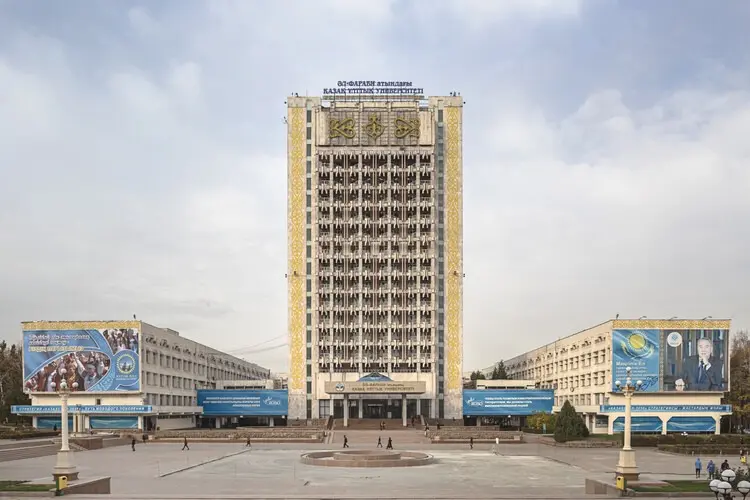
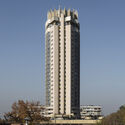
- 1960s–1970s: Fueled by space-age optimism and economic stabilization under Brezhnev, Almaty (then Alma-Ata, the republican capital) undergoes a massive modernization wave. Architects merge Soviet Modernism with subtle Central Asian motifs. Landmark projects take shape, including the Kazakh State Circus (1972) and the monolithic Hotel Kazakhstan (1977), engineered to withstand intense seismic activity while projecting unyielding verticality.
3. Late Soviet Monumentalism and Independence (1980s–Present)
- 1981: The Palace of Culture AHBK (now the State Academic Russian Theatre for Children and Young People) is completed in Almaty, showcasing the expressive potential of late-Soviet monumentalism.
- 1986: The Jeltoqsan protests erupt in Almaty’s Brezhnev Square (now Republic Square) following Moscow’s appointment of Gennady Kolbin, marking a critical catalyst for Kazakh national consciousness on the eve of the Soviet collapse.
- 1991: The dissolution of the Soviet Union. Kazakhstan gains independence, inheriting a vast legacy of space infrastructure and modernist architecture.
- 1997: President Nursultan Nazarbayev officially shifts the capital from Almaty to Akmola (renamed Astana in 1998), turning the northern steppe into a modern architectural playground. International starchitects are brought in to craft visionary megaprojects—such as the Norman Foster-designed Khan Shatyr (2010) and the Nur Alem Future Energy Sphere (Expo 2017)—continuing the historical tradition of utilizing architecture as national propaganda and futurist escapism.
Supporting Context & Metrics: Engineering the Cosmos on Earth
The deployment of Soviet architecture in Kazakhstan was underpinned by unique environmental challenges, staggering demographic shifts, and monumental engineering triumphs.
The Seismic Laboratory of Almaty
Almaty sits in the northern Tien Shan foothills, a zone historically prone to catastrophic earthquakes (such as the devastating 1887 and 1911 Verny earthquakes). Rather than abandoning vertical ambitions in the face of tectonic instability, Soviet engineers turned Almaty into a testing ground for seismic resilience.
The Hotel Kazakhstan, standing at 102 meters, relies on a monolithic reinforced-concrete core combined with sliding joints and flexible foundation structures. Completed in 1977, it became a symbol of technical prowess—proving that socialist engineering could conquer both the cosmos and the earth beneath it.
Spatial Metrics of Modernization
- Urbanization Leap: Between 1959 and 1989, Kazakhstan’s urban population surged from under 40% to over 57%, driven by industrialization, mining, and the aerospace sector.
- Baikonur Scale: The Baikonur Cosmodrome complex originally spanned thousands of square kilometers, functioning as an extraterritorial city-state within the Kazakh steppe, complete with restricted access, classified infrastructure, and a specialized technocratic population.
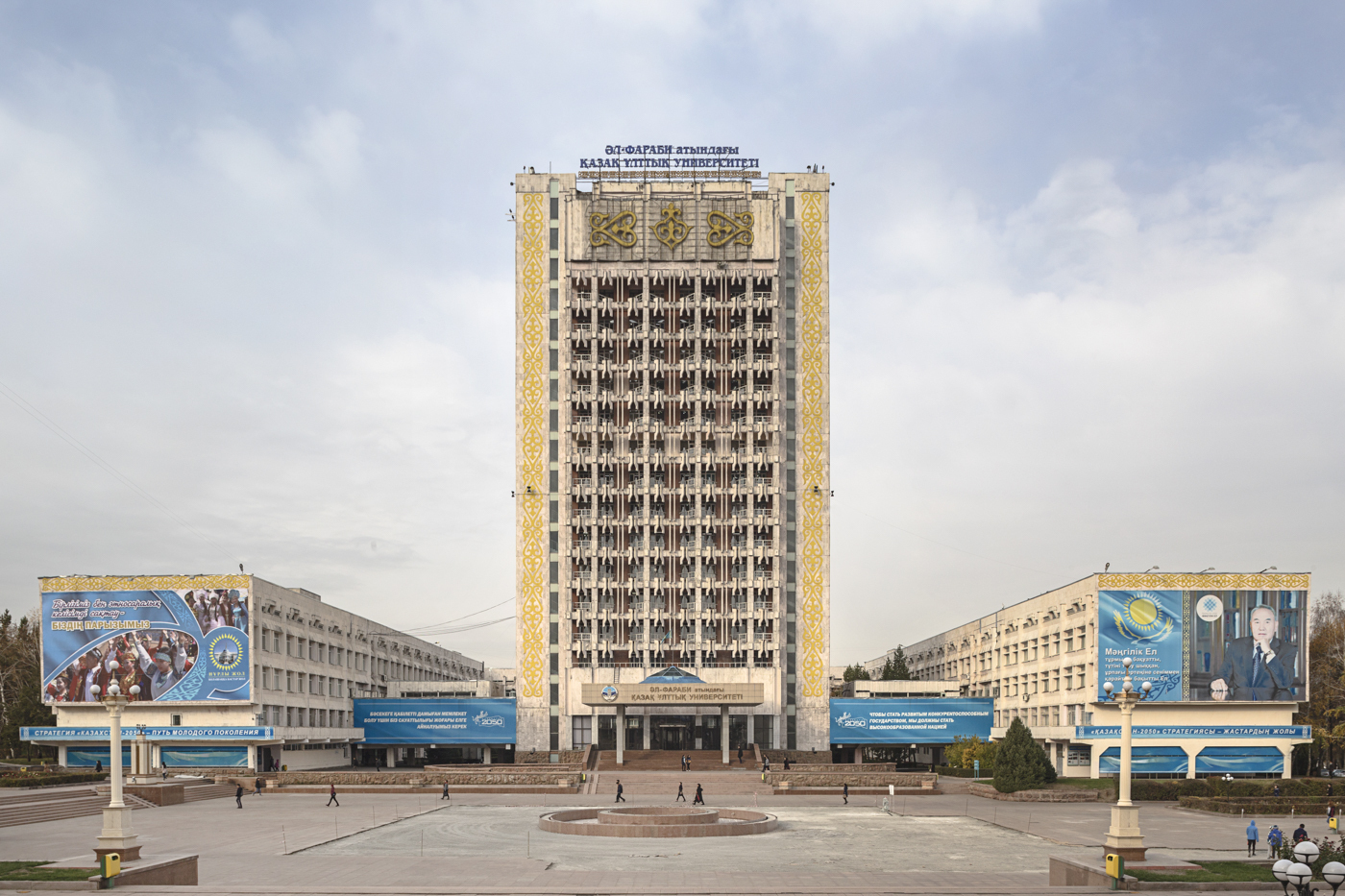
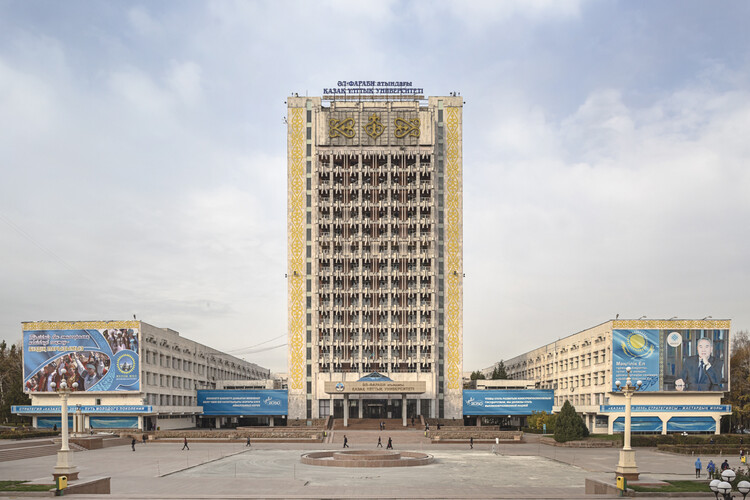
- Architectural Typologies: Soviet planners introduced standardized panel housing (khrushchyovkas and brezhnevokas) alongside bespoke cultural palaces, circuses, and university campuses, creating a dual landscape of mass egalitarian housing and singular, awe-inspiring monumental monuments.
Official Statements and Critical Perspectives
Architectural historians, preservationists, and cultural critics view the legacy of Soviet architecture in Central Asia through a complex lens, balancing the critique of totalitarian propaganda with an appreciation for avant-garde design.
"The future that the Soviet Union sought to project was not simply about imagining what cities or technologies might look like in the decades to come, but about creating the sense that a new era was already beginning, and that it would belong to the USSR."
— ArchDaily Architectural Review
Art historians specializing in Central Asian modernist heritage emphasize the synthesis of local culture and state ideology. While central authorities mandated a socialist-in-content, national-in-form doctrine, local architects often subverted strict uniformity by incorporating vernacular traditions—such as patterns reminiscent of nomadic yurts, ceramic tilework, and sun-shading brise-soleils adapted to the harsh continental climate.
Conversely, contemporary preservationists argue that these structures face unprecedented threats. Often viewed by the post-Soviet public as relics of an oppressive regime, buildings like the Kazakh State Circus or abandoned installations near Baikonur frequently suffer from neglect, unsympathetic modern renovations, or demolition. Yet, international grassroots movements and photographic documentation (such as the works of Roberto Conte and Stefano Perego) have reframed these structures as masterpieces of 20th-century structural engineering and artistic expression.
Future Outlook: The Continuum of Futurist Prophecies
The architectural trajectory of Kazakhstan demonstrates a striking continuity across political regimes. The foundational belief that an extraordinary, futuristic built environment can serve as tangible proof of a nation’s progressive destiny did not end with the dissolution of the Soviet Union in 1991.

From Baikonur to Astana: The Evolution of State-Sponsored Futurism
In independent Kazakhstan, this impulse found its ultimate expression in the rapid construction of Astana. Transformed from a provincial steppe town into a futuristic capital, Astana operates on the same psychological frequency as Soviet-era Almaty or Baikonur.
- The Khan Shatyr Entertainment Center: Designed by Foster + Partners, this transparent tent structure utilizes advanced ETFE (Ethylene Tetrafluoroethylene) cushions to maintain a tropical microclimate in a city known for its brutal winters. It echoes the Soviet fascination with massive, climate-defying enclosed spaces.
- Nur Alem (Expo 2017): The world’s largest spherical building, standing at 100 meters tall, serves as a museum dedicated to future energy. Its spherical geometry and unyielding structural audacity bear an uncanny conceptual resemblance to the space-age iconography of the 1960s USSR.
Conclusion
Soviet architecture in Kazakhstan was never merely a collection of buildings; it was a physical manifestation of ideological propaganda designed to convince citizens and the global community of socialism’s inevitable triumph over time and space. Today, as Kazakhstan navigates the 21st century through high-tech megaprojects and ambitious urban master plans, the architectural echoes of the Soviet era remain visible. They stand as enduring testaments to humanity’s perpetual desire to project political ambition, technological mastery, and national identity into the built environment—turning the frontier of the steppe into a permanent horizon of the future.



