

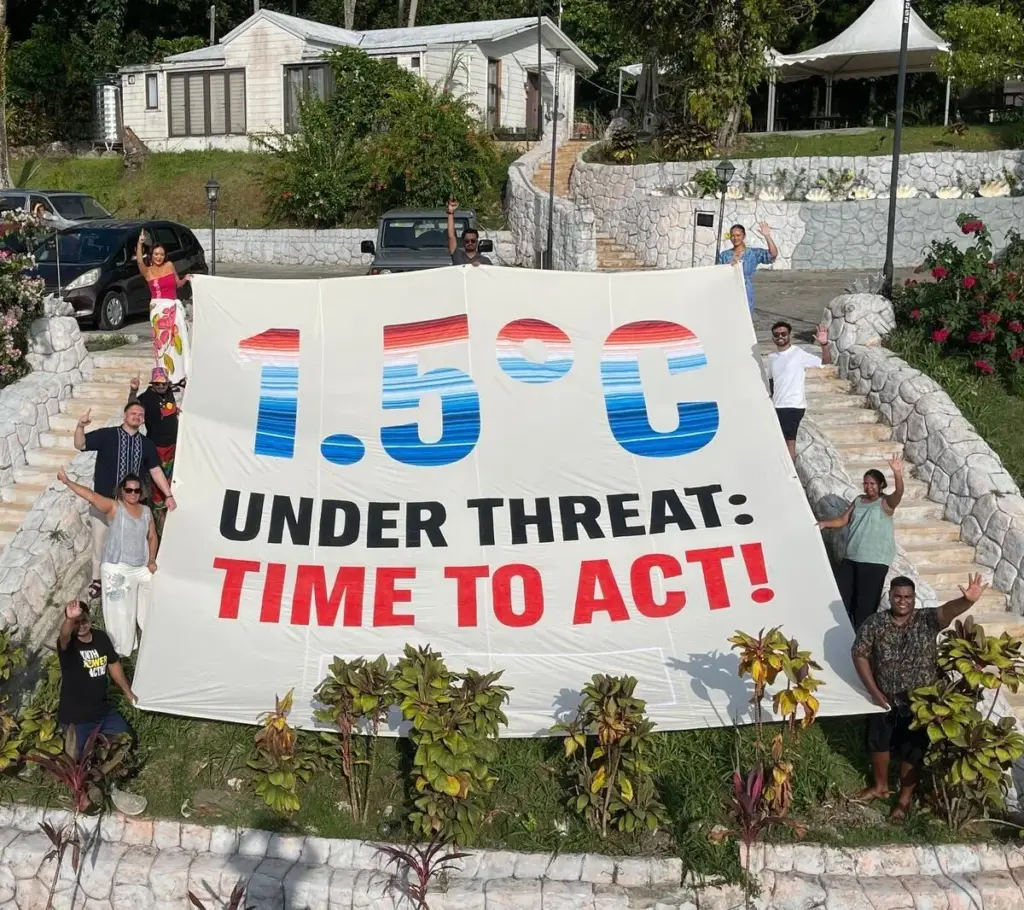
NEW YORK, UNITED STATES — As world leaders converge in New York for the United Nations General Assembly, a pivotal political battleground is taking shape around the future of global climate governance. Against the backdrop of escalating climate chaos—marked by catastrophic wildfires, record-breaking global temperatures, and mounting economic hardship for everyday citizens—Greenpeace International has issued a scathing critique of global inaction, launching a robust campaign to hold fossil fuel executives and major polluters financially accountable for the planetary crisis.
The urgency of the moment is underscored by the High-Level Event on Climate Action and the Just Transition. Serving as a capstone initiative for outgoing UN Secretary-General António Guterres, who has made climate stabilization a defining pillar of his legacy, this high-stakes summit is seen by analysts as a crucial, perhaps last-minute window to consolidate an effective international response to the compounding global climate and energy crises.
Yet, as diplomatic talks unfold in New York, environmental watchdogs warn that the chasm between diplomatic rhetoric and on-the-ground reality has never been wider. With critical milestones looming on the horizon—including the upcoming UN climate conference COP31 in Türkiye and the biennial UN biodiversity conference COP17 in Armenia—Greenpeace is aggressively mobilizing. The organization is demanding that governments immediately accelerate actions toward the landmark commitments agreed upon at COP28 in Dubai, specifically the pledge to transition away from fossil fuels and completely halt forest destruction by 2030.
Executive Overview: A Critical Juncture for Global Climate Policy
The convergence of high-level UN diplomacy and grassroots activism comes at a fragile moment for the international climate regime. Earlier in September, the United Nations Environment Programme (UNEP) released a sobering assessment indicating that the world has officially failed to limit global warming to the vital Paris Agreement threshold of 1.5°C. Instead, UNEP outlined a dangerous "overshoot, peak and decline" pathway, signaling that humanity will temporarily breach this critical temperature ceiling before any possibility of reversing the trend.
For vulnerable communities worldwide, this "overshoot" is not a mere statistical abstraction; it is experienced daily through record-shattering heatwaves, intensifying hurricanes, and unprecedented ecosystem degradation. Despite this existential reality, multinational fossil fuel conglomerates continue to post astronomical financial windfalls, frequently subsidized by public funds and protected by sluggish political frameworks.
Greenpeace’s intervention at the UN General Assembly centers on a tripartite demand:
- Accelerated National Roadmaps: Governments must move beyond empty promises and enact binding national policies to fund a fast, fair, and just transition to renewable energy.
- Ecosystem Preservation: Immediate, uncompromising protection for high-integrity forests to meet the 2030 zero-deforestation mandates.
- The Polluter Pays Principle: The implementation of permanent, aggressive windfall taxes on fossil fuel corporations to fund domestic cost-of-living reliefs and fulfill long-overdue international climate finance obligations to the Global South.
Detailed Chronology: From COP28 Commitments to the New York Climate Summit
The trajectory leading to the current High-Level Event on Climate Action and the Just Transition has been marked by escalating tension between scientific warnings and political hesitation.
- Late 2023 (COP28, Dubai): Following intense negotiations, nations formally agreed for the first time to "transition away from fossil fuels in energy systems" and halt global forest degradation by the end of the decade. While hailed as a historic textual breakthrough, critics immediately noted the absence of binding enforcement mechanisms and concrete financing timelines.
- Early to Mid-2024: Global temperatures consistently shattered historical records month after month. Unprecedented extreme weather events—ranging from devastating mega-fires across the Americas and Europe to catastrophic flooding in parts of Asia and Africa—testes the resilience of global infrastructure.
- September 2024: The United Nations Environment Programme (UNEP) published its authoritative emissions gap analysis, formally acknowledging that current Nationally Determined Contributions (NDCs) are insufficient to prevent the world from crossing the 1.5°C warming threshold, cementing the grim reality of a temporary climate overshoot.
- Present Day (UN General Assembly, New York): Outgoing Secretary-General Guterres convenes the High-Level Event on Climate Action and the Just Transition. Amidst corporate lobbying and geopolitical fragmentation, Greenpeace launches a global mobilization—backed by a petition exceeding two million signatures—demanding that world leaders force polluters to pay for the damages they have wrought.
Supporting Context & Metrics: Profits, "Fossilflation," and Ecosystem Collapse
The economic architecture underpinning the modern fossil fuel industry is fundamentally misaligned with planetary survival. While ordinary citizens bear the brunt of what Greenpeace terms "fossilflation"—surging costs at fuel pumps, grocery checkouts, insurance premiums, and municipal repair bills driven by climate disasters—energy giants continue to reap historic profits.
Market analysts note that geopolitical instability, including conflicts in energy-rich regions such as the Middle East, has repeatedly functioned as a catalyst for artificial price spikes, swelling corporate balance sheets at the direct expense of global consumers. This wealth accumulation stands in stark contrast to the severe funding shortfalls plaguing international climate finance mechanisms designed to support the Global South.
Parallel to the energy crisis is an unfolding ecological catastrophe. High-integrity forests, which act as the planet’s primary terrestrial carbon sinks, are disappearing at an alarming rate. According to biodiversity experts, the rampant destruction of these ecosystems not only releases gigatons of stored carbon back into the atmosphere—further locking in the 1.5°C overshoot—but also unravels the web of life essential for global food and water security.
Official Statements: Voices from Greenpeace International
Jasper Inventor: Ending the Era of Impunity
Jasper Inventor, Deputy Programme Director at Greenpeace International, delivered a pointed critique of political cowardice in the face of corporate greed:
"We are overshooting our climate limits while fossil fuel companies are overflowing with profits. As those most responsible for the climate crisis continue to cash in, this year’s repeated disasters pose a clear question: will politicians finally end the industry’s destruction? Talk is cheap, but life is priceless and our climate stability is disintegrating the longer we delay."
Inventor emphasized that systemic transformation cannot be achieved through polarization, but requires cohesive, multilateral resolve:
"The answer is not found in discord or division, but urgent collective action for our mutual benefit. Governments must develop and implement national roadmaps that accelerate a fast, fair and funded just transition into renewable energy and ensure we hold fossil fuel polluters and forest destroyers to account for the destruction they’ve caused."
An Lambrechts: The Uncompromising Boundaries of Biodiversity
Focusing on the interconnected nature of the climate and ecological crises, An Lambrechts, Biodiversity Policy Expert at Greenpeace International, highlighted the existential threat facing global forests:
"The devastating wildfires this year must finally compel us to act with the urgency we need to protect high integrity forests and end forest destruction by 2030, as agreed at COP28 and as part of the Kunming-Montreal Global Biodiversity Framework."
Lambrechts issued a stark warning regarding arbitrary timelines:
"These 2030 targets are not only aspirational, they represent a hard climate and biodiversity boundary. But as forest and ecosystem loss continue on our rapidly heating planet, these wildfires risk becoming a testament to our collective failure to act."
Looking toward upcoming diplomatic milestones, Lambrechts pointed to emerging frameworks as vital tools for accountability:
"The Brazil COP30 Presidency’s Forest Roadmap creates the momentum for solutions to be put in place. What’s required is clear government action and deliverables to end and reverse forest destruction by 2030. A future world of 1.5°C hinges on defending forests now and in the future."
Rebecca Newsom: Making the Wealthiest Polluters Pay
Addressing the socioeconomic dimensions of the crisis, Rebecca Newsom, Global Political Lead at Greenpeace International, focused on public outrage and the necessity of structural fiscal reform:
"We are united with one simple demand: make the wealthiest polluters pay for the damage they cause. People are fed up with paying for a crisis they didn’t create, hit by fossilflation at the pump, the checkout, on insurance and in the climate damage communities are confronted with."
Newsom explicitly tied corporate windfall gains to the necessity of public sector funding and international equity:
"Fossil fuel profits are soaring off the back of the war on Iran. Permanently increasing taxes on them and shifting fiscal incentives towards renewables should be obvious for any government serious about a just transition and ensuring Global South countries get the public international climate finance they’re owed. The money is there, it just needs to be put into the right hands."
Future Outlook: The Road Ahead to COP31 and Beyond
As the New York climate events conclude, the international community faces a narrow and rapidly closing window of opportunity. The credibility of the multilateral climate process hangs in the balance.
The transition from the current diplomatic sessions to the upcoming biennial UN biodiversity conference COP17 in Armenia and the future UN climate conference COP31 in Türkiye will serve as the ultimate litmus test for national governments. Will they capitulate to the short-term lobbying pressures of petrostates and multinational corporations, or will they summon the political courage to enact binding financial penalties on polluters and subsidize a rapid, equitable shift to renewable energy?
With over two million citizens already lending their voices to the "Make Polluters Pay" petition presented during the UN General Assembly, the public mandate is clear. The mechanisms for change—ranging from the Brazil COP30 Forest Roadmap to established international legal frameworks—exist. What remains to be seen is whether global leaders possess the political will to deploy them before the climate overshoot hardens into permanent, irreversible catastrophe.



