


Executive Overview
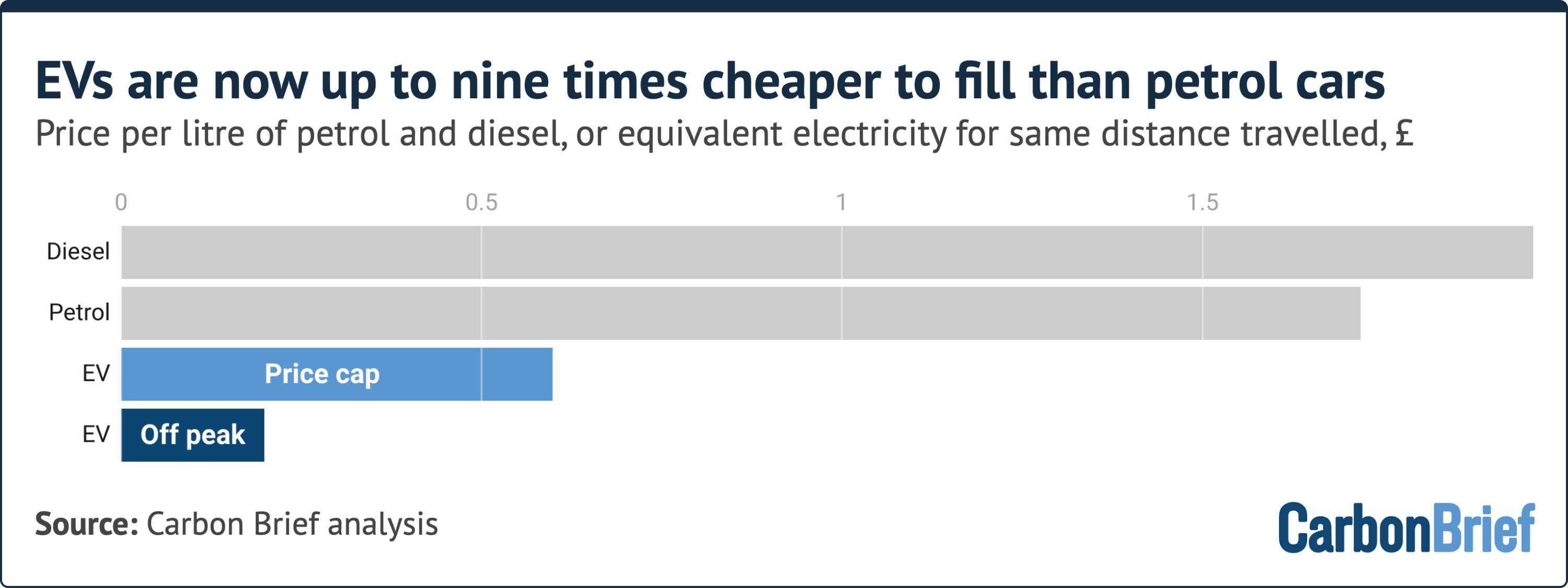
A perfect storm of escalating Middle Eastern conflict, systematic military targeting of Eastern European refining infrastructure, and severe supply disruptions in the global oil market has widened the running cost gap between electric vehicles (EVs) and internal combustion engine (ICE) cars to unprecedented levels. Fresh data and analysis from climate research organization Carbon Brief reveal that driving a battery-electric vehicle in the United Kingdom is now up to nine times cheaper per mile than operating an equivalent diesel or petrol car.
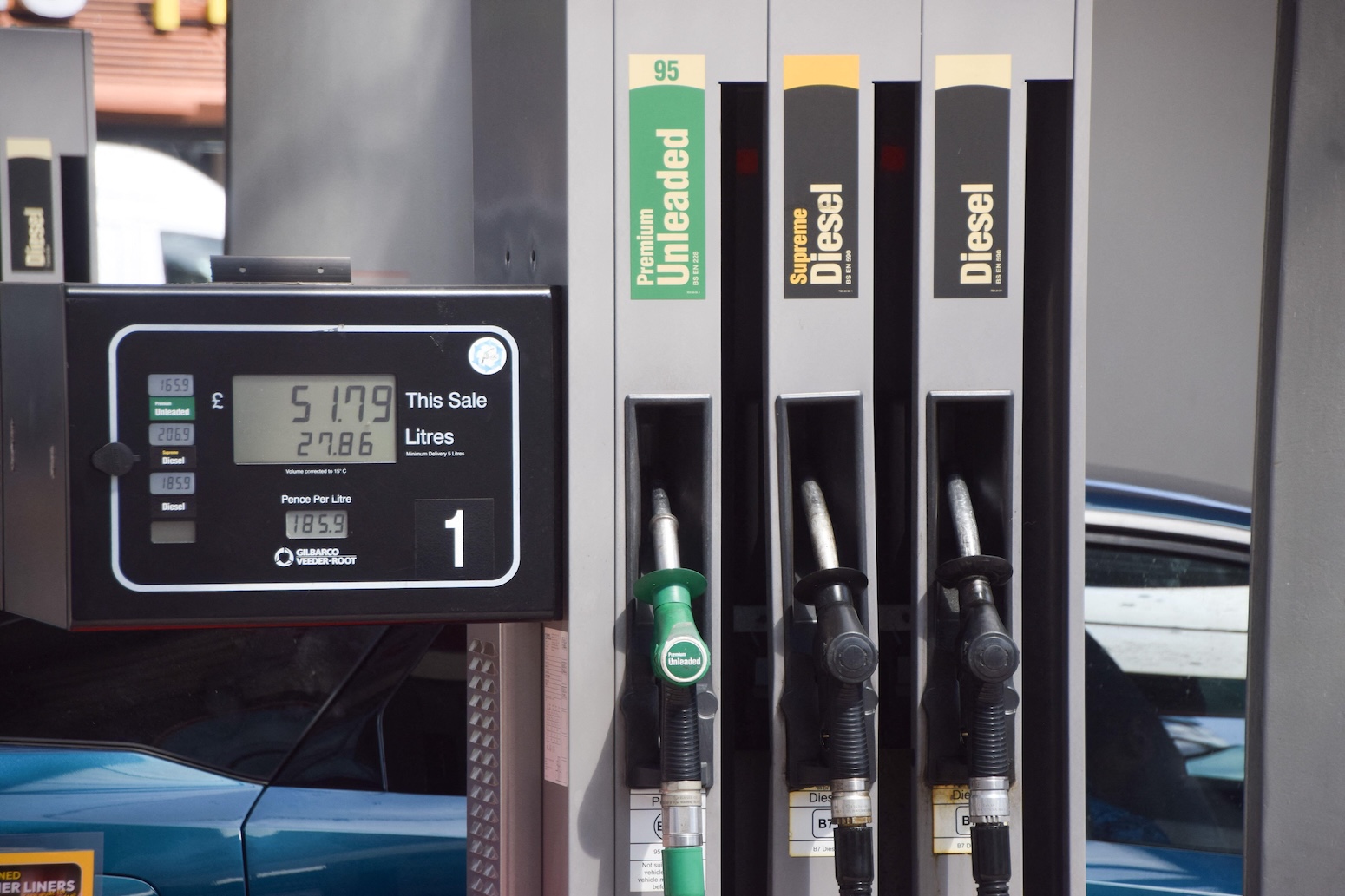
As global benchmark crude oil prices surged past $100 per barrel—marking a steep 50% increase since June—UK pump prices for traditional fuels have reached historic highs. Average diesel prices have spiked to £1.96 per litre, with industry analysts forecasting a swift rise past the psychological £2.00 threshold. Petrol has similarly tracked upward, averaging £1.72 per litre nationwide and reaching nearly £2.00 at high-cost forecourts.
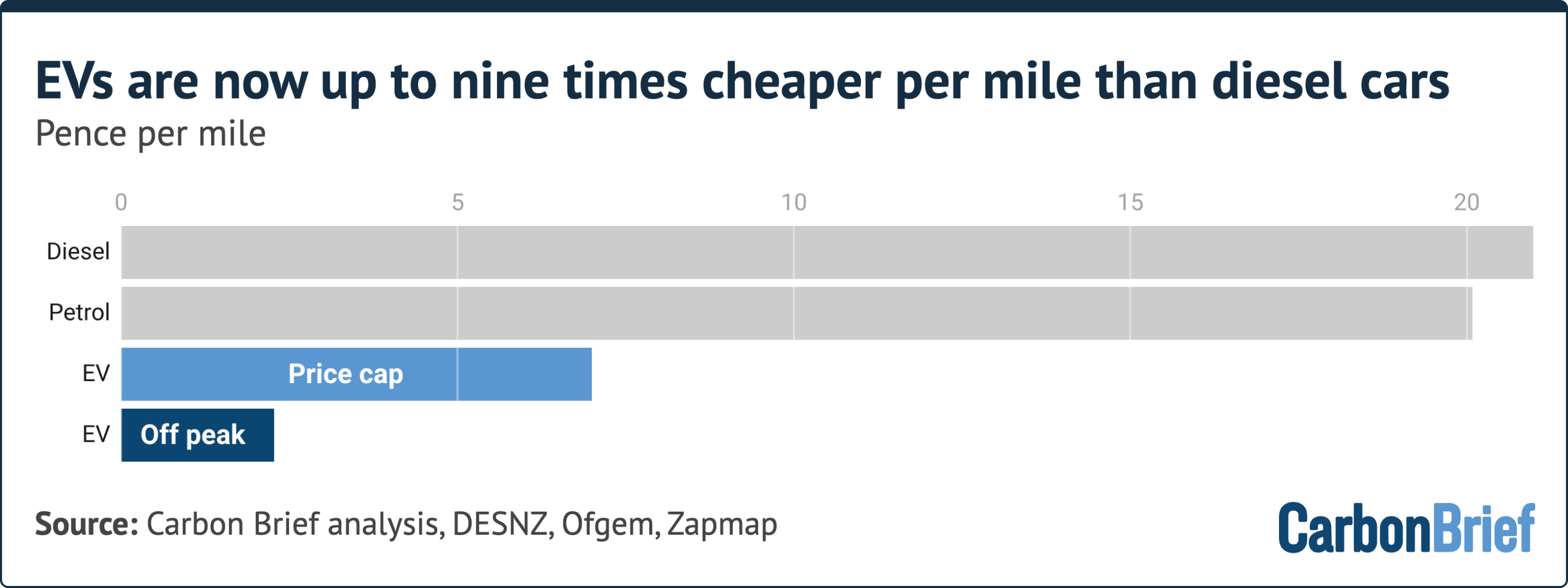
In stark contrast, drivers charging an electric vehicle on off-peak domestic tariffs are currently paying as little as 2.3p per mile, compared to 21p per mile for diesel and 20.1p per mile for petrol. Even drivers reliant on standard household electricity rates capped by energy regulator Ofgem pay approximately 7p per mile—less than a third of the cost of fossil-fuel transport.
This widening divergence represents a fundamental economic shift for British motorists. The typical UK EV driver now realizes an estimated £1,200 in annual fuel savings compared to petrol counterparts, while a single home-charge equivalent to a standard 55-litre tank yields immediate savings of around £80. Consequently, despite persistent headwinds in public charging infrastructure and macroeconomic inflation, consumer behavior is shifting rapidly: pure battery-electric vehicles captured nearly 30% of all new UK car sales in August, pointing toward a decisive turning point in the decarbonization of road transport.
Detailed Chronology: The Making of a Global Energy Crisis
The dramatic widening of UK transport costs is the direct byproduct of a cascading geopolitical crisis that began unfolding early in the year, progressively choking international petroleum production and refining capacity.
+-----------------------------------------------------------------------------------+
|                            2026 GEOPOLITICAL TIMELINE                             |
+-------------------+---------------------------------------------------------------+
| February          | Military clashes involving US and Iranian forces trigger initial |
|                   | volatility across Middle Eastern crude markets.               |
+-------------------+---------------------------------------------------------------+
| H1 (Jan - Jun)    | Ukrainian drone strikes systematically target Russian oil     |
|                   | infrastructure, striking refineries once every 3 days.        |
+-------------------+---------------------------------------------------------------+
| June - August     | Conflict escalates between Yemen's Houthis and Saudi Arabia;  |
|                   | Brent crude surges 50% to surpass $100 per barrel.            |
+-------------------+---------------------------------------------------------------+
| September 20      | High-profile strike hits Moscow's Kapotnya oil refinery,      |
|                   | sharply reducing regional diesel output.                      |
+-------------------+---------------------------------------------------------------+
| Late September    | UK diesel reaches £1.96/L; EV off-peak driving costs remain    |
|                   | stable at 2.3p/mile—a 9x economic advantage.                  |
+-----------------------------------------------------------------------------------+
The Initial Flashpoints (February – June)
The origin of the current fuel surge traces back to February, when military clashes involving American forces and Iranian assets catalyzed widespread risk premiums across global oil exchanges. Over the subsequent four months, refined product markets faced mounting pressure as regional instability threatened key maritime transit routes, including the Strait of Hormuz.
Simultaneously, a persistent attrition campaign against Eastern European energy assets gained momentum. During the first six months of the year, Russian petroleum processing infrastructure was struck by targeted drone attacks an average of once every three days. Given Russia’s status as the world’s second-largest exporter of diesel, the disruption forced nearly half of the country’s top diesel-producing refineries to severely throttle output, constraining global supply channels.
The Autumn Escalation (July – September)
By mid-summer, geopolitical friction intensified along two distinct fronts. Conflicts involving Yemen’s Houthi forces and Saudi Arabia escalated sharply, sending systemic shockwaves through Middle Eastern oil production hubs. Between June and September, crude oil prices mounted a relentless rally, climbing roughly 50% to breach the $100-per-barrel mark for the first time in years.
The crisis reached a tipping point on September 20, following a high-profile attack on Moscow’s major Kapotnya oil refinery. The severe loss of processing capacity exacerbated an already acute international shortage of middle distillates. Within days, wholesale diesel markets surged worldwide. In the UK, average pump prices for diesel jumped 38% above February baseline levels to reach £1.96 per litre, while petrol climbed 31% to hit £1.72 per litre.
Supporting Context & Metrics: Analyzing the Running Cost Gap
To fully grasp the economic disparity facing UK motorists, Carbon Brief synthesized fuel and energy price metrics sourced from the Department for Energy Security and Net Zero (DESNZ), energy market regulator Ofgem, and EV data platform Zapmap.
Per-Mile Cost Breakdown
When evaluated on a pence-per-mile basis, the efficiency advantage of electric powertrains combined with domestic electricity pricing creates an insurmountable cost margin over traditional internal combustion engines:
- Diesel Vehicles: Operating at standard fuel efficiency, the current average cost sits at 21.0p per mile.
- Petrol Vehicles: With national pump prices averaging £1.72/L, driving costs stand at 20.1p per mile.
- Standard-Tariff EVs (Ofgem Price Cap): Charged at the domestic cap of 26.1p per kilowatt-hour (kWh), driving costs average approximately 7.0p per mile—a three-fold reduction compared to ICE vehicles.
- Off-Peak Tariff EVs: Drivers utilizing overnight smart-charging tariffs (where rates drop dramatically during low-demand hours) pay as little as 2.3p per mile—rendering electric transport nearly nine times cheaper than diesel.
| Fuel / Power Source | Average Retail Price | Per-Mile Operating Cost | Litre-Equivalent Energy Cost | Relative Cost Factor |
|---|---|---|---|---|
| Diesel (Pump) | £1.96 / Litre | 21.0p | £1.96 | 9.1x Baseline |
| Petrol (Pump) | £1.72 / Litre | 20.1p | £1.72 | 8.7x Baseline |
| EV (Standard Price Cap) | 26.1p / kWh | 7.0p | ~£0.60 | 3.0x Baseline |
| EV (Off-Peak Smart Tariff) | ~8.5p / kWh | 2.3p | ~£0.20 | 1.0x (Baseline) |
Fuel-Tank Comparison and Annual Savings
For a standard family car equipped with a 55-litre fuel tank, a complete fill-up with petrol now costs roughly £95, while a diesel fill-up exceeds £107.
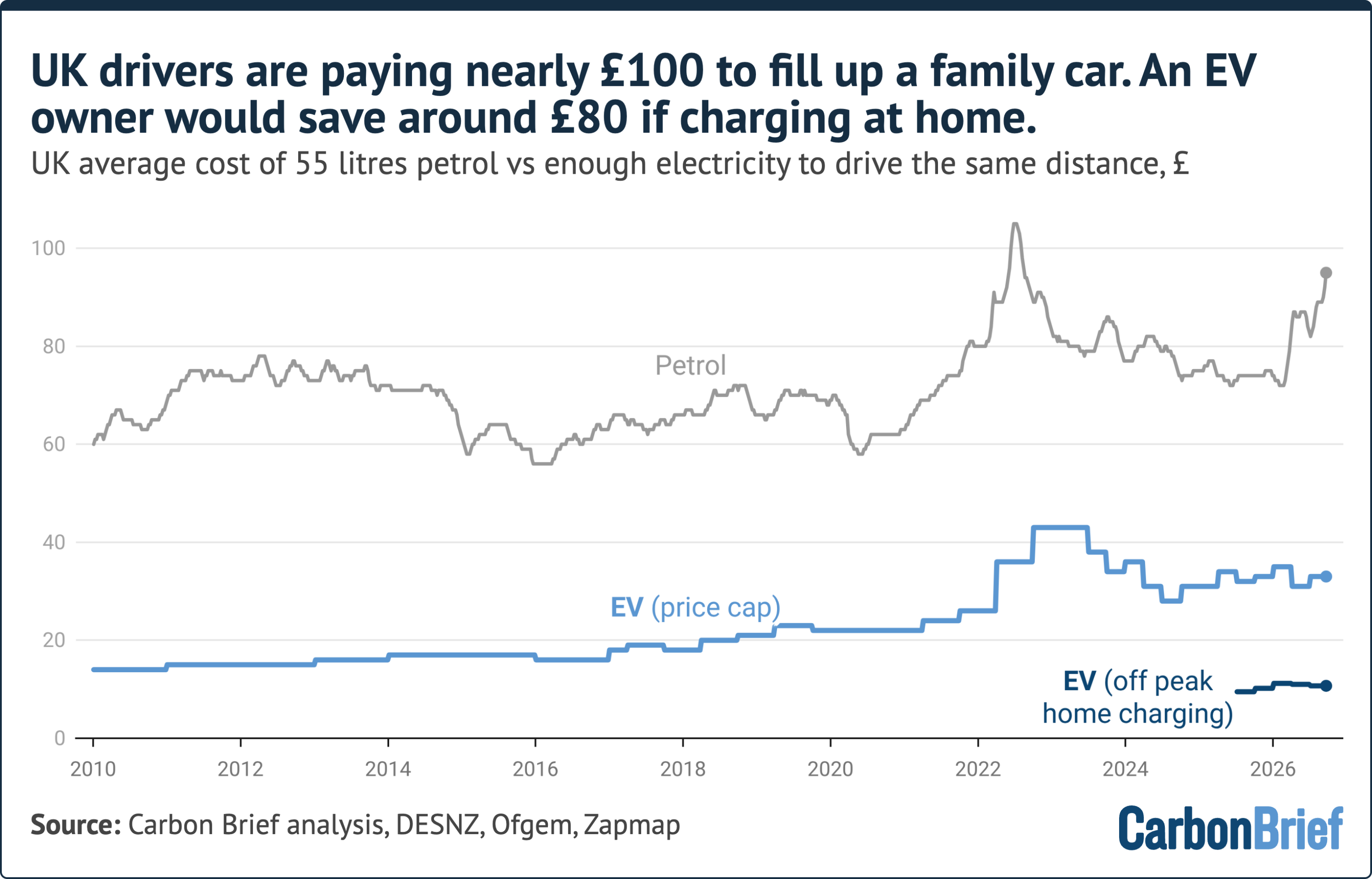
By contrast, purchasing the equivalent kilowatt-hours of electricity required to propel an EV over the exact same distance costs roughly £15 at standard price-cap rates, and under £10 when using overnight domestic off-peak windows. This nets home-charging motorists an immediate savings of approximately £80 per full "tank" equivalent.
    TYPICAL FULL TANK / EQUIVALENT CHARGE COST COMPARISON (£)

  £120 +-------------------------------------------------------+
       |                                              [£107.80]|
  £100 |                                    [£94.60]           |
       |                                                       |
   £80 |                                                       |
       |                                                       |
   £60 |                                                       |
       |                                                       |
   £40 |                                                       |
       |                          [£15.20]                     |
   £20 |                                        [£8.80]        |
    £0 +-------------------------------------------------------+
            Diesel              Petrol          EV (Cap)      EV (Off-Peak)
On an annual basis, previous analysis published by Carbon Brief in June 2026 demonstrated that EV drivers were saving an average of £1,100 per year compared to petrol vehicle owners. Factoring in the autumn oil surge, those projected net savings have now expanded to £1,200 per year.
Household Electricity Tariffs and the Price Cap Mechanism
A critical element in maintaining EV cost competitiveness is the structure of the UK domestic electricity market. Under Ofgem’s quarterly price cap updates, the unit price of electricity is scheduled to remain remarkably stable through autumn. While wholesale natural gas increases will push total energy bills upward in October, the vast majority of that increase is tied directly to gas heating rates. The unit price for electricity will rise by less than 1%, moving from 26.1p/kWh to 26.3p/kWh.
Forecasts indicate a larger 20% increase in electricity unit rates in January 2027, as sustained high global gas prices gradually filter into wholesale power markets. However, even under a 20% rate hike scenario, electric vehicle running costs would rise to only ~8.4p per mile on standard tariffs—leaving EV drivers vastly insulated from the extreme price volatility plaguing petroleum forecourts.
Official Statements & Regulatory Frameworks
Industry stakeholders and policy observers emphasize that while the operational economics heavily favor electric mobility, market penetration faces structural nuances across charging access and upcoming tax revisions.
Fleet Dynamics and Adoption Statistics
Data released by the Society of Motor Manufacturers and Traders (SMMT) highlights a accelerating transition in new vehicle acquisition, even as legacy fleets maintain a heavy footprint:
- Total On-Road Fleet: Of the approximately 35 million passenger cars registered on UK roads, traditional petrol models still represent 55% of the fleet. Pure battery-electric vehicles account for 6%, with plug-in hybrids (PHEVs) taking a 3% share.
- New Registration Trends: In August, pure BEVs comprised 30% of all new car registrations, a significant expansion from the 26.5% market share recorded in August 2025.
Commenting on the registration shifts, industry analysts note that escalating pump prices serve as an aggressive catalyst for prospective car buyers to abandon internal combustion models in favor of plug-in alternatives.
Public Charging vs. Home Infrastructure
A primary point of contention within transport economics is the divergence between domestic and public charging expenses. Public rapid-charging networks carry higher operational, capital, and commercial land overheads, resulting in per-kWh charges that sit considerably higher than domestic price caps.

However, government survey data published by DESNZ indicates that approximately 90% of all electric vehicle charging in the UK occurs at home. For the vast majority of EV owners, public chargers function as secondary infrastructure for long-distance travel rather than a primary energy source, preserving the primary economic advantage of home-tariff power.
Future Tax Adjustments: April 2028 Pay-Per-Mile Duty
Policy frameworks are also evolving to address long-term shortfalls in fuel duty revenues. HM Treasury has confirmed plans to introduce a dedicated pay-per-mile Road Power Duty on electric vehicles starting in April 2028.
Under proposed guidelines, the tax will add an estimated 3p per mile to the operating cost of zero-emission vehicles. While this policy change will narrow the operational gap slightly, energy economists stress that even with a 3p per mile tax added, an EV charged on an off-peak tariff (5.3p total per mile) will remain roughly four times cheaper to operate than a petrol or diesel car operating under current market conditions.
Future Outlook: Transport Transition Under Geopolitical Stress
The widening gap between fossil fuel and electric vehicle running costs underscores a broader structural realignment in the UK economy. As geopolitical fragility continues to destabilize international liquid fuel supply chains, domestic electrification offers a partial buffer against external trade shocks.

Key Factors Shaping the Road Transport Sector Through 2027
-
Refining Deficits and Forecourt Pressure:
With global oilproduction bound by Middle Eastern conflict and Eastern European refining capacity severely restricted, middle distillate supplies (diesel and jet fuel) are expected to remain tightly constrained into early 2027. If retail diesel breaches the £2.00/L mark, retail demand destruction for traditional vehicles could accelerate.
-
Grid Decoupling and Renewable Capacity:
Although UK electricity prices remain partially linked to wholesale natural gas rates, expanding domestic offshore wind, solar power, and nuclear output will progressively dilute fossil fuel dependencies within the national grid. This structural evolution provides long-term tariff stabilization for power distribution that petroleum importers cannot replicate. -
Fleet Turnover Dynamics:
While 91% of current UK road traffic remains reliant on internal combustion or hybrid technology, the accelerating rate of new electric car registrations—reaching nearly one in three new sales—suggests that fleet turnover will gain momentum. Corporate fleets and high-mileage commercial operators, facing severe diesel cost inflation, are expected to lead mass transition strategies.
Conclusion
The 2026 fossil fuel crisis has starkly illustrated the exposure of traditional transport systems to international conflict. With diesel pushing toward record peaks and petrol following close behind, the economic case for electric mobility has shifted from a marginal consumer calculation to a major financial advantage. Driven by high home-charging efficiency and off-peak energy management, UK electric vehicle drivers stand as the primary beneficiaries of an energy transition that is rapidly moving from policy objective to market reality.



