By Shaan Sood Published in partnership with the Oakland Institute
Executive Overview
A pervasive and insidious narrative has firmly established itself within the upper echelons of global finance, international politics, and environmental governance. We are repeatedly told by the world’s most powerful institutions that humanity faces a stark binary choice: aggressively scale up the mining of "critical minerals" or abandon all hope of securing a green, net-zero future.
Major international bodies project a staggering surge in demand. The World Bank estimates that production of essential minerals must skyrocket by 500% by 2050 to meet the infrastructure requirements of the global energy transition. The United Nations Conference on Trade and Development (UNCTAD) asserts that roughly 250 new mines must be blasted, excavated, and operationalized—including 80 new copper mines, 70 lithium mines, 70 nickel mines, and 30 cobalt mines—solely to satisfy international emissions targets. Concurrently, organizations like the World Wide Fund for Nature (WWF) advocate for a dramatic expansion of supply chains for these materials, universally labeled as "transition minerals."
For years, the public has been fed a grim calculus: the countless ecological atrocities tied to mineral extraction—rivers poisoned by toxic tailings and heavy metal runoff, ancient old-growth forests clear-cut for access roads, pulverized air quality, and the rapid collapse of local wildlife populations—are framed as regrettable yet unavoidable "transition costs."
However, a comprehensive new investigative report from the Oakland Institute completely upends this foundational premise. "Transition minerals," as data reveals, are deeply misnamed. The vast majority of these extracted elements flow directly into industrial sectors that have nothing whatsoever to do with clean energy. In fact, many are channeled into industries that stand in direct opposition to ecological sustainability. Powered by the explosive expansion of artificial intelligence (AI) data centers and surging global military budgets, the demand for these minerals is accelerating industrial and environmental degradation at an unprecedented pace.
Rather than serving as the building blocks of a sustainable future, the aggressive expansion of mining recommended by international bodies threatens to unleash unprecedented violence, widespread displacement of Indigenous and local communities, and irreversible environmental devastation across the Global South. This narrative serves a singular, functional purpose: greenwashing the destructive practices of the mining industry and packaging corporate profit-seeking as a profound social and environmental good. To secure a genuinely livable planet, this foundational falsehood must be rigorously dismantled.
Detailed Chronology: The Evolution of the "Green Mining" Consensus
Constructing Global Acceptance for an Unpopular Sector
To understand how the extraction industry successfully repositioned itself as an environmental savior, one must first look at its historical standing in the public eye. A comprehensive 2023 GlobeScan radar survey spanning 32 countries revealed a stark reality: across virtually every surveyed population, the mining sector was consistently rated as having the worst social and environmental impact of any major economic industry.
Faced with this deep-seated global skepticism and mounting public resistance, major mining conglomerates executed a sophisticated corporate pivot. Seizing upon the climate crisis, these firms transformed their public relations strategies, aggressively branding themselves as indispensable guardians of the green transition while burying decades of toxic environmental legacies and severe human rights violations.
This strategic alignment birthed a peculiar and dangerous paradox: international institutions, originally mandated to defend the common good and protect vulnerable populations, found themselves in absolute synchronization with the architects of ecological destruction.
The World Bank and the "Climate-Smart" Façade
A prime exemplar of this institutional capture is the World Bank’s Climate Smart Mining Initiative, which purports to ensure that mineral extraction is managed in a manner that "minimizes the environmental and climate footprint."
A cornerstone member of this initiative is Rio Tinto, a mining behemoth carrying a multi-generational legacy of severe environmental and human rights abuses across the globe. Despite its checkered past, Rio Tinto champions its role in corporate sustainability reports, asserting:
"The world needs mining, and it needs mining done the right way… we’re committed to providing these materials safely, sustainably, and in a capital disciplined way."
Yet, the stark divergence between corporate rhetoric and ground-level reality is glaring. Months prior to the publication of these sustainability pledges, Rio Tinto faced severe international accusations of contaminating local water systems in Madagascar with uranium and other radioactive elements. Fishermen and villagers living adjacent to the extraction sites reported catastrophic health impacts. As one local fisherman told the Financial Times, "It’s killing our children and killing everything around the mine."
Despite these documented harms, Rio Tinto retains the coveted "stamp of approval" from the World Bank’s climate-smart initiatives, illustrating how institutional frameworks are weaponized to sanitize corporate malfeasance.
The Corporate Boom and the Onset of the 2026 Shift
This phenomenon of institutional greenwashing is by no means isolated to a single firm. Across the board, major mining corporations have wrapped their relentless acquisition of foreign land and resources in the comforting lexicon of sustainability.
The financial dividends of this strategy have been astronomical. By 2025, the world’s 50 largest mining corporations experienced an aggregate market capitalization surge of nearly $900 billion—representing a staggering 70% increase in valuation over the span of a single year.
However, as the geopolitical landscape shifted into 2026, the thin veneer of environmental altruism began to slip away entirely, replaced by open admissions regarding the true geopolitical and technological drivers behind the global mineral scramble.
Supporting Context & Metrics: Where Do the Minerals Actually Go?
The central argument deployed by the pro-mining lobby rests on the absolute necessity of feeding the clean energy machine. Yet, a rigorous analysis of data from the International Energy Agency (IEA), compiled and evaluated by the Oakland Institute, exposes this claim as statistically hollow.
The True Breakdown of Critical Mineral Demand
When examining global consumption patterns for critical minerals, the data reveals a startling discrepancy: more than 70% of all critical minerals end up in products, technologies, and infrastructure completely unrelated to the green transition.
The Clean Energy Fraction: Out of total projected mineral demand, only roughly one-fifth is genuinely required to scale up wind turbines, solar photovoltaic arrays, and grid-scale energy storage systems necessary for a net-zero future.
The Surplus Illusion: The remaining vast majority of extracted materials are funneled into consumer electronics, luxury vehicles, heavy industrial manufacturing, artificial intelligence hardware, and military defense infrastructure.
Furthermore, intelligent, human-centric policy choices could dramatically reduce even this modest requirement for green energy infrastructure. A landmark 2023 study by the University of California, Davis, demonstrated that if governments prioritized public transit expansion, vehicle-sharing frameworks, and aggressive circular-economy recycling initiatives, U.S. lithium demand alone could be reduced by an astounding 92% by 2050, bypassing the need for dozens of proposed extraction sites.
The Human and Ecological Toll on the Global South
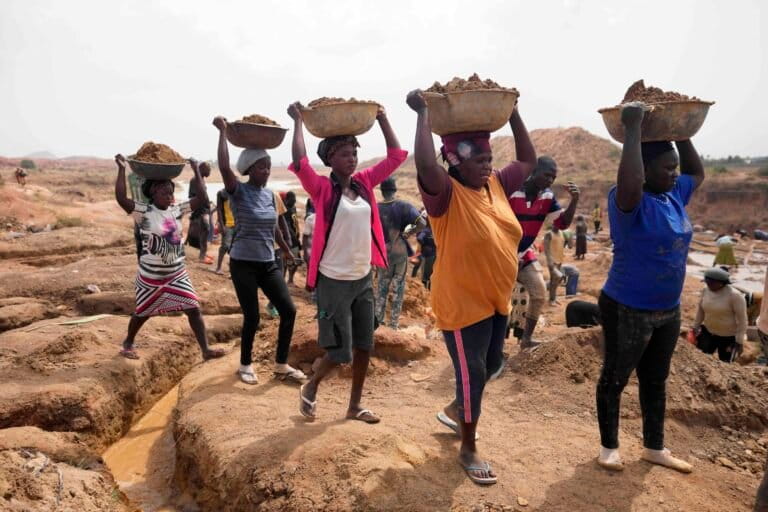
While corporate boardrooms in London, New York, and Sydney celebrate record market valuations, the physical reality of this extraction rush is borne disproportionately by marginalized populations in the Global South.
According to empirical geographic research published in Nature Sustainability, an estimated 69% of all current transition mineral extraction projects are located directly on or immediately adjacent to the ancestral lands of Indigenous and local communities.
The Democratic Republic of Congo (DRC): The race for cobalt and copper has deeply exacerbated and fueled the deadliest ongoing conflict since World War II, entrenching corruption, child labor, and paramilitary violence.
The Atacama Desert, Chile: In the Salar de Atacama, intensive lithium brine extraction has consumed more than 65% of the region’s total available water supply, devastating indigenous farming communities, fragile desert ecosystems, and native flora and fauna.
Official Statements: Stripping Away the Green Pretense
While international financial institutions and environmental non-profits have historically labored to clothe mineral extraction in the noble robes of climate action, recent political developments in major Western capitals have openly abandoned even the pretense of environmentalism.
At the United States-led Critical Minerals Ministerial held in February 2026—a massive geopolitical summit convening representatives from more than 50 nations and serving as the launchpad for a $10 billion U.S.-led mineral initiative—the mask finally dropped.
In his opening remarks, U.S. Secretary of State Marco Rubio stripped away any environmental framing, bluntly asserting:
"Critical minerals are vital to the devices that we use every single day. They power our infrastructure, our industry, and our national defense."
Expounding upon this pragmatic, security-driven mandate, Jacob Helberg, U.S. Undersecretary of State for Economic Affairs, added:
"The AI revolution we’re living through is leading to record historic demand for… virtually every element on the periodic table."
Notably, across the entirety of the summit’s high-level opening statements—which laid the groundwork for massive new extraction deals spanning from Africa to Latin America—neither sustainability nor the clean energy transition was mentioned a single time.
When major geopolitical architects openly admit that their primary motivations for pillaging fragile global ecosystems and contaminating indigenous water supplies are corporate industrial expansion, artificial intelligence supremacy, and national military defense, the global community has an obligation to take them at their word. Continuing to maintain the comforting fiction of environmental necessity is not merely naive; it is actively complicit in global ecological destruction.
Future Outlook: Dismantling the Myth for a Livable Planet
The path forward requires an uncompromising, intellectual reckoning with the foundational lies underwriting modern industrial policy. Nothing good or sustainable can ever be built upon a foundation of institutional deception.
If humanity genuinely aspires to secure a livable planet, arresting climate breakdown, and protecting vulnerable ecosystems, the total deconstruction of the "transition minerals" narrative stands as one of the most urgent tasks of our era.
Achieving this demands a three-fold paradigm shift:
Demand-Side Intervention: Policymakers must pivot away from supply-side expansionism and embrace aggressive demand-reduction strategies, prioritizing public mass transit, urban redesign, circular economy models, and mandatory electronics recycling over endless virgin extraction.
True Accountability: International financial bodies like the World Bank must be stripped of their self-appointed authority to greenwash corporate polluters through "climate-smart" certifications that mask ongoing human rights abuses and radioactive water contamination.
Indigenous Sovereignty: The legal and territorial rights of Indigenous and local communities across the Global South must be held paramount, ensuring absolute veto power over extractive industries operating within their ancestral domains.
The mythology of green mining has served corporate interests long enough. By confronting the reality that the mineral rush is largely driven by militarism, consumerism, and artificial intelligence rather than planetary salvation, society can begin to chart a genuinely sustainable course toward a low-carbon future—one that does not sacrifice the Earth’s most vulnerable communities in the name of saving it.
Key Citations & Further Reading
Owen, J. R., Kemp, D., Lechner, A. M., Harris, J., Zhang, R., & Lèbre, É. (2022). Energy transition minerals and their intersection with land-connected peoples. Nature Sustainability, 6(2), 203-211. DOI: 10.1038/s41893-022-00994-6
Oakland Institute (2026). The Great Global Scramble: Exposing the True Drivers of Critical Mineral Extraction. Research Report.