

Executive Overview
From the bustling canals of Amsterdam to the historic heart of Mexico City, and from the industrial ports of Hamburg to the strategic waters of the Bosphorus, the global environmental movement has entered a phase of intensified urgency. Over the past week, Greenpeace and allied grassroots organizations have deployed a powerful arsenal of peaceful direct actions, public mobilizations, and visual campaigns to challenge corporate greenwashing, unchecked fossil fuel expansion, toxic chemical proliferation, and the compounding crises of global climate change.
For more than half a century, Greenpeace has championed photo-activism as a vital instrument of accountability. By bearing witness to environmental injustices and capturing them in real-time, the organization transforms localized struggles into universally resonant calls to action. The events of this past week underscore a unified global sentiment: the era of corporate impunity must end, and the transition toward a truly equitable, sustainable future must be accelerated without delay.
This report provides a comprehensive, chronologically organized examination of Greenpeace’s international actions over the past week, supported by broader contextual frameworks, metrics, and a forward-looking analysis of the global ecological movement.

Detailed Chronology of Global Actions
1. Thailand: Challenging the Fossil Gas Scam at GasTech 2026 (Bangkok)
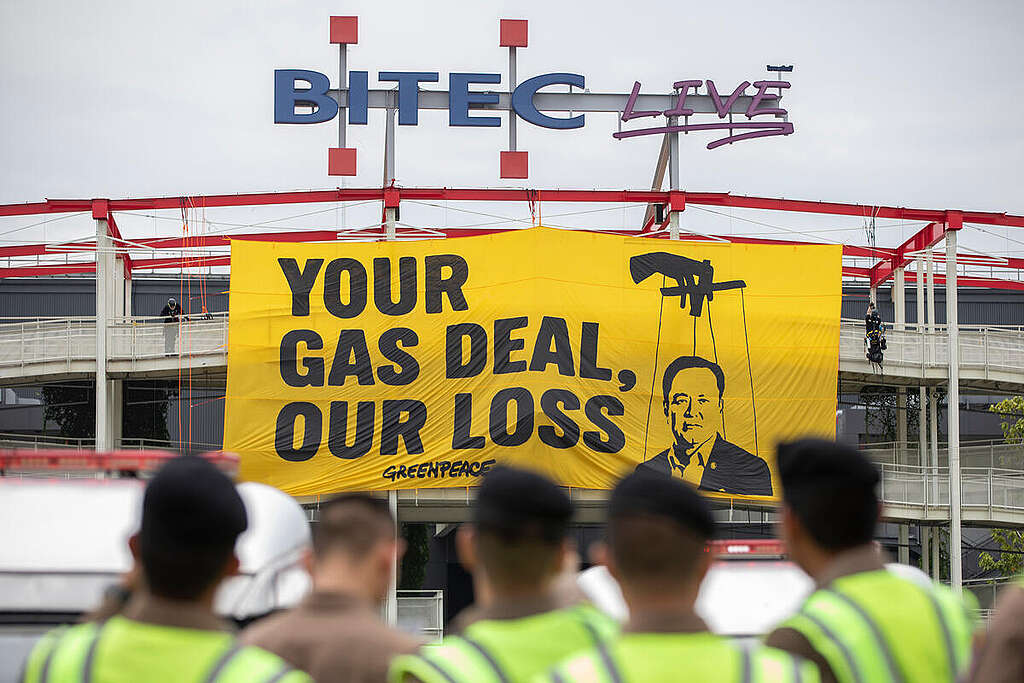
As industry leaders and government officials convened in Bangkok for the opening of GasTech 2026, Greenpeace Thailand activists made an unmistakable statement right at the doorstep of the summit. Unfurling a massive 17-by-7-meter banner bearing the stark message “YOUR GAS DEAL, OUR LOSS,” the activists confronted the foundational narrative pushed by the fossil fuel lobby.
The demonstration directly challenged the industry’s aggressive promotion of fossil gas and liquefied natural gas (LNG) expansion, which corporations and supportive governments frequently frame as bridge solutions for energy security, economic growth, and climate mitigation. Greenpeace Thailand countered this narrative, branding fossil gas expansion a dangerous distraction that locks nations into long-term carbon dependency. Activists urged both the Thai government and attending energy conglomerates to halt new gas investments immediately. Instead, they demanded a pivot toward a just energy transition centered on maximized investments in renewable power, grid modernization, energy storage, and comprehensive efficiency programs.
2. The Netherlands: Tens of Thousands Demand Climate Justice in Amsterdam
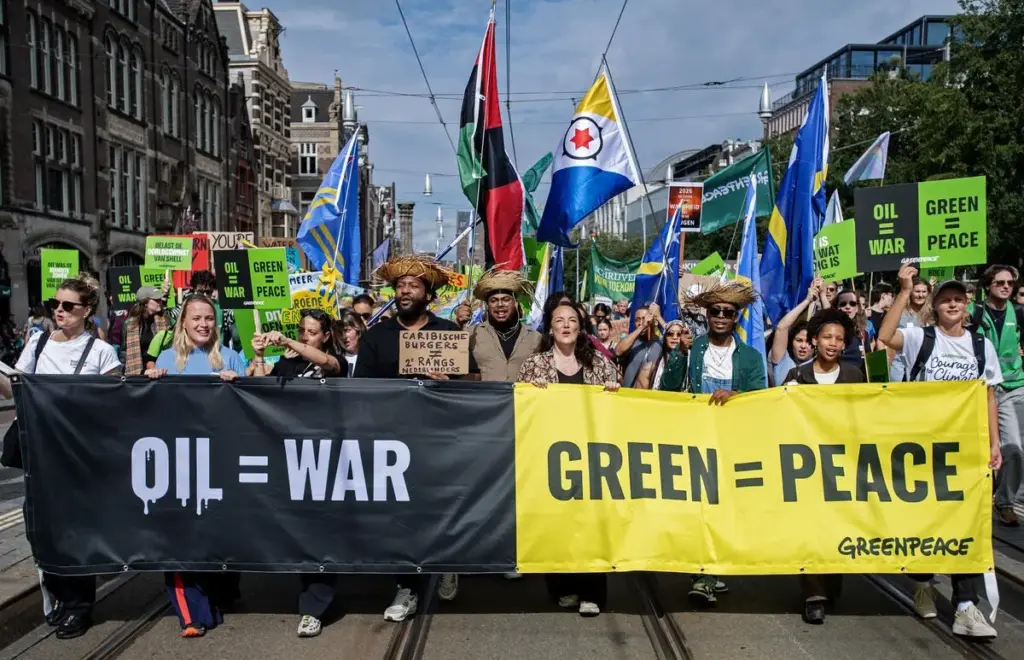
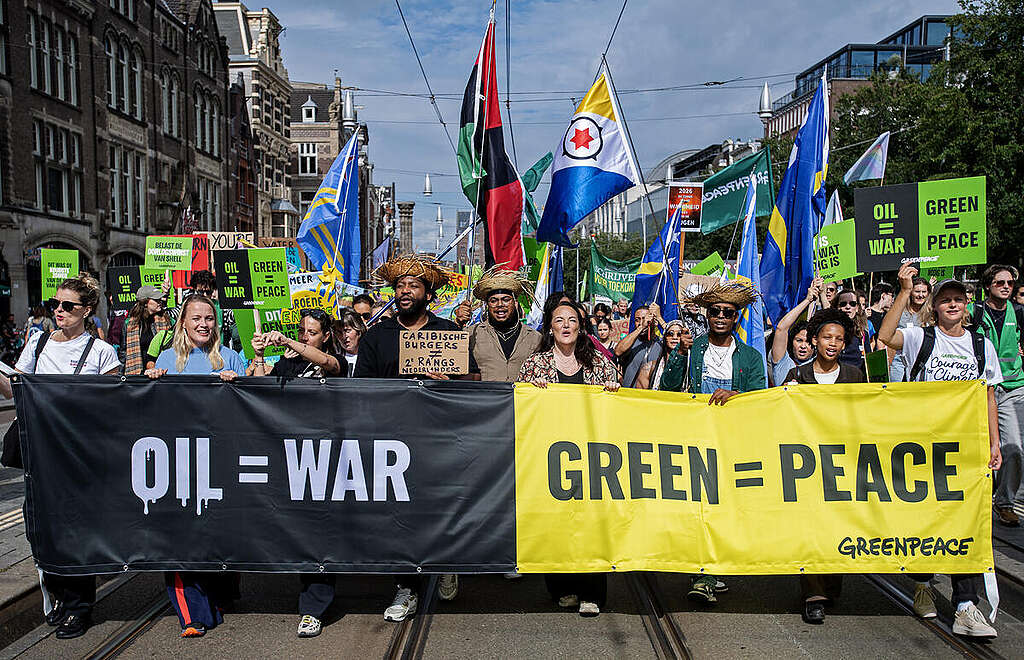
On Saturday, September 12, 2026, the Dutch capital became a sea of climate resistance as tens of thousands of citizens flooded the streets for the annual Amsterdam Climate March. Representing a broad cross-section of society—from youth activists and indigenous groups to scientists and labor unions—the massive mobilization called for an immediate and decisive end to society’s reliance on fossil fuels.
Protesters directed their anger at rampant corporate pollution and political inertia, demanding that policymakers implement binding regulations to hold major polluters accountable. Backed by striking visual displays and captured masterfully through lenses of photojournalists Marten van Dijl and Gosse Bouma, the march underscored the unwavering resolve of European civil society to secure a fair, livable, and sustainable future for all generations.
3. Germany: Exposing Windfall Profits in Hamburg and Targeting Fast Fashion in Berlin
Germany served as a dual theater of environmental and economic protest, with Greenpeace activists launching high-impact campaigns against corporate profiteering and disposable consumer culture.
- Hamburg Port Fuel Storage Facility Projection: In a striking nighttime action, Greenpeace Germany activists used high-powered projectors to beam an image of a towering, ever-growing pile of coins directly onto a major fuel storage facility in the Port of Hamburg. The projection served as a visual indictment of soaring windfall profits enjoyed by the petrol market while ordinary citizens bear the brunt of skyrocketing energy costs. Accompanied by the stark slogan, “They profit — we pay!”, the action laid bare the economic inequities driving the modern energy crisis.
- Berlin Pop-Up Store Action Against Shein: In the heart of Berlin, activists targeted a temporary pop-up store operated by ultra-fast-fashion giant Shein. Using pink warning barrier tape and pointed signage declaring the shop "Closed due to irresponsibility," protesters drew public attention to the hidden ecological and health hazards of disposable fashion. Greenpeace highlighted that rigorous laboratory tests of Shein’s online inventory have repeatedly uncovered dangerously high concentrations of toxic substances, including per- and polyfluoroalkyl substances (PFAS)—notoriously known as "forever chemicals"—alongside phthalates, which act as hazardous plasticizers.
4. Mexico: Demanding the Cancellation of the Topolobampo Ammonia Plant (Mexico City)
In Mexico City’s historic Plaza de la Constitution, known as the Zócalo, Greenpeace Mexico staged a peaceful yet daring protest to address a looming ecological disaster in Sinaloa. Following the raising of the national flag, a dedicated group of 20 activists gathered before the Palacio Nacional to appeal directly to President Claudia Sheinbaum Pardo.
Activists scaled a towering flagpole to unfurl a banner reading, “PRESIDENT: PROTECT TOPOLOBAMPO!”, while ground-level participants displayed a large red circular banner reading "Not in Mexico!". The direct action targeted the controversial construction of a mega-ammonia plant in Topolobampo, Sinaloa, being developed by Grupo Proman and Gas y Petroquímica de Occidente (GPO). Environmentalists warn that the plant poses severe risks to local marine ecosystems, indigenous fishing communities, and regional climate stability, prompting calls for executive intervention to revoke its permits.
5. Indonesia: Documenting the Devastation of Forest and Land Fires (West Kalimantan)
Thousands of miles away in Southeast Asia, the human and environmental toll of ecological degradation was starkly visible along the Kapuas River in Kalibandung Village, Kubu Raya, West Kalimantan. Thick, toxic haze blanketed the region, driven by recurrent forest and land fires. These blazes—frequently exacerbated by slash-and-burn clearing for industrial agriculture and exacerbated by prolonged droughts linked to climate change—threaten regional biodiversity, destroy indigenous livelihoods, and release massive volumes of carbon into the atmosphere, compounding the global climate emergency.
6. Türkiye: The Arctic Sunrise Navigates the Bosphorus to Demand a Coal Phase-Out
As Greenpeace’s legendary flagship, the Arctic Sunrise, sailed through the historic and strategic waters of the Bosphorus, crew members and activists on board sent an unmistakable message to the Turkish government and the wider Central and Eastern European region. Unfurling a bold banner reading “Phase out coal, now!”, the ship marked the triumphant conclusion of a comprehensive Black Sea tour.

Organized by Greenpeace’s Central and Eastern Europe office, the voyage served as a floating embassy for ecological preservation, working to expose the lethal dangers of coal-fired power and championing the rapid deployment of decentralized renewable energy infrastructure across the region.
7. Cameroon: Eco-Jogging and Grassroots Plastic Action in Yaoundé
Grassroots activism took center stage in Central Africa as fifteen dedicated volunteers in Yaoundé joined forces with the CNEDD (a prominent Cameroonian non-governmental organization dedicated to sustainable development and environmental protection) for an ecological march and cleanup.
Participants combined physical activity with civic duty by collecting discarded plastic waste from the urban landscape. The event concluded with an interactive public debate addressing the escalating plastic pollution crisis in Cameroon and the broader African continent, highlighting the urgent need for robust waste management systems and binding global plastic treaties.

Supporting Context & Metrics
The convergence of these diverse actions highlights interconnected global crises:
- The Fossil Gas Illusion: The International Energy Agency (IEA) has repeatedly stated that achieving net-zero emissions by 2050 leaves no room for new oil, gas, or coal developments. Yet, industry summits like GasTech continue to market fossil gas as a "green transition fuel," a claim thoroughly debunked by emissions accounting that factors in fugitive methane leaks.
- Fast Fashion’s Chemical Footprint: The textile industry accounts for roughly 10% of global carbon emissions and nearly 20% of wastewater. Independent testing referenced by Greenpeace reveals that fast-fashion giants frequently bypass consumer safety standards, embedding endocrine disruptors and persistent organic pollutants directly into daily consumer garments.
- The Plastics Pandemic: Globally, over 400 million tons of plastic are produced annually, with less than 10% successfully recycled. Community-led initiatives like the cleanup in Yaoundé demonstrate grassroots resilience in the face of corporate plastic dumping, emphasizing that waste management must be paired with upstream production caps.
Official Statements
- Greenpeace Thailand on GasTech 2026:
"Promoting fossil gas and LNG expansion under the guise of energy security is a deliberate deception. The government and energy corporations must halt these doomed investments immediately and redirect capital toward energy efficiency, storage, grids, and renewable power."
- Greenpeace Mexico on the Topolobampo Project:
"We call on President Claudia Sheinbaum Pardo to stand with the people of Sinaloa and protect our coastal ecosystems. The mega-ammonia plant in Topolobampo represents an unacceptable threat to our environment and public health. It must be cancelled."

- Greenpeace International on the Power of Visuals:
"For over fifty years, our camera lenses have served as the eyes of the global conscience. By capturing environmental injustice in real-time, we strip power from corporate greenwashers and place the truth firmly in the hands of the public."
Future Outlook
The breadth and intensity of this week’s mobilizations signal a pivotal shift in the global climate landscape. As governments prepare for upcoming international climate summits and corporations double down on greenwashed techno-fixes, civil society is drawing a hard line in the sand.
From the courtrooms and corporate boardrooms to the streets of Amsterdam, the waters of the Bosphorus, and the plazas of Mexico City, the message from the global environmental movement remains resolute. Greenpeace will continue to bear witness, expose corporate malfeasance, and mobilize millions worldwide until governments and industries abandon destructive fossil-fuel paradigms in favor of a just, equitable, and sustainable planetary future.

To explore more photo and video documentation from Greenpeace’s global actions, visit the official Greenpeace Media Library.



