Executive Overview
To an observer tracking the global energy transition through mainstream news outlets, corporate press releases, and trade publications, hydrogen and direct electrification often appear as neck-and-neck competitors. Scrutinize the information stream, and you will find a steady drumbeat of headlines detailing hydrogen-powered fuel-cell trucks, passenger rail lines, marine prototypes, high-speed combustion streamliners, and experimental energy storage pilots.
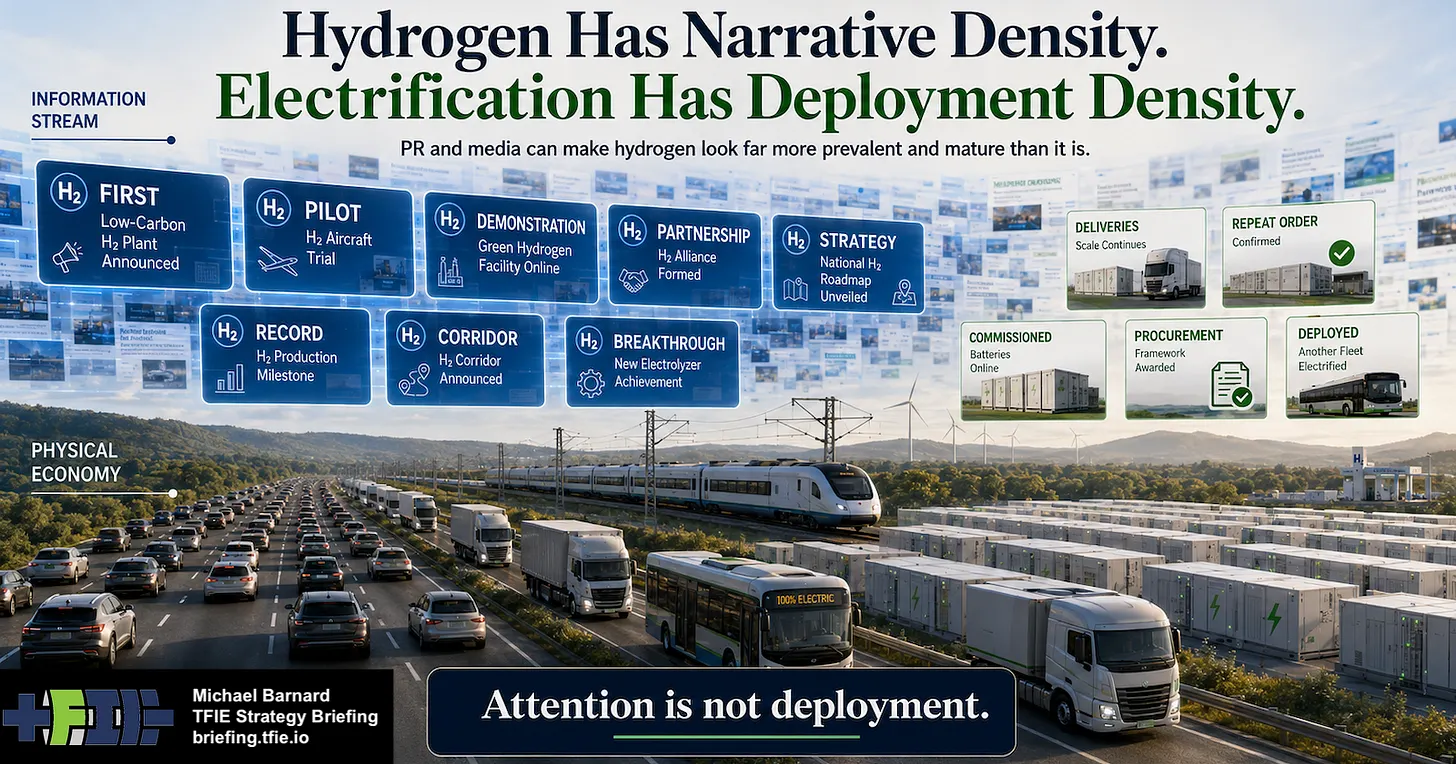
Yet, when this narrative density is held up against physical deployment data, a startling disconnect emerges. Hydrogen occupies a vastly disproportionate share of public attention relative to its actual market footprint. While direct electrification technologies—namely lithium-ion batteries and grid-scale solar-plus-storage frameworks—are scaling exponentially across billions of units and terawatt-hours, hydrogen remains largely confined to niche applications, localized pilots, and early-stage demonstrations.
This article examines data spanning from 2022 through 2025 to dissect how the media ecosystem distorts technological progress. By evaluating the "announcement economy" versus real-world physical denominators, we can uncover why hydrogen commands such high narrative density, how novelty biases shape public perception, and what analysts, policymakers, and investors must do to distinguish between true commercial scale and persistent publicity cycles.
Detailed Chronology: The Divergence of Information and Deployment (2022–2025)
To understand how public perception diverges from industrial reality, we must map the trajectory of clean energy communications over a multi-year period. A bounded register of positive milestones recorded between 2022 and 2025 reveals that the information gap is surprisingly narrow at the surface level, while the physical gap is immense.
2022: The Post-Pandemic Pilot Boom
As global supply chains began recovering from pandemic-era disruptions, corporate announcements for both battery and hydrogen solutions surged. Governments worldwide rolled out ambitious green hydrogen strategies, heavily subsidizing electrolyzer manufacturing and fuel-cell R&D. During this initial phase, every minor hydrogen milestone—a municipal bus deployment here, a localized refueling station there—was treated as a major breakthrough by trade publications. Simultaneously, battery electric vehicles (BEVs) were scaling rapidly, but their growth was increasingly viewed as routine, shifting media focus away from individual production milestones and toward macro-level supply chain constraints.
2023–2024: The Proliferation of Pilots vs. Mass Manufacturing
By 2023, the operational realities of both pathways began to diverge sharply. In the heavy-duty trucking sector, battery-electric trucks were rolling off assembly lines by the tens of thousands, particularly in China and expanding into parts of Europe and North America. Hydrogen heavy-duty trucks, however, largely remained in the pilot or pre-commercial fleet demonstration stage.
Despite this, the announcement cadence remained remarkably balanced. A company unveiling a single hydrogen-powered semi-truck generated just as much headline noise as a legacy automaker announcing a factory retooling for thousands of battery-electric units. This era cemented the illusion of parity. Because hydrogen deployments were scarce, each individual event retained high news value (scarcity equals newsworthiness), whereas battery deployments had crossed the threshold from "novelty" to "industry standard."
2025: The Widening Chasm
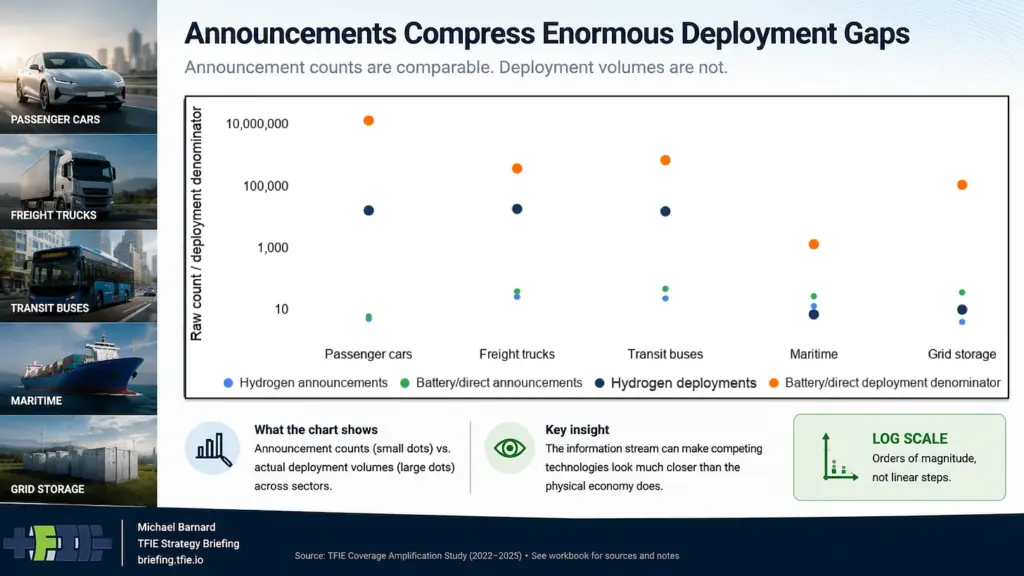
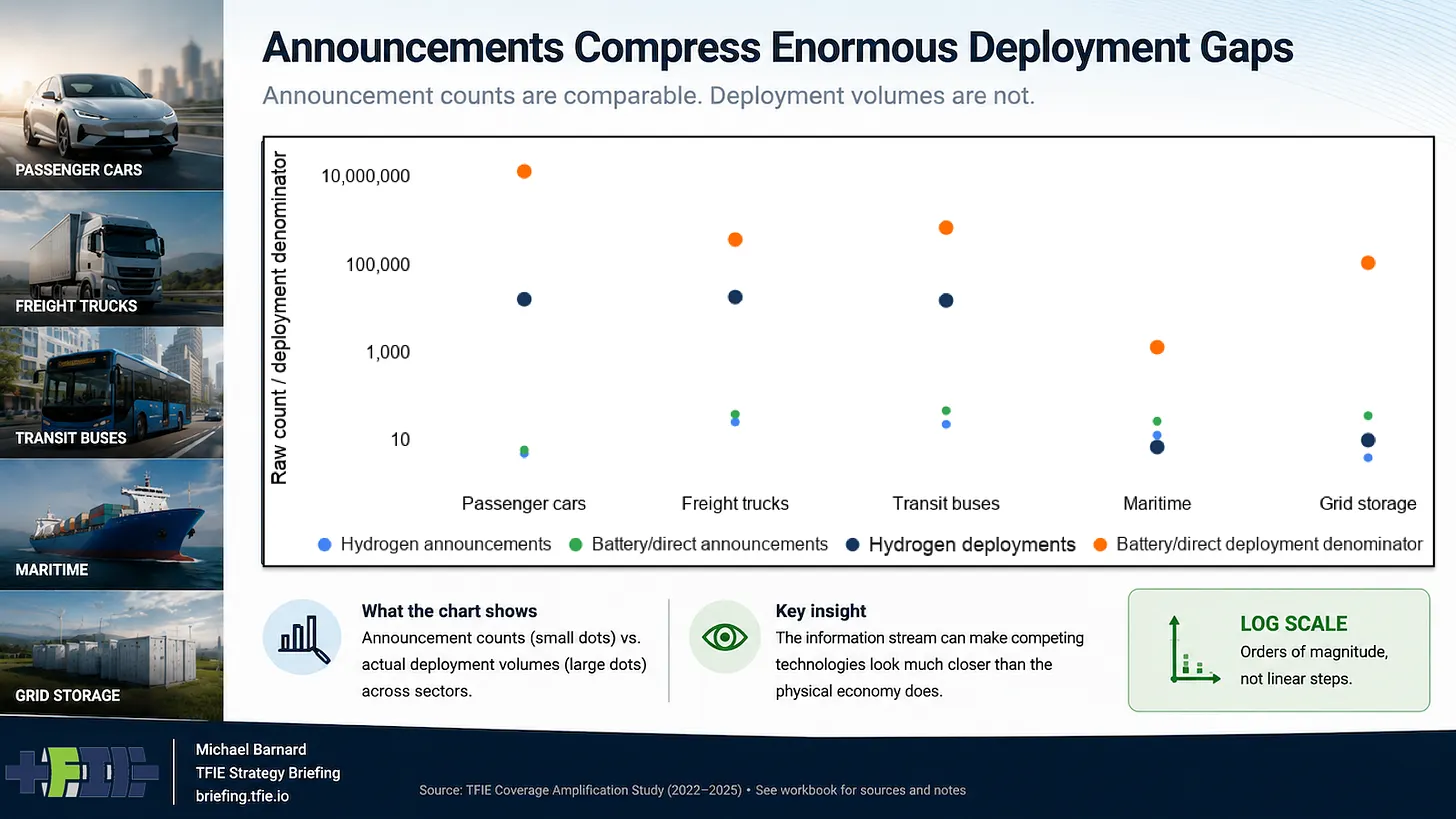
By the close of 2025, the cumulative data exposed the structural divergence between narrative and reality. An analysis of positive milestones from 2022 to 2025 shows that batteries generated 206 distinct announcements compared to hydrogen’s 114—a modest 1.8-to-one ratio in the information stream. However, when we apply physical denominators, that 1.8-to-one information ratio evaporates, replaced by deployment gaps spanning from tens to more than 10,000 times.
Supporting Context & Metrics: Unmasking the Physical Denominators
To accurately appraise the energy transition, analysts must strip away narrative inflation and restore physical denominators across key industrial sectors.
SECTOR COMPARISON: ANNOUNCEMENTS VS. ACTUAL DEPLOYMENT (2025 Snapshot)
-----------------------------------------------------------------------------------------
Sector                  Announcement Ratio (Batt:H2)      Physical Deployment Ratio
-----------------------------------------------------------------------------------------
Freight Trucks          1.5 : 1                           ~20 : 1 (China focus)
Transit Buses           2.0 : 1                           ~45 : 1 (Global estimate)
Maritime Vessels        2.0 : 1                         >180 : 1 (DNV operating fleet)
Passenger Cars          ~1 : 1                            ~800 : 1 (Global sales)
Grid Storage            9.0 : 1                       >10,800 : 1 (Power capacity additions)
-----------------------------------------------------------------------------------------
1. Freight Trucks
In the freight sector, the announcement ratio hovered at approximately 1.5-to-one in favor of batteries. Yet, physical deployment tells an entirely different story. By the end of 2025, China alone boasted roughly 366,000 electric heavy trucks operating on its roads. By contrast, the global total for fuel-cell heavy trucks stood at approximately 18,000 units—yielding a physical deployment gap of over 20 to one.
2. Transit Buses
Public transit reveals a similar structural disparity. The milestone register recorded 47 battery announcements versus 23 hydrogen announcements (roughly a two-to-one ratio). On the ground, however, more than 680,000 electric buses were actively operating in China alone, while the global count for fuel-cell buses hovered around 15,000.
3. Maritime Shipping
Maritime applications exhibit a strikingly skewed information-to-deployment ratio. Announcements concerning hydrogen and alternative marine fuels are separated by only about two to one. However, empirical fleet data compiled by DNV (Det Norske Veritas) reveals a stark reality: operating-fleet evidence showed a mere seven hydrogen-fuelled vessels globally, compared to more than 1,300 battery-equipped vessels currently navigating commercial waterways.
4. Passenger Cars
In the passenger vehicle market, the compression of reality is nearly absolute. The milestone register recorded five hydrogen roots against six battery roots—near-total parity in the information stream. Yet, the physical denominator for 2025 sales showed roughly 16,000 fuel-cell passenger vehicles globally, stacked against approximately 13 million battery-electric passenger cars.
5. Grid-Scale Energy Storage
Grid storage represents the most extreme divergence. The information stream produced four genuine hydrogen-storage announcement roots alongside 36 battery-storage roots—a nine-to-one information difference. Physically, however, the comparison defies simple scaling: approximately 10 MW of hydrogen demonstration capacity sat beside roughly 108,000 MW (108 GW) of newly added battery-storage capacity in 2025. While this power-versus-duration comparison does not account for multi-day seasonal storage needs, the market scale ratio sits at an astounding 10,800 to one.
The Mechanics of News Distortion: Why Hydrogen Dominates Headlines
The systemic distortion observed in clean energy reporting does not stem from journalistic dishonesty or intentional misinformation. Rather, it is a byproduct of how modern media ecosystems operate.
1. The Event-Driven Nature of News
News media is structured around discrete, novel events. A commercial fleet operator purchasing 500 battery-electric delivery vans generates a single announcement. Conversely, a consortium launching a single hydrogen-powered fuel-cell train pilot across a regional railway also generates a single announcement. To a casual reader scrolling through news aggregators, these two events carry equal weight in the information feed, masking the vastly different capital allocations and commercial footprints behind them.
2. The Economics of Scarcity and Novelty
Once a technology matures and becomes routine, its growth is driven by repeat procurement, standard supply contracts, and quiet factory expansions—none of which make for compelling daily headlines. Because hydrogen deployments remain relatively scarce, every iteration retains high news value. A first hydrogen train in a new country, a localized hydrogen truck pilot, or a maritime fuel-cell demonstrator is inherently newsworthy precisely because it is an exception rather than the rule.
3. The Case Study of Extreme Publicity: JCB’s Hydromax Record
The potency of narrative density over market reality was vividly illustrated by JCB’s Hydromax record car. The purpose-built hydrogen-combustion streamliner completed two FIA-observed runs at Bonneville Salt Flats, averaging an impressive 406.320 mph.
Following the run, news aggregators grouped 127 distinct sources around the resulting record story, following an earlier publicity cycle that had already produced an 88-source cluster. The engineering achievement was genuine, but its commercial denominator remained singular: one vehicle, zero production fleets, no active customer utilization, unproven operating economics, and zero repeat procurement. The media machine multiplied exposure to the story, leaving casual observers with the impression of a thriving commercial pathway where none existed.
Commercial Maturity and the Evidence Ladder
To move beyond headline counts, analysts utilize commercialization ladders to assess the operational readiness of emerging technologies. In a normalized four-year sample of energy transition milestones, battery-electric events averaged 5.97 out of seven on a standardized commercialization ladder, whereas hydrogen events averaged 4.40.
COMMERCIALIZATION LADDER COMPARISON
-----------------------------------------------------------------------------------------
Metric Category             Battery-Electric Events         Hydrogen Events
-----------------------------------------------------------------------------------------
Average Maturity Score      5.97 / 7.0                      4.40 / 7.0
Scaled Deployment Share     ~82%                            ~40%
Primary Evidence Type       Repeat procurement / Scale      Pilots / Demonstrations
-----------------------------------------------------------------------------------------
Crucially, approximately 82% of battery-related events represented scaled deployment, commercial expansion, or repeat procurement. By contrast, only about 40% of hydrogen events reached that threshold; the remaining 60% consisted of early-stage feasibility studies, lab demonstrations, or one-off government-funded pilots.

This is not to say that hydrogen has no commercial future. Transit buses represent a notable counterexample, featuring genuine repeat procurements and multi-year operating experience in municipalities across Europe and Asia. Passenger rail similarly boasts functional operating evidence on non-electrified regional lines. However, analysts must maintain rigorous distinctions between successful demonstrations, paid pilots, repeated operation, and scaled commercial procurement—treating these forms of evidence as interchangeable is a critical analytical error.
Future Outlook: Navigating the Noise in the Energy Transition
As the global energy transition accelerates through the late 2020s, the divergence between narrative density and physical deployment poses significant risks for investors, policymakers, and corporate strategists.
When media streams systematically compress vast differences in deployment into similarly sized stories, capital can be misallocated toward sectors that generate high publicity but lack fundamental market momentum. Conversely, proven technologies that are scaling quietly may suffer from under-appreciation in policy frameworks that rely on surface-level media metrics.
Recommendations for Analysts and Policymakers:
- Enforce Denominator Discipline: Never evaluate a technology based solely on announcement frequency or media share of voice. Always anchor analysis in physical metrics: operating fleets, gigawatt-hours deployed, and annual sales volumes.
- Deconstruct the Evidence Ladder: Differentiate between early-stage laboratory demonstrations, government-subsidized pilots, and fully commercialized repeat procurements.
- Recognize Scarcity Bias: Acknowledge that media attention is inversely proportional to maturity. The technologies generating the most headlines are often those struggling to achieve mass-market adoption.
By applying rigorous evidentiary standards, stakeholders can cut through the narrative fog, identifying where real decarbonization is occurring and ensuring that capital flows toward the most scalable, cost-effective solutions for a sustainable future.