

Executive Overview
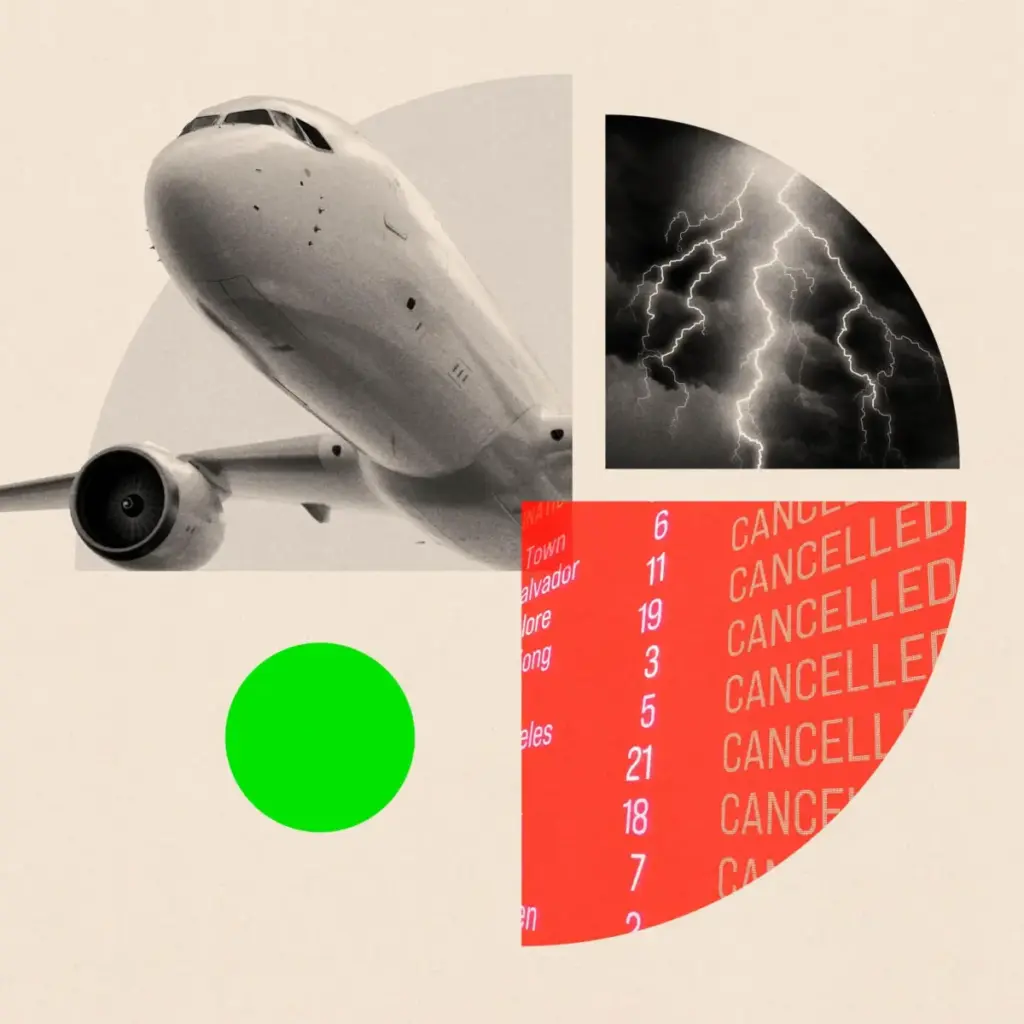
As late June brought a suffocating heatwave across parts of the United Kingdom and northern Europe, compounding environmental stress built an atmospheric powder keg. Towering thunderclouds congregated menacingly over the south of England and continental airspace, colliding with the massive influx of passengers kicking off the summer holiday season. What should have been a standard, high-volume Saturday at London’s Heathrow and Gatwick airports swiftly cascaded into an unprecedented operational crisis. Air traffic controllers, grappling with convective storm cells that fundamentally shrank usable airspace, were forced to ground aircraft and reroute flights on a massive scale. Approximately 900 flights suffered delays stretching up to 11 hours, while scores of others were cancelled entirely.
While blue skies and cooler temperatures eventually returned to the UK, aviation and climate experts are issuing a stark warning: the chaos of June was not a historical anomaly, but a preview of a fragile future. As global temperatures climb, destabilizing weather systems and supercharging the atmosphere, extreme weather events are projected to become more frequent, intense, and unpredictable. From airspace congestion and extreme convective storms to invisible clear-air turbulence and existential coastal flooding, the infrastructure of global aviation is on a collision course with a changing climate.
Detailed Chronology: The Anatomy of a Summer Airspace Collapse
The disruption witnessed in late June highlights the systemic vulnerability of hyper-dense European airspace. When severe convective activity materializes over regions as densely packed as southern England and northern Europe, the ripple effects are felt instantly across international borders.
As air traffic controllers at National Air Traffic Services’ (NATS) main control hub in Swanwick, Hampshire, monitored radar screens, severe storm fronts began carving through critical arrival and departure corridors. On days characterized by high heat and humidity, warm, moisture-laden air near the ground rises rapidly, expanding and cooling to form massive cumulonimbus clouds. These storm cells force controllers to dynamically shrink the available airspace, imposing strict routing constraints to keep aircraft clear of extreme turbulence, lightning, and hail.

On this particular Saturday, the tactical necessity of avoiding storms resulted in severe gridlock. Planes destined for London were held on tarmacs across Europe, waiting for departure slots that could not open until airspace cleared. Conversely, aircraft already airborne faced sudden, mandatory deviations.
When planes are unable to land at primary hubs like Heathrow or Gatwick due to sudden microbursts, high crosswinds, or saturated runways, they are diverted to secondary airports. However, this creates a secondary operational bottleneck: if too many unscheduled aircraft descend upon regional fields simultaneously, those airports quickly exhaust their parking stands, refueling infrastructure, and passenger processing capacities. In worst-case scenarios, facilities are forced to refuse all incoming traffic save for absolute emergencies, stranding passengers hundreds of miles from their intended destinations.
Supporting Context & Metrics: The Physics of Atmospheric Instability
To understand why modern aviation is increasingly vulnerable, one must examine the fundamental physics of the atmosphere. Thunderstorms are driven by convective energy. For every single degree Celsius that the Earth warms, the atmosphere’s capacity to hold moisture increases by approximately 7%. This moisture surplus acts as high-octane fuel for storm systems.
While climate models do not unanimously predict a higher total frequency of thunderstorms globally, scientific consensus indicates that the storms we do experience will be vastly more violent. Studies show that higher latitudes in the northern hemisphere are primed for the greatest increases in favorable conditions for severe convective weather.

The physical hazards posed to aircraft by these storms are severe:
- Structural Turbulence: Severe convective updrafts and downdrafts generate violent turbulence capable of straining an aircraft’s structural frame and injuring unsecured passengers and crew.
- Hail Impacts: High-altitude ice accumulation and large hail frequently crack reinforced cockpit windshields and induce catastrophic engine flameouts or compressor stalls.
- Tactical vs. Strategic Limits: Modern onboard weather radars allow pilots to peer up to 320 nautical miles ahead, complemented by live internet-based forecasting resources. Yet, aeronautical experts like Professor Guy Gratton of Cranfield University emphasize that these systems remain strictly "tactical rather than strategic." They provide short-range visibility to dodge immediate hazards, but they cannot facilitate long-range predictive routing days in advance.
The Looming Fuel Dilemma
Because weather systems shift with minimal notice, unplanned diversions force aircraft to burn through emergency fuel reserves. Andrew Charlton, managing director of Swiss-based consultancy Aviation Advocacy, points out that if storm-induced delays become a permanent operational fixture, airlines will be legally and practically required to load significantly more fuel as a standard baseline. Carrying excess fuel increases aircraft weight, which in turn drives up fuel consumption—an airline’s single largest variable operating cost. Ultimately, those inflated overheads will be passed directly down to the consumer through higher ticket prices.
Official Statements and Divergent Industry Perspectives
The aviation community is deeply divided over the exact degree of existential risk posed by these climatic shifts.
Tim Atkinson, an airline risk consultant and former veteran pilot, argues that the sheer density of European skies leaves the region uniquely exposed. He paints a sobering worst-case scenario: a day when rapid, unpredictable storms simultaneously force the complete closure or operational curtailment of all London-bound airports—Heathrow, Gatwick, Stansted, and Luton—while transatlantic and European flights converge on the region with rapidly dwindling fuel reserves.

"What we’re seeing now is very rapid climate change," Atkinson warns. "We’re going from the kind of weather activity which takes out an airport, and which the system kind of copes with… to a situation where, with very little predictability, it would be possible to lose all of the London airports from real-time operation quite swiftly and with little notice." Atkinson believes such an event could push the industry past its safety margins, potentially resulting in an aircraft exhausting its fuel reserves mid-air.
By contrast, industry veterans like Andrew Charlton urge a more measured perspective. While acknowledging the severity of worst-case theoretical models, Charlton maintains faith in the resilience of modern air traffic management:
"You’ve always got to imagine the worst-case scenario. But I also think we need to keep that worst case in context. Yes, it’s possible to imagine it. But I’m also fairly comfortable with the ability of this industry to react well and make good decisions… of all the things that wake me up at 3am… this is not the top of that list."
Meanwhile, infrastructure providers are leaning heavily on technological innovation to absorb environmental shocks. NATS, alongside major hubs like Heathrow and Gatwick, has transitioned away from traditional, rigid minimum distance separations between landing aircraft. Instead, they utilize dynamic spacing algorithms that continuously recalculate arrival intervals based on real-time wind speeds and aircraft types. According to NATS, this technology has successfully squeezed extra capacity out of existing runways, mitigating delays during marginal weather.

Beyond airborne congestion, climate change threatens airport ground infrastructure. Torrential downpours carry a high risk of catastrophic flooding, a phenomenon vividly illustrated in April 2024 when unprecedented downpours paralyzed Dubai International Airport, forcing runway closures and canceling over 1,200 flights across two days. Even if runways remain completely dry, regional flooding of surrounding motorways, railways, and parking structures can effectively sever passenger access to terminals.
Mitigating these hazards carries staggering price tags. Following severe Christmas flooding in 2013, Gatwick Airport poured tens of millions of pounds into multi-layered flood defense systems—expenditures that pale in comparison to the multi-billion-pound infrastructure expansions currently underway.
The Invisible Menace: Clear-Air Turbulence
Beyond convective thunderstorms, aviation faces an escalating threat in the upper troposphere: clear-air turbulence (CAT). Occurring entirely free of clouds or visual warning cues, CAT is fueled by shifting jet stream wind shears driven by global heating.
Professor Paul Williams of the University of Reading notes that severe CAT incidents over high-traffic corridors like the North Atlantic have surged by 55% since 1979. Projections indicate that severe turbulence on busy global routes could double or triple in the coming decades. High-profile incidents—such as a Lufthansa flight from Austin to Frankfurt that encountered sudden, severe CAT, causing the aircraft to rapidly lose altitude and hospitalizing seven passengers—underscore the physical dangers posed to unprotected cabin occupants. While forecasting models and emerging laser-based detection systems offer hope, passengers must prepare for a bumpier ride globally.

Rising Tides and Coastal Vulnerabilities
The threat landscape extends to the very foundations of coastal airports. A stark report by Newcastle University revealed that roughly 269 airports worldwide are already vulnerable to coastal flooding driven by rising sea levels and intensified storm surges. Facilities built on reclaimed or low-lying coastal land—such as Amsterdam Schiphol, London City, Bahrain International, Newark Liberty International, and New York’s LaGuardia Airport (which was submerged for days following Hurricane Sandy)—face existential risks.
Protecting these vital transit hubs through elevated runways, reinforced sea walls, or complete relocation could cost the global economy up to $57 billion (£42 billion), costs that will inevitably trickle down to taxpayers and travelers.
Future Outlook: Adapting to the New Normal
The global aviation sector is caught in a profound paradox. On one hand, the industry faces immense regulatory and societal pressure to achieve net-zero carbon emissions by 2050, all while managing an expected doubling of the global commercial fleet over the next two decades. On the other hand, the physical impacts of historical emissions are already destabilizing the operational environment.
Meeting this challenge will require massive capital expenditures in infrastructural hardening, next-generation air traffic management algorithms, and advanced predictive meteorological tools. Yet experts emphasize that technology alone cannot completely insulate the skies from a volatile climate.

"I think the best we can do is mitigate," concludes Andrew Charlton. "We need to make sure we have enough space at air terminals for people whose flights are being disrupted and delayed, that we have enough hotel rooms and parking space and so on."
Ultimately, as the atmosphere continues to warm, travelers and airlines alike must brace for a new operational reality. The dramatic delays witnessed over European skies this summer are not an anomaly to be neatly filed away and forgotten; they are the opening chapters of a turbulent new era in global travel.



