

Executive Overview
As the global scientific community celebrates the 20th anniversary of the Biodiversity Heritage Library (BHL), a quiet revolution is taking place in the archives, basements, and digital repositories of natural history institutions worldwide. For decades, traditional historical records have suffered from institutional blind spots, frequently reducing pioneering female scientists, naturalists, and researchers to generic identifiers like "Mrs." or omitting them entirely from standard finding aids.
A recent digitization initiative spearheaded by the Academy of Natural Sciences of Drexel University has successfully brought one such overlooked figure out of archival obscurity: Carrie Baily Aaron (frequently recorded historically as "Mrs. Aaron"). Through the collaborative efforts of catalogers, archivists, student interns, and digital platforms like BHL and Wikidata, Aaron’s 19th-century entomological essays, detailed field notebooks, and decades-long correspondence have been digitized, transcribed, and permanently linked to global authority files.
This deep dive examines the rediscovery of Carrie Aaron’s papers, detailing her contributions to historical entomology—specifically her pioneering investigations into mosquito eradication and biological control methods. Furthermore, this report explores the mechanics of modern digital librarianship, the ongoing collaborative projects between the Academy and the American Entomological Society (AES), and the broader implications of open-access digital repositories for rewriting the history of science.
Detailed Chronology: The Life, Work, and Rediscovery of Carrie Aaron
To fully appreciate the scope of the recent archival project, it is essential to trace the timeline of Carrie Aaron’s scientific engagements, her relationship with the American Entomological Society, and the modern digital workflow that rescued her legacy from administrative oversight.
1889–1901: Entomological Investigations and Mosquito Eradication
Carrie Aaron’s most prominent historical footprint centers on her detailed analytical work regarding dipterous insects. During the late 19th century, public health concerns regarding mosquito-borne vectors prompted a surge of amateur and professional scientific interest in population control. Robert Henry Lamborn—a financier and industrialist whose suffering from mosquito swarms during the construction of the Lake Superior Railroad motivated him to action—established a prestigious essay contest. He offered significant financial prizes for the three best essays outlining effective methods to mitigate or eradicate the mosquito pest.
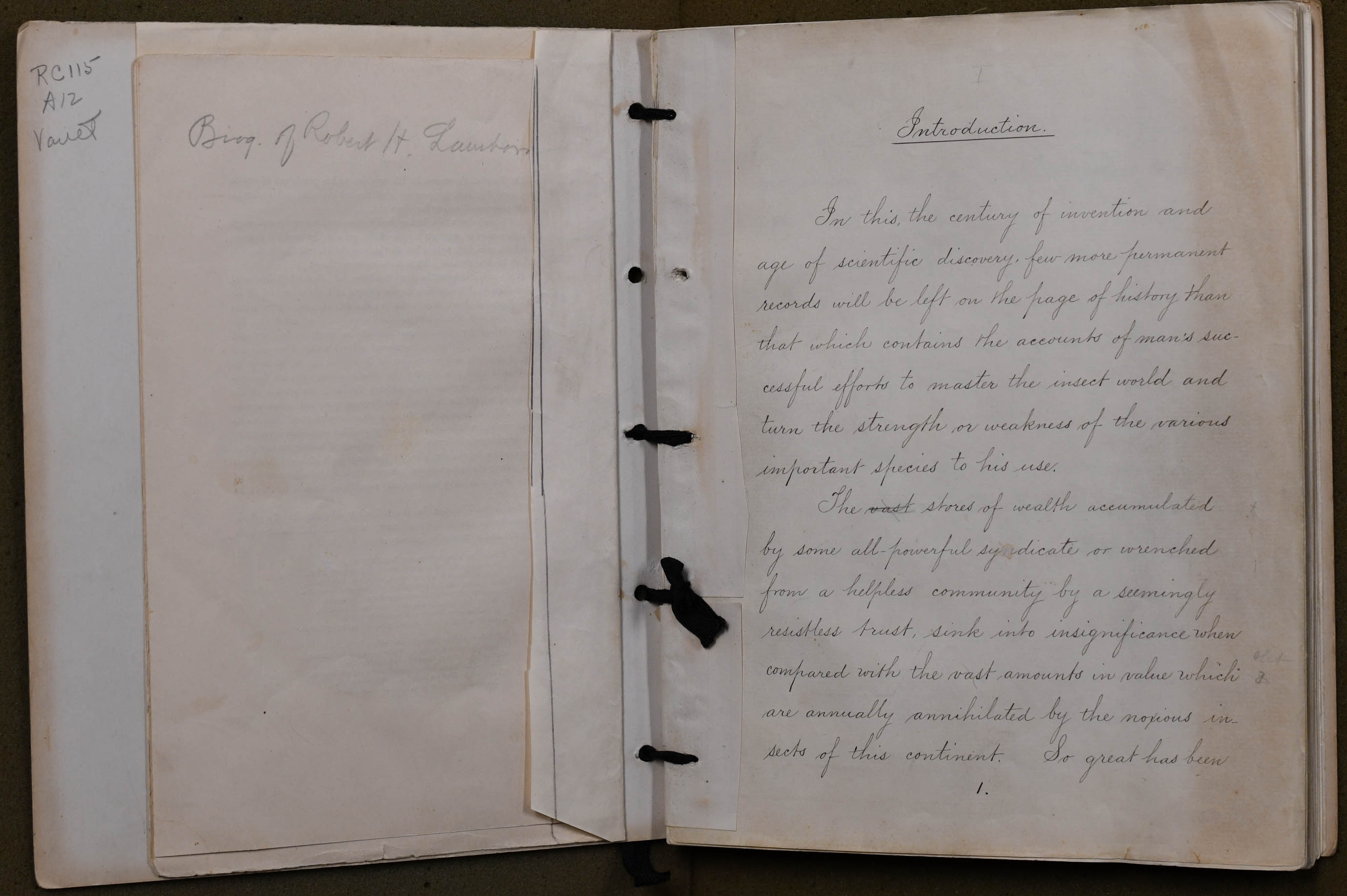
Aaron rose to the challenge, submitting an exhaustive entomological treatise. In her biographical notice regarding Lamborn, she wrote:
"While engaged in building the Lake Superior Railroad, Dr. Lamborn suffered so from the attacks of countless mosquitos, that he became interested in extermination of the insect, and later offered prizes for the three best essays on the subject."
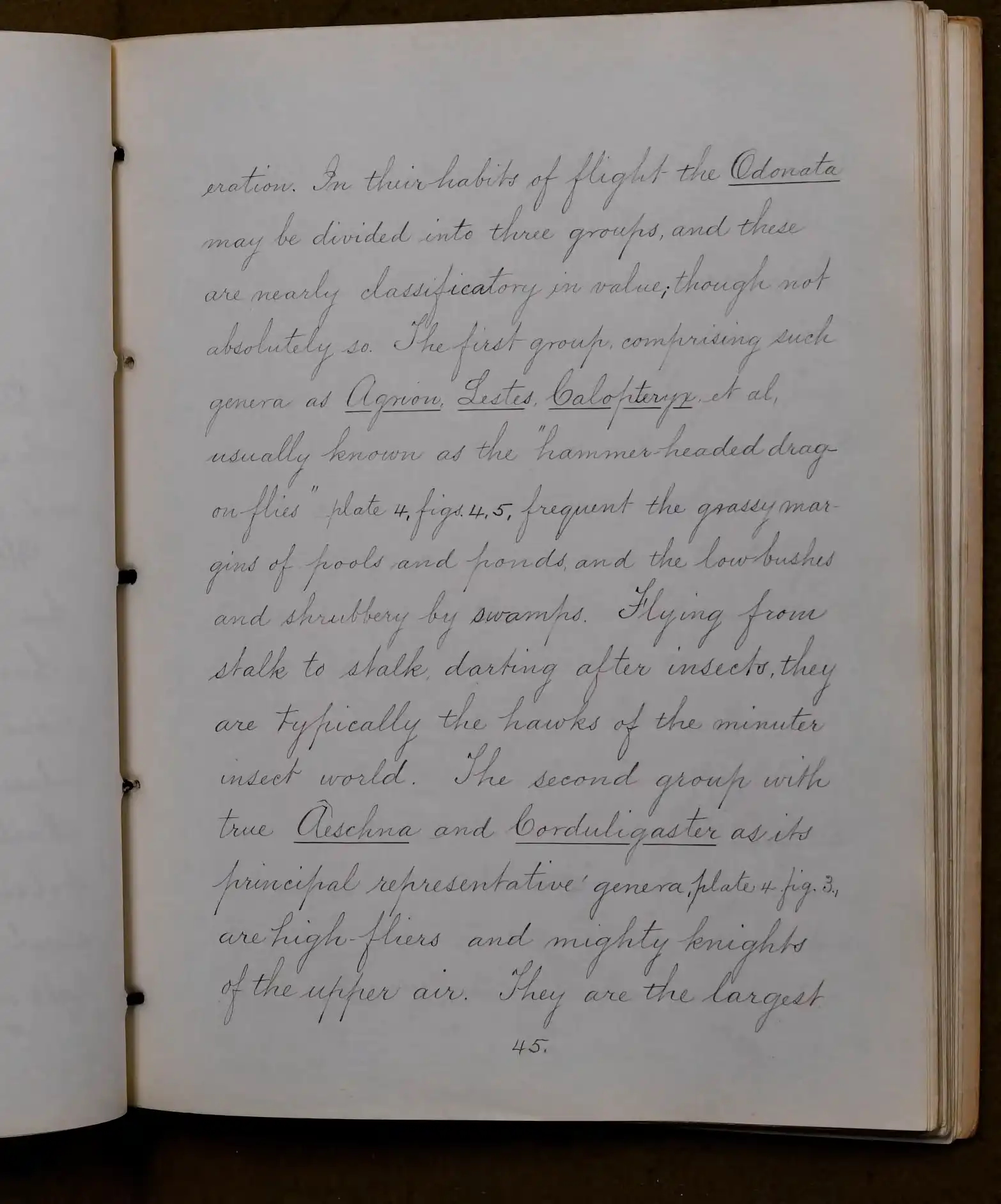
Preserved within the Academy’s Small Collections and Individual Manuscripts (ANSP-Coll-0156), A notebook containing an entomological essay by Carrie Aaron showcases her sophisticated approach to ecological balance. Rather than relying solely on chemical interventions, Aaron analyzed natural predators, most notably championing dragonflies—which she vividly described as "the hawks of the minuter insect world"—as primary biological agents for mosquito reduction.
Her investigations went beyond theoretical observation. Archival notes reveal that Aaron and her contemporaries actively attempted to inoculate themselves with fluids extracted from mosquitoes. However, these experimental efforts proved unsuccessful, a limitation Aaron humorously attributed "to the inferiority of the needle as an injector, compared with the delicate hypopharynx."
Her prize-winning essay was subsequently published alongside other select submissions in the landmark volume Dragon Flies vs. Mosquitoes: Can the Mosquito Pest be Mitigated? under the title "The Dipterous Enemies of Man."
January 1900: Resignation and Institutional Critique
Despite her success and an enthusiastic congratulatory letter from prominent entomologist Henry Skinner—who assured her that her scientific reputation was secure—Aaron maintained an ambivalent relationship with formal academic institutions.
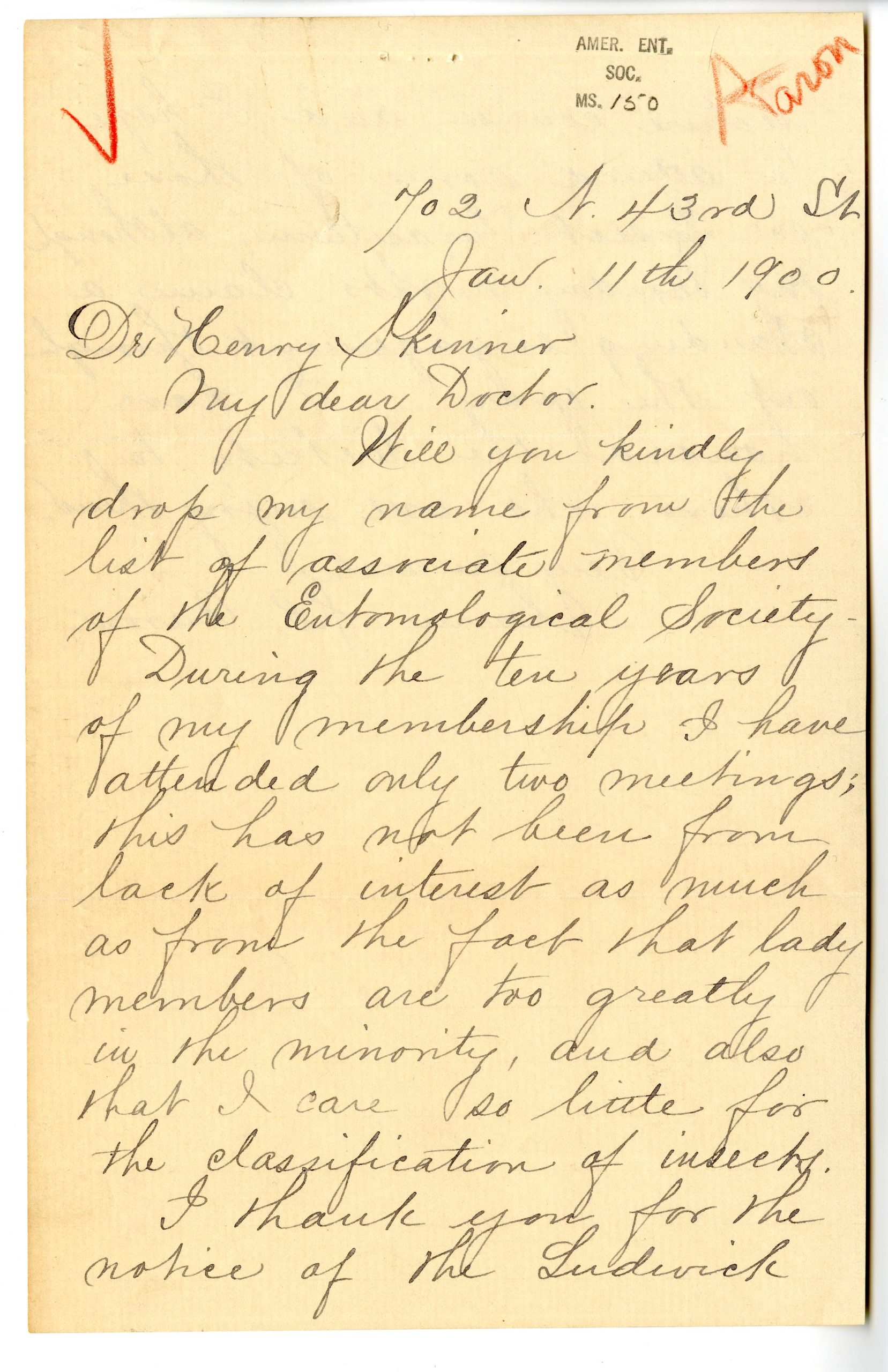
On January 11, 1900, Aaron formally requested that the American Entomological Society remove her name from its list of associate members. In her correspondence with Skinner (ANSP-Coll-0150, Box 1, Folder 1), she explained her motivations with striking candor:
"During the ten years of my membership I have attended only two meetings; this has not been from lack of interest as much as from the fact that lady members are too greatly in the minority, and also that I care so little for the classification of insects."
This primary source offers a rare, first-person perspective on the structural barriers and cultural isolation experienced by women in 19th-century scientific societies. Despite stepping back from active membership, Aaron maintained a warm, lifelong professional correspondence with Skinner, later thanking him in a 1923 letter for their "more than thirty year sympathetic friendship."
March 1926: Later Travels and Encounters
Decades after her formal departure from society meetings, Aaron’s active curiosity remained undiminished. Letters written during her travels to Southern California—specifically Santa Monica, which she characterized as "the land of perpetual bloom and uninterrupted sounds of birds and insects"—document her ongoing fascination with natural history museums.
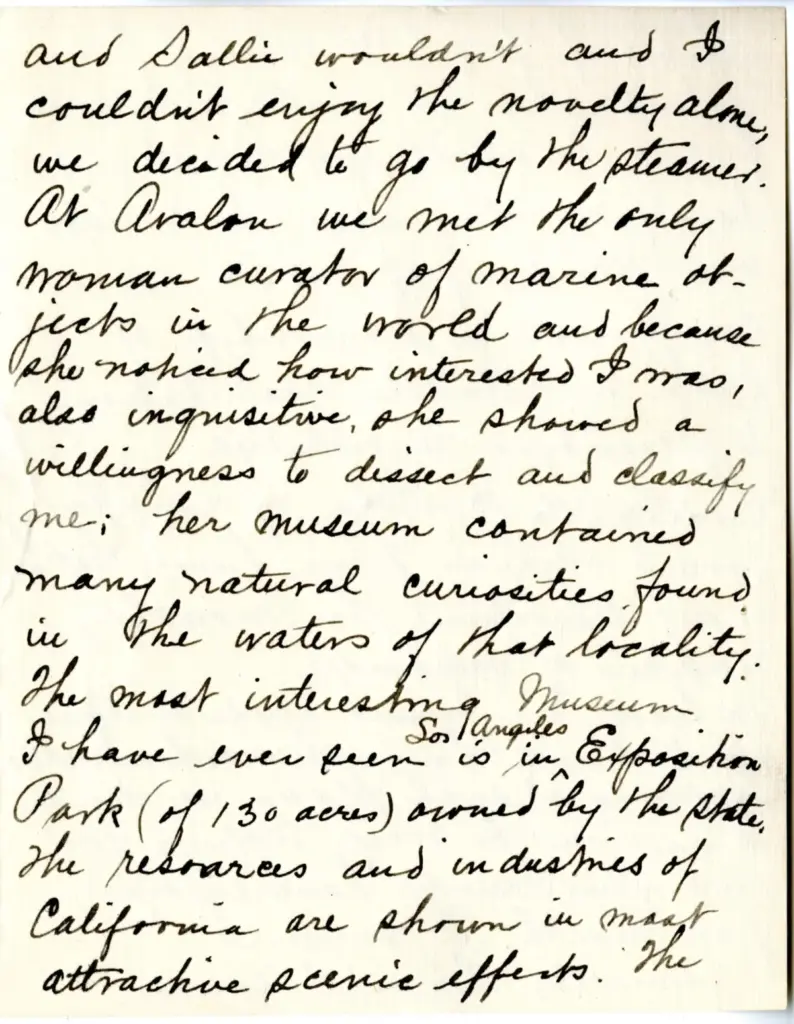
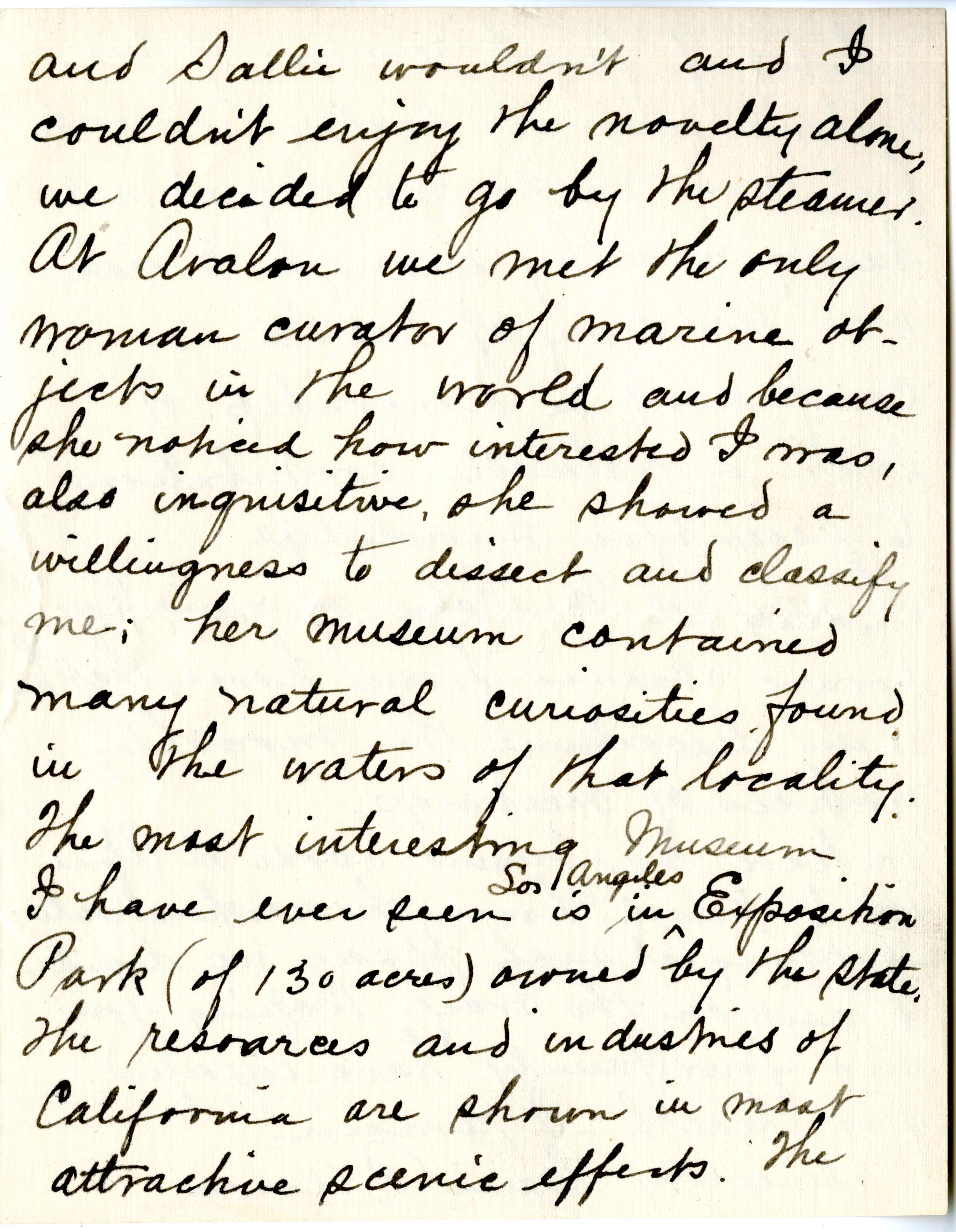
In a letter dated March 8, 1926, Aaron recounted a remarkable encounter during a visit to Avalon:
"At Avalon we met the only woman curator of marine objects in the world and because she noticed how interested I was, also inquisitive, she shared a willingness to dissect and classify me; her museum contained many natural curiosities found in the waters of that locality. The most interesting museum I have ever seen is in Los Angeles, Exposition Park (of 130 acres) owned by the state, the resources and industries of California are shown in most attractive scenic effects. The exhibit of fossil remains of prehistoric animals really is wonderful, and made me regret not being healthy enough to make our Academy of Nat. Sci. a competitor in ownership of such a valuable contribution to scientific knowledge."
This passage has opened an exciting new avenue of historical inquiry for Academy researchers: identifying the anonymous female marine curator operating in Avalon during the mid-1920s.
The Modern Digital Workflow: 2024–Present
The journey from forgotten manuscript to globally accessible digital asset required a coordinated institutional effort:
- Identification and Digitization: As part of the BHL at 20 anniversary initiative, the Academy of Natural Sciences of Drexel University targeted 83 historical scientists’ notebooks and field journals for digitization. Among them was Aaron’s 1889–1901 notebook.
- The "Mrs. Aaron" Correction: During initial cataloging, the finding aid recorded the author merely as "Mrs. Aaron," stripping her of her Christian name and individual identity—a recurring systemic issue in archival science.
- Archival Intervention: Academy Archivist Jessica Lydon identified the discrepancy and supplied vital biographical context to the Cataloging and Digital Resources Librarian.
- Global Linked Data Integration: Librarians constructed a unique BHL Creator ID for Carrie Aaron, systematically linking it to her Wikidata identifier (
Q125503946). This transformed an isolated local record into a globally indexed node of semantic data. - AES Correspondence Project: Concurrently, student intern Will Le—funded by Dr. William Day and the American Entomological Society—began digitizing the complete American Entomological Society correspondence collection, uploading letters to PA Photos and Documents and making Aaron’s California letters readable from modern laptops.
Supporting Context & Metrics
The quantitative and structural impact of the BHL at 20 initiative highlights the scale of modern digital preservation in natural history libraries:
- 20 Years of Global Impact: Since its inception, the Biodiversity Heritage Library has operated as the world’s largest open-access digital repository for biodiversity literature and archival materials, liberating millions of pages of legacy print material.
- 83 Field Journals: The specific Academy project prioritized the high-resolution imaging, transcription, and metadata enhancement of 83 foundational field books and scientist notebooks.
- 1 Dedicated Wikidata ID: The creation of Wikidata identifier
Q125503946ensures that Carrie Aaron’s scholarly outputs can be tracked across semantic web applications, machine-learning models, and global library catalogs (such as WorldCat and VIAF). - Multi-Institutional Collaboration: The initiative bridges academic departments, the Academy Library and Archives, student digitization assistants, the American Entomological Society, and international digital aggregators.
Official Statements & Institutional Perspectives
The Role of Modern Librarianship
Reflecting on the discovery, the Academy’s Cataloging and Digital Resources Librarian noted the transformative psychological shift that occurs when modern library tools intersect with historical archives:
"This might sound like a small detail only librarians would notice, but it’s a huge step in building recognition for an author… After working with archival notebooks and reading Carrie Aaron’s letters, I’m thrilled to see how digitization and public access to collections spur research into lesser-known individuals and uncover more potential research subjects! I don’t consider myself a historian, but it’s difficult to resist historical research when presented with easily accessible primary sources and when given the tools to link subjects across different platforms."
The Biodiversity Heritage Library Mandate
In an official statement marking its milestone anniversary, the Biodiversity Heritage Library underscored the mission driving these collaborative efforts:
"For 20 years, BHL has helped uncover the people and stories hidden within biodiversity literature and archives, making them freely available for new generations to discover. Your support helps us continue digitizing, connecting, and sharing collections like Carrie Aaron’s notebook—and ensures that more overlooked voices and histories can be found."
Future Outlook: Unfinished Research and Ongoing Archives
The rediscovery of Carrie Aaron is far from an isolated event; rather, it serves as a proof-of-concept for how modern digital infrastructure can continuously revitalize historical collections.
Several key initiatives and research vectors emerge from this project:
- The Hunt for the Avalon Curator: Archival and biographical sleuthing is currently underway to identify the anonymous female marine curator whom Aaron met in Avalon in 1926. Solving this mystery will add another vital biographical data point to the network of early 20th-century women in marine science.
- Full-Collection Integration of AES Papers: Student intern Will Le’s ongoing digitization of the American Entomological Society correspondence collection will yield hundreds of additional letters, shedding light on the interpersonal networks, professional mentorships, and administrative realities faced by naturalists in Philadelphia and beyond.
- Semantic Web Expansion: By continuing to mint BHL Creator IDs and connecting local library holdings to Wikidata and Wikipedia, the Academy of Natural Sciences aims to systematically eliminate anonymous entries and honorific-only designations ("Mrs.") for all historical female contributors in its custody.
As open-access repositories continue to mature, the boundary between professional historian and curious archivist grows increasingly porous. Through the lens of high-resolution digital imaging, careful transcription, and linked data architecture, figures like Carrie Aaron—who once stepped away from scientific societies due to institutional isolation—are finally taking their rightful place in the historical record.



