For two decades, the Biodiversity Heritage Library (BHL) has operated as the digital bedrock of natural history, scanning millions of pages of rare books, field journals, and institutional archives to democratize access to the Earth’s biological legacy. Yet, the true power of this massive repository extends far beyond the identification of species or ecological metrics. It lies in the human stories previously buried beneath decades of institutional obscurity, handwritten cursive, and incomplete metadata.
A prime example of this archival rescue mission has recently come to light through the collaborative efforts of the Academy of Natural Sciences (ANSP) of Drexel University and the BHL community. During a project to digitize, transcribe, and integrate 83 historical scientific field journals and notebooks, library professionals confronted a systemic flaw common to historical research: the erasure of women scientists behind patriarchal naming conventions and vague metadata.
At the center of this discovery is Carrie Baily Aaron, a 19th-century entomological writer whose insightful essay on mosquito eradication was initially cataloged merely as a work by "Mrs. Aaron." Through the joint persistence of ANSP Cataloging and Digital Resources Librarian Briana Giasullo, Academy Archivist Jessica Lydon, and a dedicated team of student interns and funding partners, Aaron’s historic notebook has been brought to digital life.
This initiative has done more than just publish a single artifact. By linking Carrie Aaron’s newly minted BHL Creator ID to her official Wikidata identifier, and by cross-referencing her personal correspondence housed within the American Entomological Society (AES) collection, researchers have pried open a vivid window into late 19th- and early 20th-century American science. The effort illustrates how modern digital humanities tools are transforming passive library catalogs into dynamic ecosystems of discovery, breathing new life into forgotten voices and inspiring a modern hunt for historical figures like the elusive "only woman curator of marine objects in the world."
Detailed Chronology: From 19th-Century Field Notes to 21st-Century Discovery
The journey of Carrie Aaron’s papers from dusty manuscript boxes in Philadelphia to global screens via the BHL spans over a century of scientific evolution, institutional storage, and meticulous digital restoration.
The Late 19th Century: Essays, Dragonflies, and Mosquito Wars
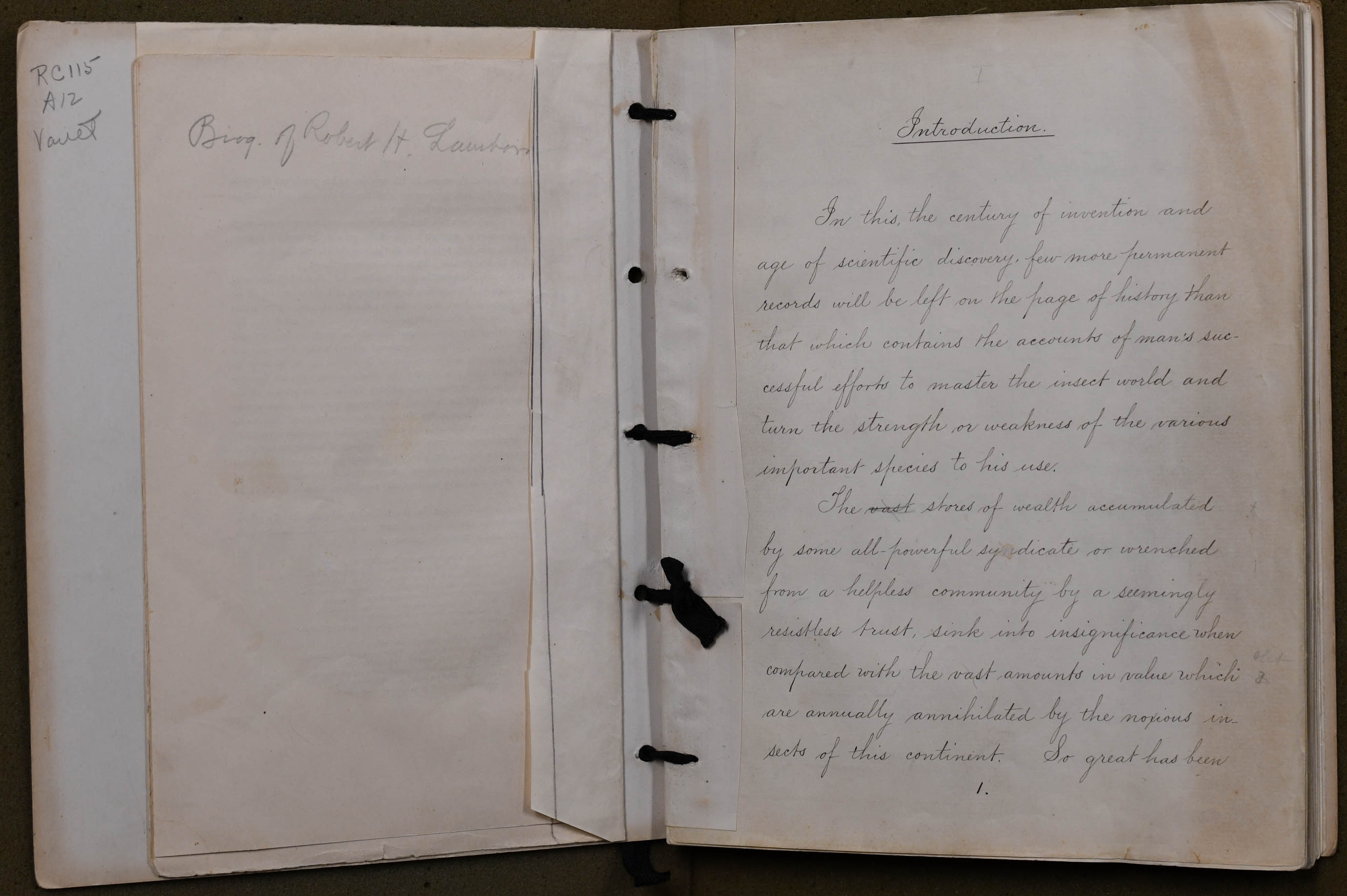
The narrative begins in the closing decades of the 19th century, an era when the vectors of human disease were poorly understood and the mosquito was viewed less as an ecological marvel and more as a pestilent scourge. The catalyst for Aaron’s most prominent entomological work was Dr. Robert Henry Lamborn. While directing the construction of the Lake Superior Railroad, Lamborn suffered relentless assaults from dense swarms of mosquitoes. Driven to desperation and scientific curiosity, Lamborn established a public contest offering cash prizes for the three most comprehensive and insightful essays exploring methods to eradicate or mitigate the mosquito pest.
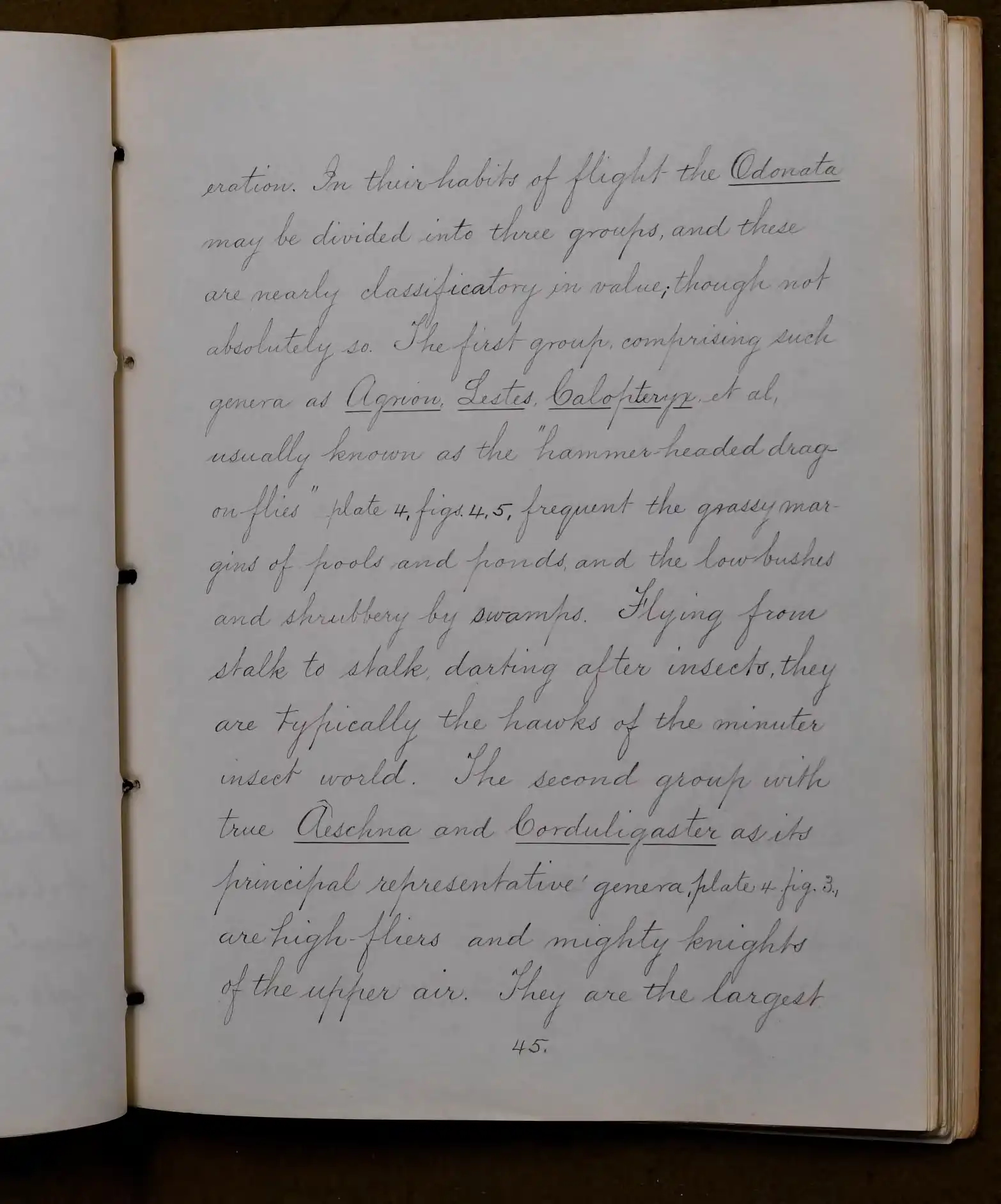
Carrie Aaron stepped forward to meet the challenge. In her meticulous handwriting, she drafted an extensive essay analyzing biological methods for controlling mosquito populations. Among her most striking insights was her advocacy for dragonflies, which she famously poeticized as "the hawks of the minuter insect world."
Her research went beyond mere observation. In an era when self-experimentation was viewed by some naturalists as a valid empirical method, Aaron and her peers attempted to inoculate themselves with what was then described as poisonous droplets from mosquitoes. As Aaron later noted with characteristic dry wit, the experiment proved "not successful, owing probably to the inferiority of the needle as an injector, compared with the delicate hypopharynx."
Aaron’s rigorous analysis did not go unnoticed. Her essay was ultimately selected and published alongside other winning submissions in the seminal compilation Dragon Flies vs. Mosquitoes: Can the Mosquito Pest be Mitigated? under the title "The Dipterous Enemies of Man." Shortly after, Henry Skinner—a prominent entomologist and pillar of the American Entomological Society—wrote to congratulate Aaron, confirming that her prize-winning contribution ensured her entomological reputation would "now be well established."
The 1900s–1920s: Institutional Disillusionment and Coast-to-Coast Correspondence
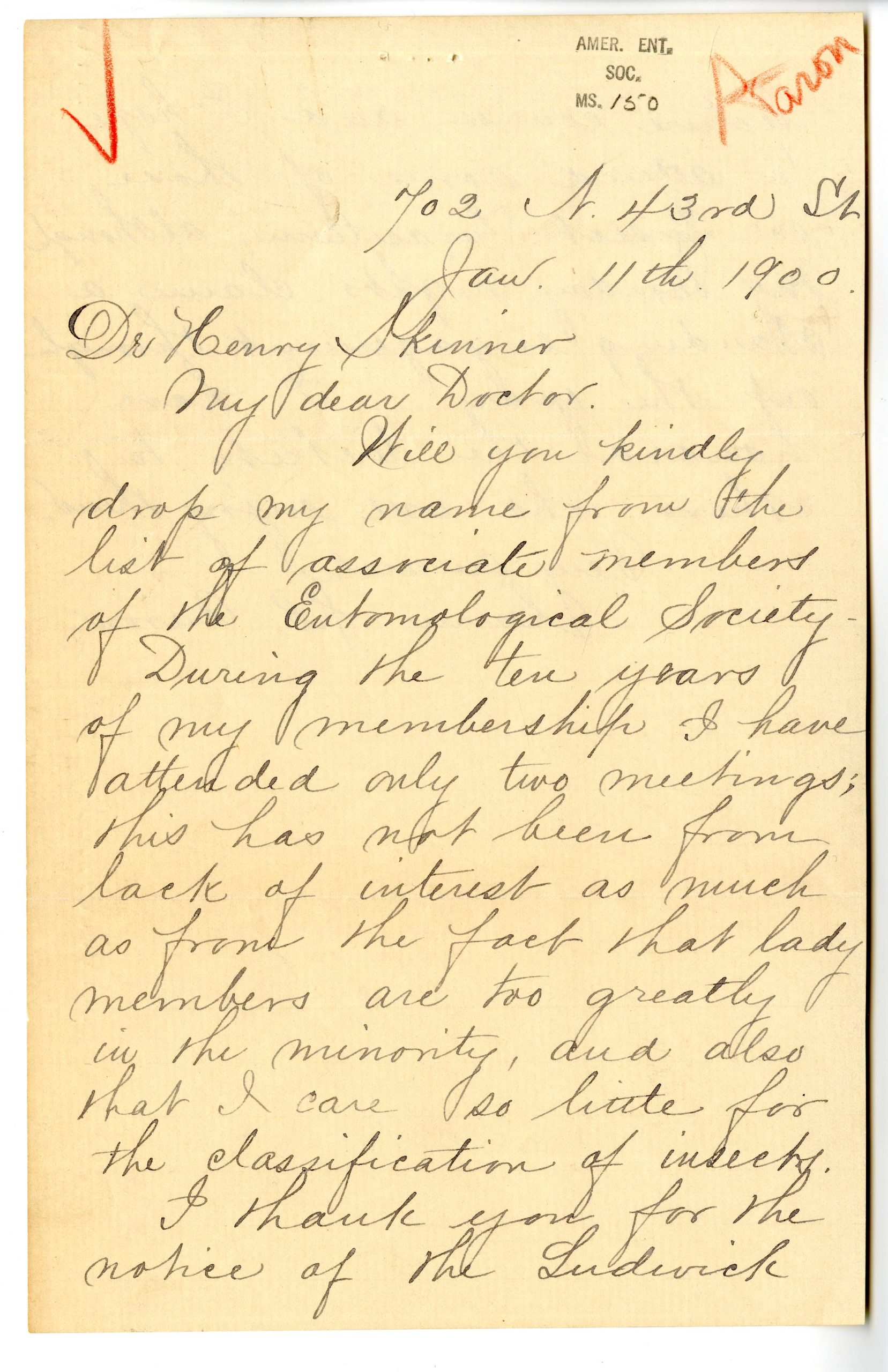
Despite her early success and induction into the scientific community, Aaron’s relationship with institutional entomology cooled over time. In a letter dated January 11, 1900, addressed to Henry Skinner, Aaron formally requested that her name be stripped from the list of associate members of the American Entomological Society.
Writing with frank introspection, she explained her decision:
"During the ten years of my membership I have attended only two meetings; this has not been from lack of interest as much as from the fact that lady members are too greatly in the minority, and also that I care so little for the classification of insects."
This disaffection with the rigid, male-dominated taxonomy of her day did not mark an end to her scientific curiosity, nor did it sever her personal ties. Her correspondence with Skinner endured for decades, characterized by what she later described in a 1923 letter as a "more than thirty year sympathetic friendship."
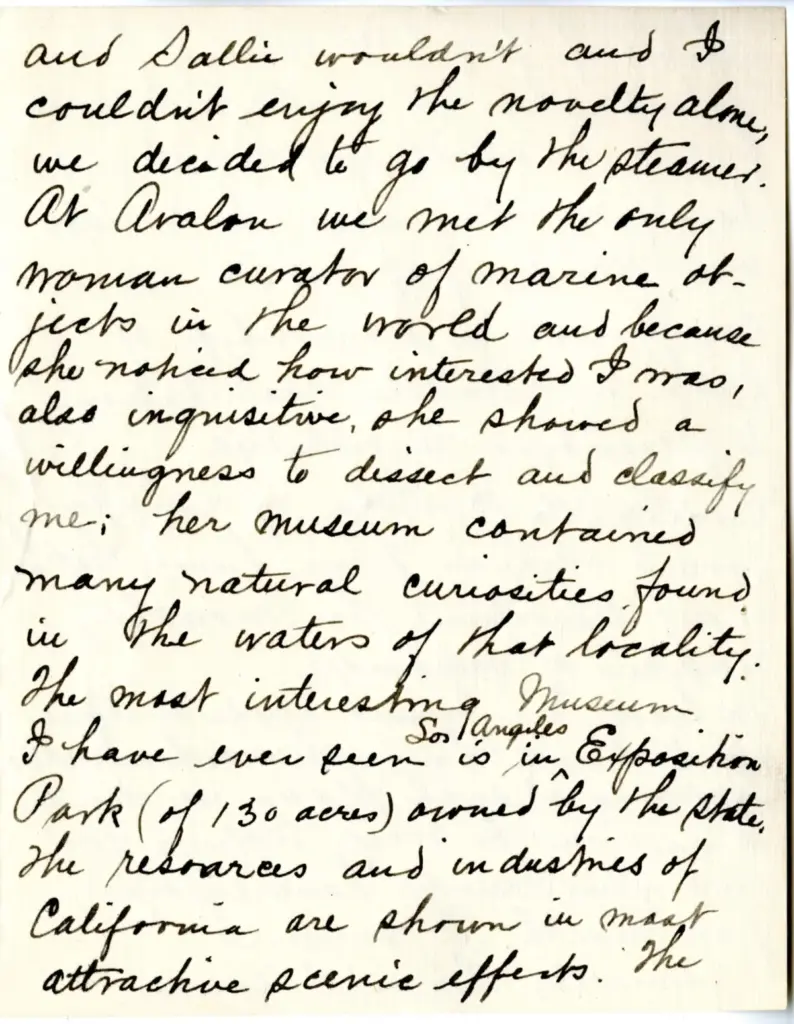
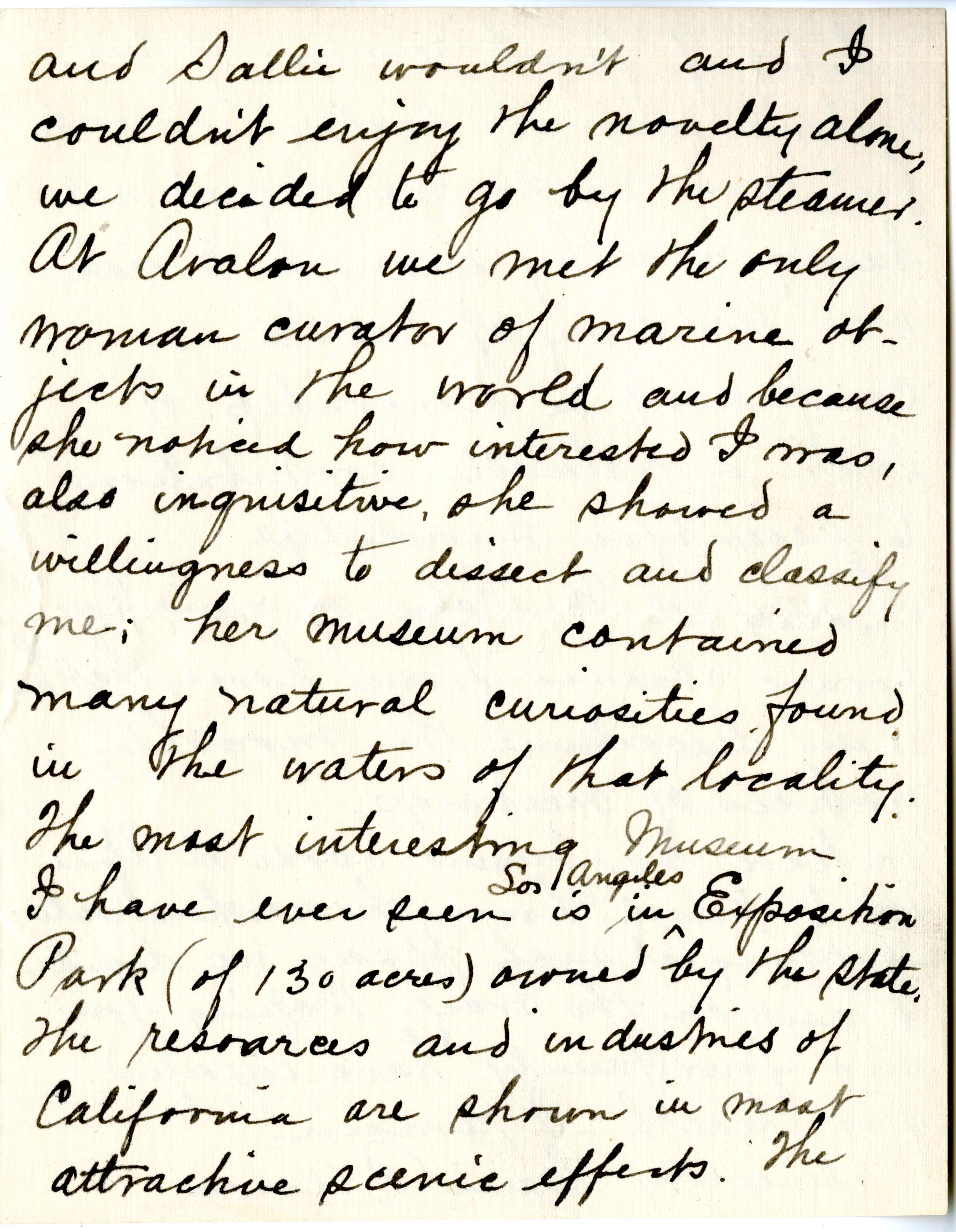
Decades later, living out her later years or traveling through the sun-drenched landscapes of California, Aaron maintained a passionate correspondence that chronicled her observations of the American West. In a letter written from Santa Monica on March 8, 1926—now digitized thanks to an AES correspondence project funded by Dr. William Day—she described the region as "the land of perpetual bloom and uninterrupted sounds of birds and insects."
Within that same letter, Aaron recounted a fateful encounter during a visit to Avalon:
"At Avalon we met the only woman curator of marine objects in the world and because she noticed how interested I was, also inquisitive, she shared a willingness to dissect and classify me; her museum contained many natural curiosities found in the waters of that locality."
She went on to praise the natural history exhibits at Los Angeles’ Exposition Park, marveling at the fossilized remains of prehistoric animals and expressing momentary regret that poor health had prevented her from helping the Academy of Natural Sciences secure similar specimens for its own vaults.
The 21st-Century Digital Renaissance
For decades, Aaron’s notebooks, essays, and personal letters remained safely preserved yet functionally sequestered within the archives of the Academy of Natural Sciences of Drexel University. That changed when Briana Giasullo and the ANSP Library and Archives team initiated a comprehensive workflow to digitize and transcribe 83 historical notebooks and field journals for inclusion in the Biodiversity Heritage Library’s BHL at 20 collection drive.
When Giasullo first pulled A notebook containing an entomological essay by Carrie Aaron from Small Collections and Individual Manuscripts Box 4 (ANSP-Coll-0156), the catalog record offered sparse details. The author was listed simply as "Mrs. Aaron," effectively erasing her first name and individual identity behind a Victorian marital title.
Recognizing this common archival hurdle, Academy Archivist Jessica Lydon intervened, providing biographical context that allowed Giasullo to correct the metadata. This correction catalyzed a major digital upgrade: the creation of an official BHL Creator ID for Carrie Aaron, cross-linked directly to her Wikidata identifier (Q125503946).
Simultaneously, student digitization assistant Will Le—working through an initiative funded by Dr. William Day and the American Entomological Society—began scanning the entire ANSP American Entomological Society correspondence collection (ANSP-Coll-0150) for upload to PA Photos and Documents. This simultaneous processing allowed Giasullo to read Aaron’s letters on her laptop screen, connecting the dots between her 1889 mosquito essays, her 1900 resignation from the AES, and her 1926 travels along the California coast.
Supporting Context & Metrics: The Scale of Archival Impact
To understand the magnitude of this discovery, it is necessary to examine the operational scale of the institutions involved and the quantifiable impact of modern digital catalog remediation.
The Biodiversity Heritage Library (BHL): Founded in 2006, BHL is celebrating its 20th anniversary as the world’s largest open-access digital repository for biodiversity literature and archives. It unites natural history and botanical libraries globally to digitize and make freely accessible the foundational literature of earth sciences.
The Academy of Natural Sciences of Drexel University (ANSP): Established in 1812, ANSP is the oldest natural history research institution in the Americas. Its Library and Archives house millions of specimens, rare books, artwork, and manuscript collections documenting the history of American and global natural science.
The Digitization Pipeline:
83 Field Journals and Notebooks: Recently targeted for high-priority digitization, transcription, and integration into BHL via the Field Journal Fixup collection initiative.
The AES Correspondence Project: Encompasses the complete digitization of the American Entomological Society’s historical correspondence files, managed by student intern Will Le and supported by donor funding from Dr. William Day and the AES.
Metadata Remediation Metrics: Transitioning a record from an anonymous or marital descriptor ("Mrs. Aaron") to a fully disambiguated BHL Creator ID linked to Wikidata increases search discoverability exponentially. It allows global search engines, automated harvesting scripts, and researchers studying women in STEM to accurately index, cite, and analyze female contributions that were previously obscured by historical cataloging practices.
Official Statements and Institutional Perspectives
The intersection of archival stewardship, technical cataloging, and feminist historical recovery has generated profound enthusiasm among the staff at the Academy of Natural Sciences and the broader BHL network.
Reflecting on the emotional and intellectual impact of her work, Briana Giasullo, Cataloging and Digital Resources Librarian at the Academy of Natural Sciences, emphasized how modern digital tools transform routine library tasks into historical detective work:
"When given the opportunity to write a blog post in celebration of BHL’s 20th anniversary, it was an easy choice among the Academy Library and Archives staff to write about Carrie Aaron. After working with archival notebooks and reading Carrie Aaron’s letters, I’m thrilled to see how digitization and public access to collections spur research into lesser-known individuals and uncover more potential research subjects! I don’t consider myself a historian, but it’s difficult to resist historical research when presented with easily accessible primary sources and when given the tools to link subjects across different platforms."
Giasullo also highlighted the collaborative synergy that made the project possible, offering public praise for her colleagues:
"Shout-out to Will Le, Jessica Lydon, Greg Cowper, and the American Entomological Society for making this happen!"
From the perspective of the Biodiversity Heritage Library administration, milestones like the BHL at 20 initiative underscore the vital role that community-contributed treasures play in shifting the narrative of scientific history. For two decades, BHL has actively worked to unearth the hidden human stories embedded within taxonomic literature. By prioritizing funding and technical infrastructure for manuscript digitization, BHL ensures that historical blind spots—such as the underrepresentation of women in 19th-century entomology—can be systematically identified and corrected by contemporary researchers.
Future Outlook: Unresolved Mysteries and the Road Ahead
The unearthing of Carrie Aaron’s notebooks and letters is not a closed chapter; rather, it serves as a launching pad for ongoing historical investigations. Giasullo’s work has already ignited a brand-new research quest that spans archival institutions on both coasts of the United States.
The Hunt for the "Only Woman Curator of Marine Objects"
The most immediate historical mystery spawned by the recent digitization is the identity of the woman Aaron encountered in Avalon, California, in March 1926. Described by Aaron as "the only woman curator of marine objects in the world," this individual captured the imagination of the Philadelphia naturalist through her willingness to discuss the dissection, classification, and public exhibition of marine specimens.
Identifying this pioneering marine curator requires cross-referencing California museum records from the 1920s, local historical societies on Santa Catalina Island, and early 20th-century marine biological stations. Archivists and historians suspect that as more regional California collections are digitized and indexed online, the identity of this mysterious curator will emerge from the shadows, adding yet another foundational woman scientist to the historical record.
Expanding the Digital Horizon
As Will Le continues his work digitizing the remainder of the American Entomological Society correspondence collection under the supervision of ANSP archivists, additional letters, drafts, and institutional communications are expected to shed further light on Aaron’s network of correspondents. These documents will not only illuminate Aaron’s personal life and scientific philosophy but also provide deeper insight into how female amateur and professional naturalists navigated exclusionary societies like the AES at the turn of the 20th century.
Furthermore, the integration of these materials into the Biodiversity Heritage Library as part of its 20th-anniversary celebrations ensures that Aaron’s legacy is permanently secured against physical loss, degradation, or institutional oversight.
A Call to Support Digital Preservation
Stories like Carrie Aaron’s demonstrate the immense cultural and scientific value locked away in paper archives. Yet, such discoveries are entirely dependent on sustained financial support, technical infrastructure, and human labor. Digitizing fragile cursive manuscripts, verifying historical metadata, building Wikidata cross-references, and maintaining open-access platforms like the Biodiversity Heritage Library require ongoing resources.
As BHL marks two decades of breaking down barriers to biodiversity literature, the initiative serves as a powerful reminder: the archive is not merely a dusty warehouse of dead facts. When illuminated by open-access technology and curated by dedicated librarians, it is a living, breathing landscape where the voices of the past can finally speak for themselves, challenging us to rewrite the history of science with equity, accuracy, and depth.