

Executive Overview
For two decades, the Biodiversity Heritage Library (BHL) has served as the digital cornerstone for global biodiversity literature, transforming obscure paper records into accessible, interconnected web pages. As BHL celebrates its milestone 20th anniversary, participating institutions are showcasing the hidden treasures nestled within their archives. Among the most compelling narratives to emerge from this celebration is the rediscovery of Carrie Aaron—a nineteenth- and twentieth-century naturalist whose meticulous field notes, essays, and personal correspondence were nearly lost to historical obscurity.
Working behind the scenes at the Academy of Natural Sciences of Drexel University, library professionals recently undertook a comprehensive initiative to digitize, transcribe, and catalog 83 historical scientist notebooks and field journals. This meticulous curation process did more than simply preserve aging paper; it corrected historical oversights, linked fragmented records through Wikidata identifiers, and reintroduced the sharp, witty voice of Carrie Aaron to the modern scientific community.
This article explores the journey of Aaron’s rediscovered manuscripts, the collaborative institutional effort that brought them online, and the broader implications of digital archiving for uncovering marginalized historical figures in the natural sciences.
Detailed Chronology: The Life, Work, and Rediscovery of Carrie Aaron
To fully appreciate the significance of Aaron’s digital footprint, one must trace the timeline of her work—from her nineteenth-century scientific endeavors to the twenty-first-century technological pipelines that rescued her name from anonymity.
1889–1901: The Mosquito Eradication Essay and Scientific Pursuits
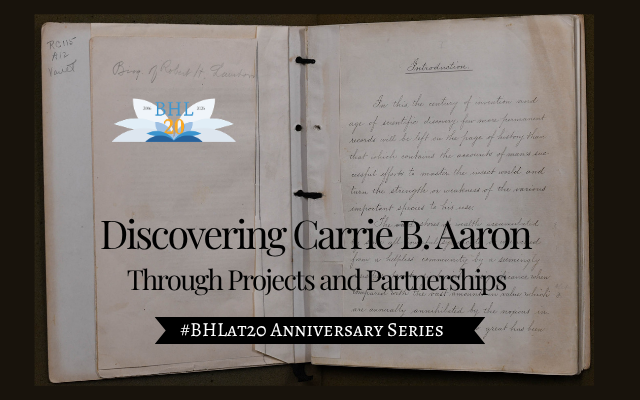
Carrie Aaron’s historical footprint is anchored by a meticulously handwritten manuscript titled A notebook containing an entomological essay by Carrie Aaron. Written across the turn of the twentieth century, the notebook centers on an essay originally submitted to a specialized contest.
The contest was organized by Robert Henry Lamborn, a railroad builder who suffered intensely from mosquito attacks during the construction of the Lake Superior Railroad. Motivated by his trials, Lamborn offered prizes for the three best essays outlining effective methods to exterminate or mitigate the mosquito pest. Aaron rose to the challenge, penning a comprehensive biographical notice of Lamborn alongside a rigorous entomological analysis.
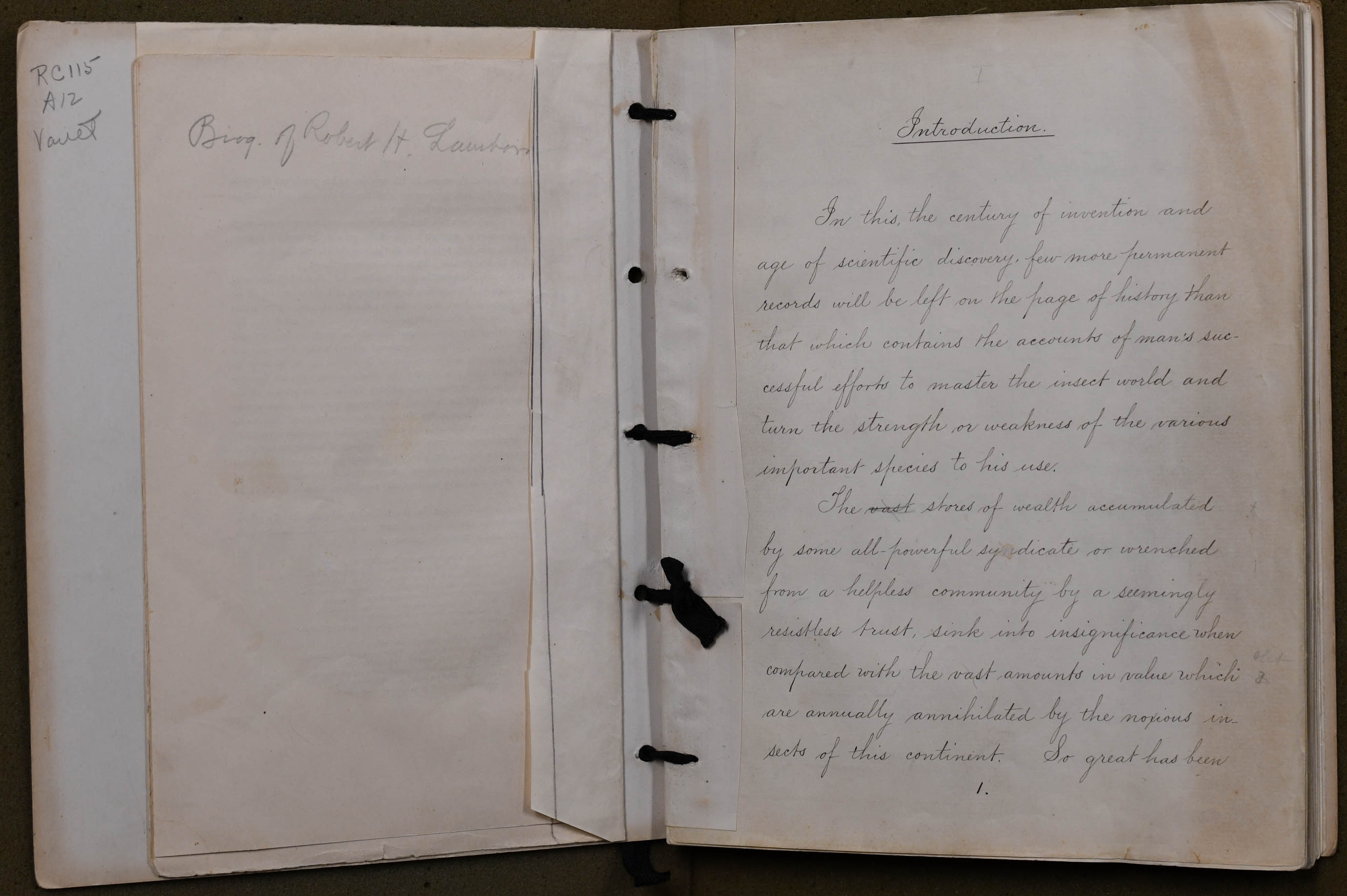
Within the essay—later published in the compilation Dragon Flies vs. Mosquitoes: Can the Mosquito Pest be Mitigated? under the title "The Dipterous Enemies of Man"—Aaron explored biological methods to reduce mosquito populations. Notably, she championed the dragonfly, famously describing it as "the hawks of the minuter insect world." Her research was remarkably hands-on; Aaron and her associates even attempted to inoculate themselves with what was then described as poisonous droplets extracted from mosquitoes. Though the self-experimentation failed—which Aaron playfully attributed to "the inferiority of the needle as an injector, compared with the delicate hypopharynx"—it underscored her dedication to empirical observation.
1900: Stepping Away from the American Entomological Society
Following her success in the Lamborn essay contest, Aaron received a congratulatory letter from prominent entomologist Henry Skinner, who confirmed that her reputation in the scientific community was now "well established."
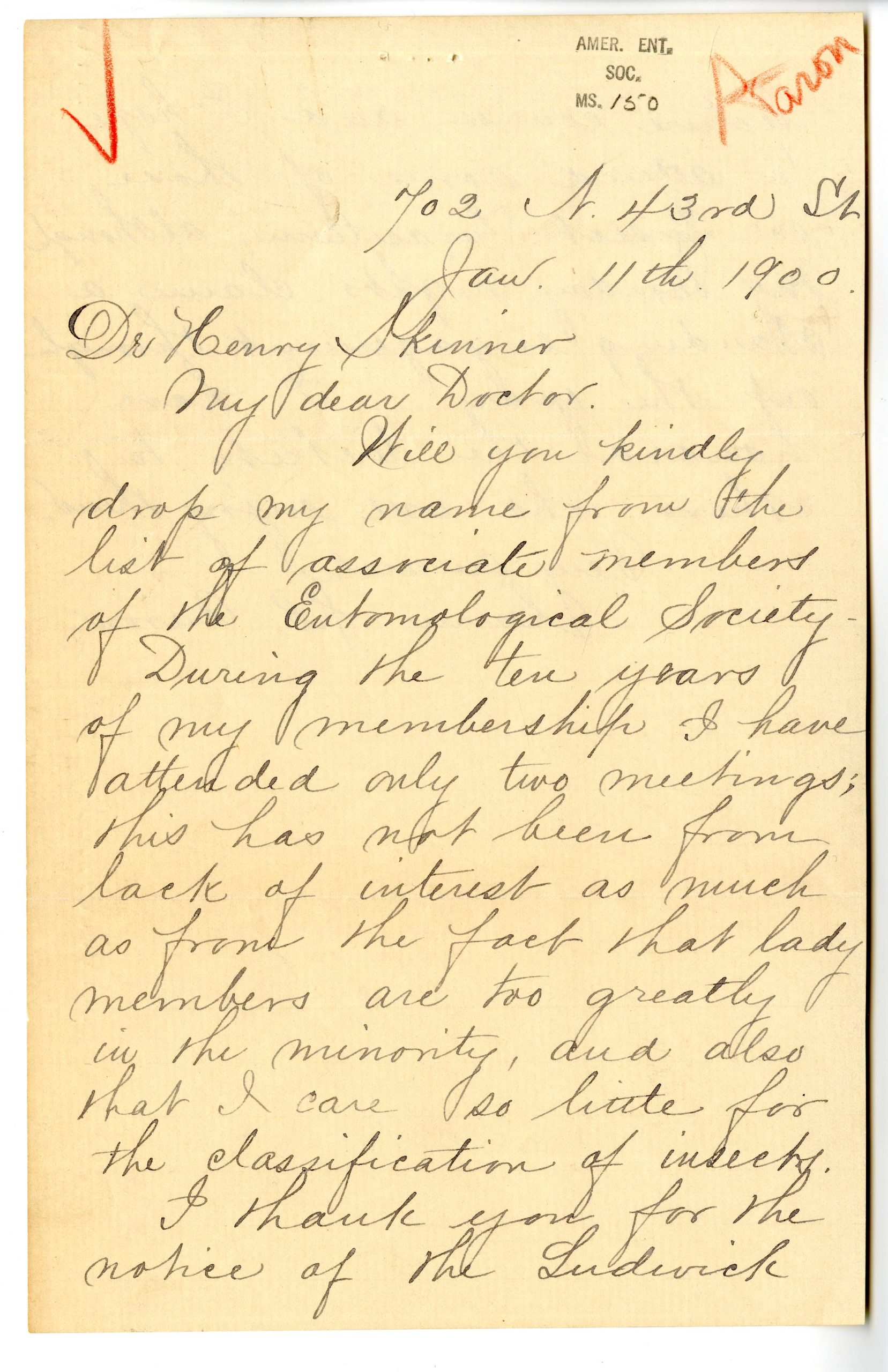
However, Aaron’s relationship with institutional science was complex. On January 11, 1900, she wrote to Skinner requesting that her name be removed from the list of associate members of the American Entomological Society (AES). Her rationale revealed systemic barriers faced by women in science at the time:
"During the ten years of my membership I have attended only two meetings; this has not been from lack of interest as much as from the fact that lady members are too greatly in the minority, and also that I care so little for the classification of insects."
Despite stepping back from formal society meetings, Aaron maintained a warm, lifelong intellectual correspondence with Skinner, later thanking him in a 1923 letter for a "more than thirty year sympathetic friendship."
1926: Travels in California and Encounters with Early Women Curators
Decades after stepping back from formal society memberships, Aaron’s correspondence reveals her continued fascination with the natural world. Writing to Skinner from Southern California on March 8, 1926, she described Santa Monica as "the land of perpetual bloom and uninterrupted sounds of birds and insects."
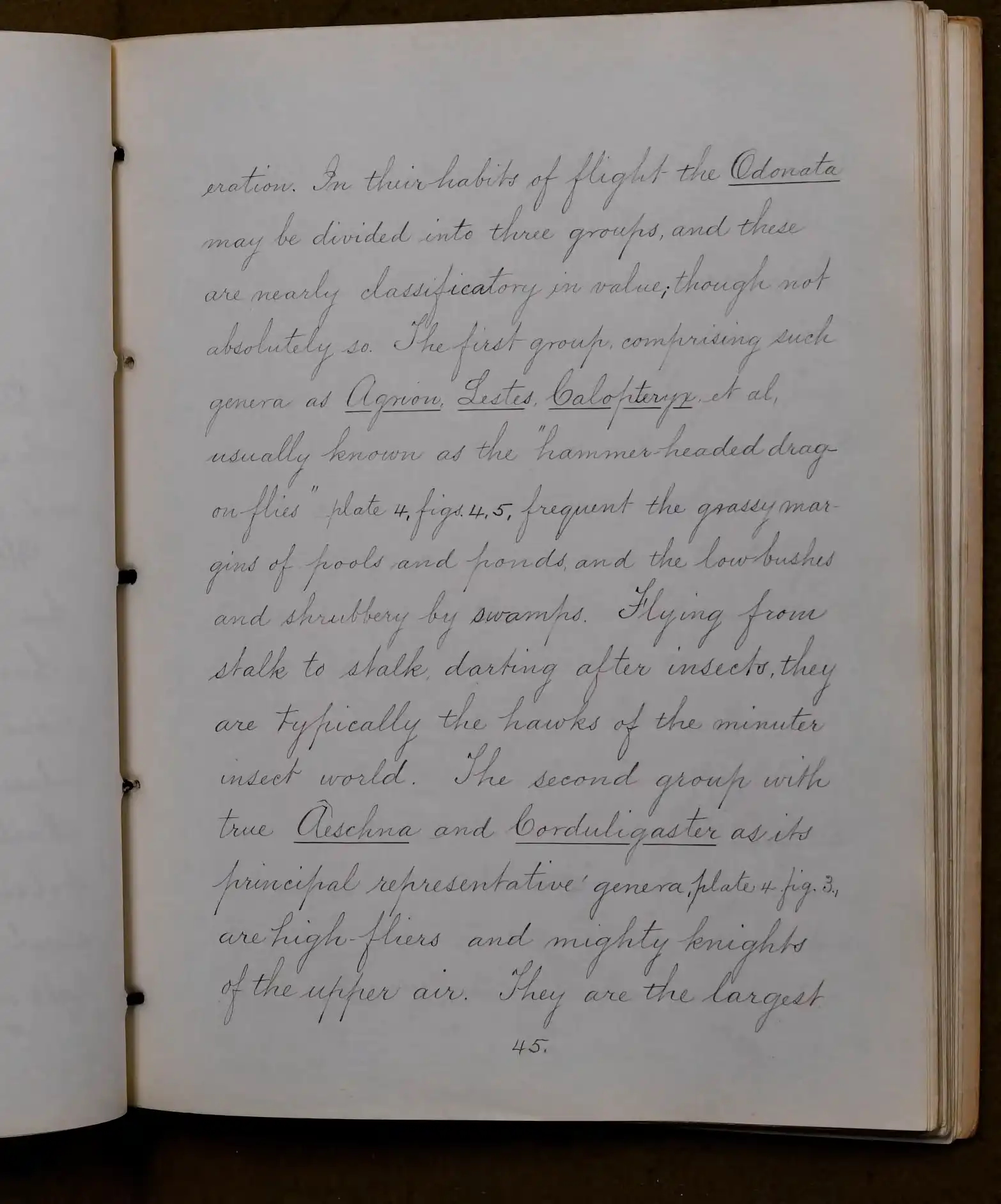
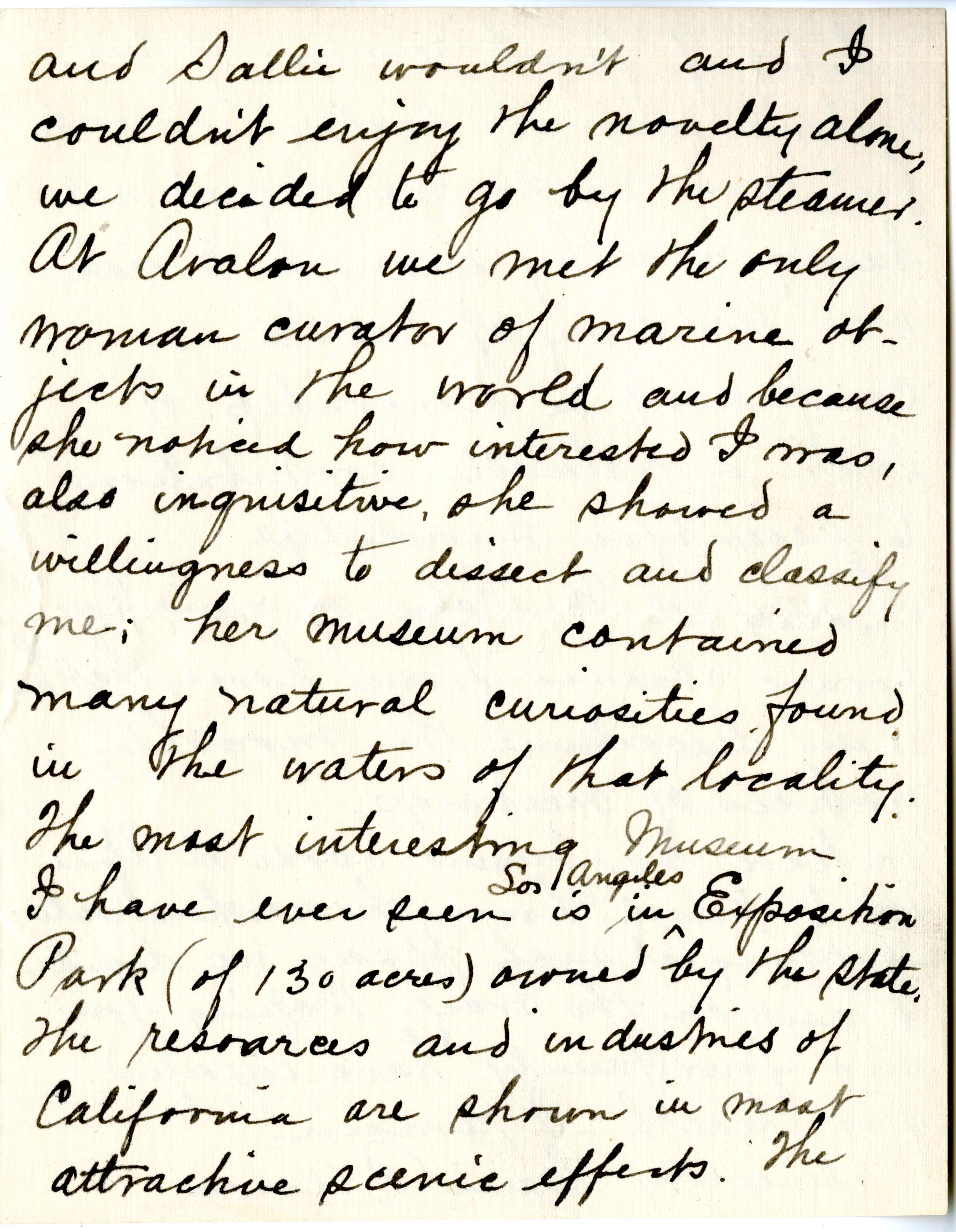
Her letters also captured pivotal encounters with other pioneering women in science. During a visit to Avalon, Aaron met "the only woman curator of marine objects in the world," who shared her enthusiasm for dissecting and classifying marine life. Later, visiting a 130-acre state-owned museum in Los Angeles’s Exposition Park, Aaron marveled at exhibits of prehistoric animal fossils, writing that the experience made her "regret not being healthy enough to make our Academy of Nat. Sci. a competitor in ownership of such a valuable contribution to scientific knowledge."
Modern Era: Digitization, Metadata Correction, and the BHL at 20 Initiative
Fast-forward nearly a century. As the Academy of Natural Sciences of Drexel University prepared contributions for BHL’s 20th anniversary, Cataloging and Digital Resources Librarian staff undertook the mammoth task of digitizing 83 historical notebooks and field journals.
Initially, catalog records listed Aaron’s notebook under the vague, depersonalized heading "Mrs. Aaron," erasing her first name and professional identity—a common pitfall in historical archival research involving women. Thanks to the vigilant oversight of Academy Archivist Jessica Lydon, the oversight was flagged. Library staff subsequently built a dedicated BHL Creator ID for Carrie Aaron and linked it to her official Wikidata identifier, elevating her from a nameless historical footnote to a recognized author in global library linked data networks.
Supporting Context & Metrics: The Mechanics of Digital Preservation
The resurrection of Carrie Aaron’s legacy was not an accident; it was the result of coordinated funding, institutional partnerships, and tireless student labor.
- The Scope of the Project: 83 historical scientist notebooks, field journals, and manuscripts from the Academy of Natural Sciences were targeted for digitization and transcription under the BHL collection initiative Field Journal Fixup.
- The AES Correspondence Collection: Spearheaded by student intern Will Le, the entire American Entomological Society (AES) correspondence collection—housing letters written by Aaron, Skinner, and other period naturalists—is being digitized and uploaded to PA Photos and Documents.
- Financial Backing: The digitization of the AES correspondence archive was made possible through the generous philanthropic support of Dr. William Day and the American Entomological Society.
- Global Interoperability: By establishing a Wikidata Q-identifier (
Q125503946) for Carrie Aaron and mapping her bibliography to BHL’s database, researchers worldwide can now trace her life, writings, and intellectual networks without needing to visit physical archives in Philadelphia.
Official Statements and Institutional Perspectives
The intersection of archival stewardship and digital accessibility has unlocked new frontiers for library professionals who traditionally viewed their roles as administrative rather than investigative.
Reflecting on the project, the Academy’s Cataloging and Digital Resources Librarian noted the unexpected emotional and intellectual impact of working with primary sources:
"After working with archival notebooks and reading Carrie Aaron’s letters, I’m thrilled to see how digitization and public access to collections spur research into lesser-known individuals and uncover more potential research subjects! I don’t consider myself a historian, but it’s difficult to resist historical research when presented with easily accessible primary sources and when given the tools to link subjects across different platforms."
From the perspective of the broader Biodiversity Heritage Library network, the mission remains clear. For two decades, BHL has championed the democratization of natural history literature. By extracting voices buried in fragile paper archives and placing them into open-access digital repositories, institutions ensure that overlooked historical figures—such as women scientists constrained by nineteenth-century social structures—reclaim their rightful places in the history of science.
Future Outlook: Unanswered Questions and the Road Ahead
The digital release of Carrie Aaron’s papers has not concluded her story; rather, it has opened an entirely new avenue of historical inquiry.
Chief among the lingering mysteries is the identity of the anonymous female marine biologist whom Aaron encountered in Avalon during her 1926 California trip. Described by Aaron as "the only woman curator of marine objects in the world," this figure represents another hidden pioneer waiting to be identified, cataloged, and celebrated through modern archival detective work. Armed with newly digitized letters, searchable text, and interconnected library databases, Academy researchers intend to track down this elusive curator.
As BHL moves past its twentieth anniversary, the workflow established by the Academy of Natural Sciences serves as a blueprint for cultural heritage institutions worldwide. By combining high-resolution digitization, rigorous linked-data cataloging (such as Wikidata integration), and student-led transcription efforts, archives can convert dusty storage boxes into vibrant, dynamic ecosystems of discovery.
For scholars, librarians, and curious minds alike, Carrie Aaron’s journey from "Mrs. Aaron" to a globally indexed entomological author proves that history is never truly finished—it is simply waiting to be unlocked.



