

Executive Overview
For two decades, the Biodiversity Heritage Library (BHL) has served as the global digital backbone for ecological and historical research, salvaging fragile ink-on-paper records and transmuting them into open-access digital knowledge. As part of the ongoing BHL at 20 commemorative series—which highlights the crown jewels of its vast international collections—attention now turns to the southernmost edge of the British Empire: Van Diemen’s Land, now known as Tasmania.
In 1849, the Royal Society of Van Diemen’s Land published the inaugural volume of its Papers and Proceedings. Established six years prior in 1843, this organization holds the distinction of being the oldest Royal Society outside of the United Kingdom. For more than 180 years, its peerless journal has chronicled the scientific discoveries, ecological alterations, socioeconomic development, and complex political realities of a transforming island landscape.
Today, thanks to the complete digitization of these volumes via the BHL’s open-access repository, researchers, historians, and Indigenous communities can examine a meticulously kept record of colonial enterprise. However, these documents are far more than dusty catalogues of dead flora and fauna; they are profoundly complex historical artifacts. They reflect the raw ambitions of early settlers, record the irreversible introduction of invasive species, document the swift transformation of Indigenous-managed ecosystems, and—critically—mirror the inherent blind spots, privileges, and injustices of the British colonial gaze.
Detailed Chronology: The Genesis and Evolution of a Scientific Chronicle
1843–1849: Laying the Foundations of Colonial Science
The Royal Society of Van Diemen’s Land for Horticulture, Botany, and Advancement of Science was founded under the patronage of the colonial administration. In an era when European powers were aggressively mapping, exploiting, and categorizing newly claimed territories, the Society sought to catalog the rich natural bounty of the island. By 1849, these efforts culminated in the publication of Volume 1 of the Papers and Proceedings, released across three parts through 1851.
The early pages of Volume 1 immediately established an empirical baseline for the colony. Nearly fifty dense pages of demographic data, weather charts, and meteorological observations captured the environment through a strictly Western, quantitative lens. Alongside these tables sat pioneering treatises on industrial and agricultural expansion, documenting coal mining operations, innovative construction techniques, and agricultural trials.

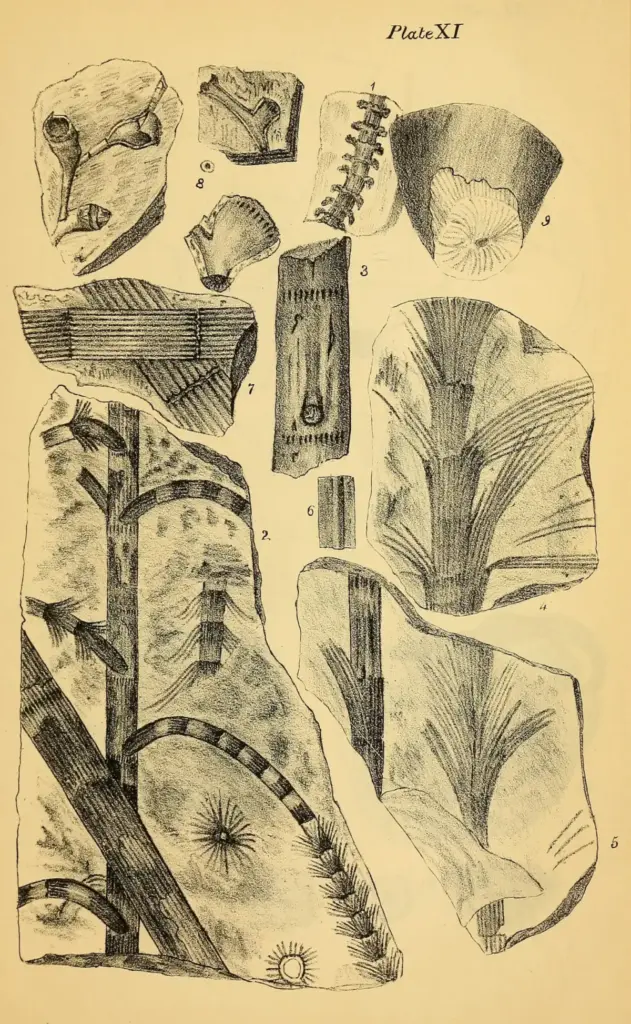
Yet, it was the inclusion of natural science contributions from international luminaries—such as John Edward Gray, John Gould, and Frederick M’Coy—that placed the journal on the global scientific map. These researchers used the specimens shipped from Hobart Town to decode ancient fossils and describe bizarre, newly encountered endemic species, such as the duck-billed platypus.
1849–1851: Incidental Observations of Ecological Upheaval
While formal scientific papers formed the core of the journals, the most startling insights into rapid ecological degradation often lay buried in the mundane meeting minutes and casual field reports submitted by society members.
- The Giants of the Forest: In 1849, a member named Mr. Hull detailed a gargantuan blue gum (Eucalyptus globulus) discovered roughly six miles from Hobart Town. Measuring an astonishing 28 yards (25.6 meters) in circumference and scaling an estimated 330 feet (100.5 meters) into the sky, the tree stood as a testament to the ancient, undisturbed forests that once dominated the region.
- Bizarre Biological Discoveries: During the same assembly tables, Mr. Champ presented a small spotted fish preserved in spirits. The specimen bewildered naturalists because it seemingly possessed four distinct legs complete with finger-like appendages. Meanwhile, Mr. Milligan triumphantly reported the safe arrival in London of two live thylacines (Thylacinus cynocephalus), dispatched from Tasmania the previous year.
- Indigenous Knowledge and Unique Flora: The journals documented traditional practices of the Tasmanian Aboriginal people, capturing uses for the native truffle-like fungus known as "native bread" (Mylitta sp.). Observers noted that when grated and baked into a milk pudding, the fungus was "very palatable." Additionally, samples of white resin from the Oyster Bay pine were recorded. This tree had an extraordinarily restricted natural distribution yet possessed exceptional properties for carpentry. Today, the rare surviving stands of this threatened species are protected within the South Esk Pine Nature Reserve.
The Cascading Impacts of Introduced Species
Perhaps the most enduring and sobering legacy preserved within the pages of the early Papers and Proceedings is the casual documentation of biological invasions—introductions that would permanently alter the island’s delicate evolutionary balance.
Naturalist Ronald Campbell Gunn contributed an insightful paper explaining how the "flying squirrel"—better known today as the sugar glider—became naturalized in Tasmania. Originally imported as an exotic pet during the 1830s, the animals quickly escaped captivity and established self-sustaining wild populations. At the time, few could fathom that this diminutive marsupial would centuries later emerge as a primary predator threatening the critically endangered swift parrot by raiding nests and preying on females, eggs, and nestlings.
Equally consequential was a paper penned by Captain Charles Stanley, which explored the logistics and practicalities of introducing brown and rainbow trout into Tasmanian waterways. Stanley’s advocacy turned into action; when live fish ova were successfully transported to the Salmon Ponds at New Norfolk and subsequently released, Tasmania’s pristine native river systems were permanently transformed to host an aggressive apex predator.

Supporting Context & Metrics: Institutional Growth and Cultural Heritage
Beyond pure ecology, the early journals preserved the operational machinery of the Royal Society itself. Financial ledgers, membership rosters, acquisition lists, and records of correspondence map the social architecture of nineteenth-century Hobart. The individuals steering the Society were invariably the colony’s most powerful administrators, merchants, and military officers.
The meetings themselves functioned as cultural salons where affluent citizens regularly donated books, fine art, geological specimens, and anthropological artifacts. These amassed contributions became the foundational seed capital for several world-class cultural institutions that endure today:
- The Royal Tasmanian Botanical Gardens
- The Tasmanian Museum and Art Gallery (TMAG)
- The Royal Society of Tasmania’s specialized Art and Library Collections
Within just four decades of initial British colonization, Van Diemen’s Land had shifted from a remote penal outpost at the edge of the known world into an organized, intensely active settler-colonial society obsessed with accumulating industrial, economic, and scientific dominion over the land.
Official Statements and Critical Reflections
Confronting Colonial Blind Spots
Modern historical and scientific analysis requires intellectual honesty, particularly when engaging with nineteenth-century literature. The journals produced by colonial administrators and scientists inherently reflected the biases, class privileges, and Eurocentric worldviews of the British Empire. They systematically overlooked Indigenous voices, erased traditional land-management systems, and stood adjacent to the devastating frontier violence and forced displacements inflicted upon the Palawa (Tasmanian Aboriginal) people.
Historians and modern readers often find these texts simultaneously compelling and deeply uncomfortable. The value of the archive lies not only in the data it actively records, but also in the historical absences, silences, and biases that modern scholars must critically interrogate.

Institutional Evolution and Reconciliation
Recognizing this complex legacy, the Royal Society of Tasmania has actively pivoted in recent decades to address historical injustices and foster truth-telling.
In a landmark institutional shift, the Society issued a formal Apology to Tasmanian Aboriginal People in 2021. Furthermore, the modern Papers and Proceedings have expanded their academic scope, moving beyond traditional natural history and Antarctic science to incorporate social history, cultural studies, and Indigenous perspectives. Annual events such as the Tasmanian Aboriginal Lecture series are now regularly featured and published within the journal, marking a profound institutional transformation.
Future Outlook: Open Access in the Age of Artificial Intelligence
The complete transition of the Papers and Proceedings of the Royal Society of Tasmania into an open-access digital format represents a watershed moment for archival science. Through the Biodiversity Heritage Library, more than 175 years of continuous publication have been liberated from physical archive boxes and made instantly searchable to anyone with an internet connection.
In an era defined by rapid technological shifts, big data, and artificial intelligence, digitized historic literature gains entirely new utilities. Researchers can now deploy computational tools, natural language processing (NLP), and machine learning across these centuries-old volumes. These technologies can extract complex ecological trends, map historical species distributions over time, and analyze shifts in colonial terminology that manual reading alone could never efficiently accomplish.
Preserving the Past for Tomorrow
The digital legacy of the Royal Society of Tasmania, preserved and championed by the Biodiversity Heritage Library, proves that these historical journals are far more than static relics. They are dynamic, living records of a landscape in transition. By maintaining free, open global access to these irreplaceable volumes, BHL ensures that the successes, failures, ecological transformations, and human stories of Tasmania remain available to inform, educate, and challenge future generations.

From the Biodiversity Heritage Library
For 20 years, the Biodiversity Heritage Library has sustained an unbroken commitment to making foundational scientific literature—such as the Papers and Proceedings of the Royal Society of Tasmania—freely accessible to researchers, conservationists, students, and curious minds across the globe. Preserving fragile historical records requires sustained dedication, technological infrastructure, and community support. To help BHL continue safeguarding the irreplaceable written heritage of our natural world for the next twenty years, consider supporting their mission through donations and institutional partnerships.



