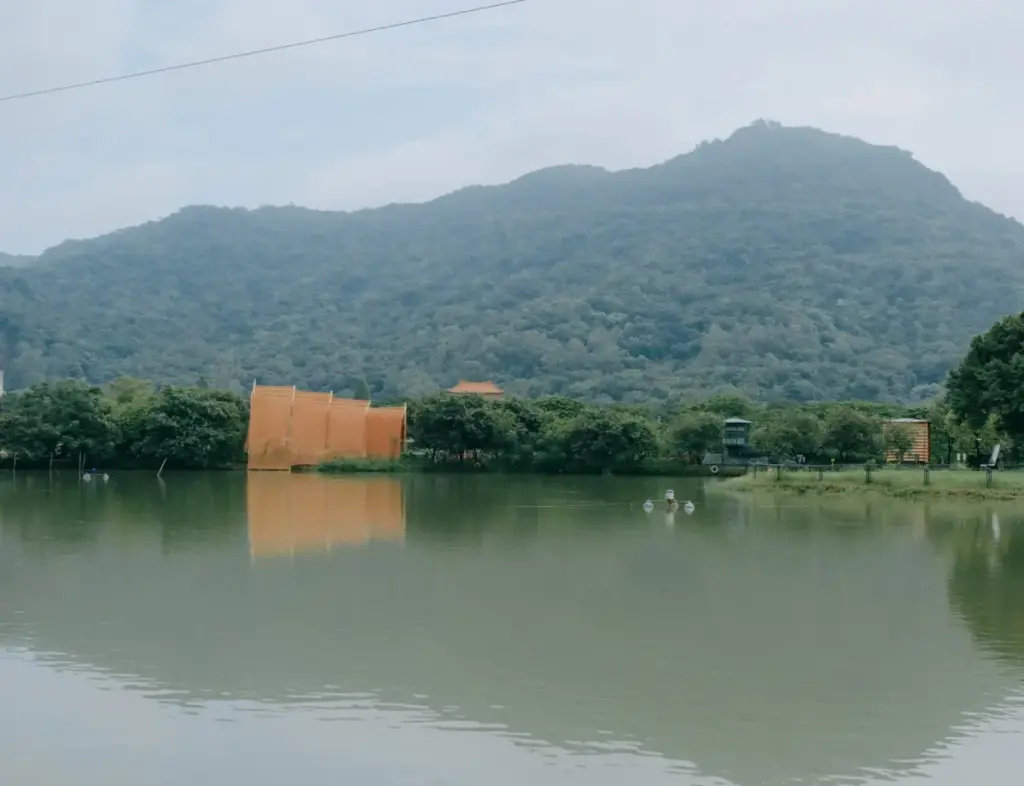
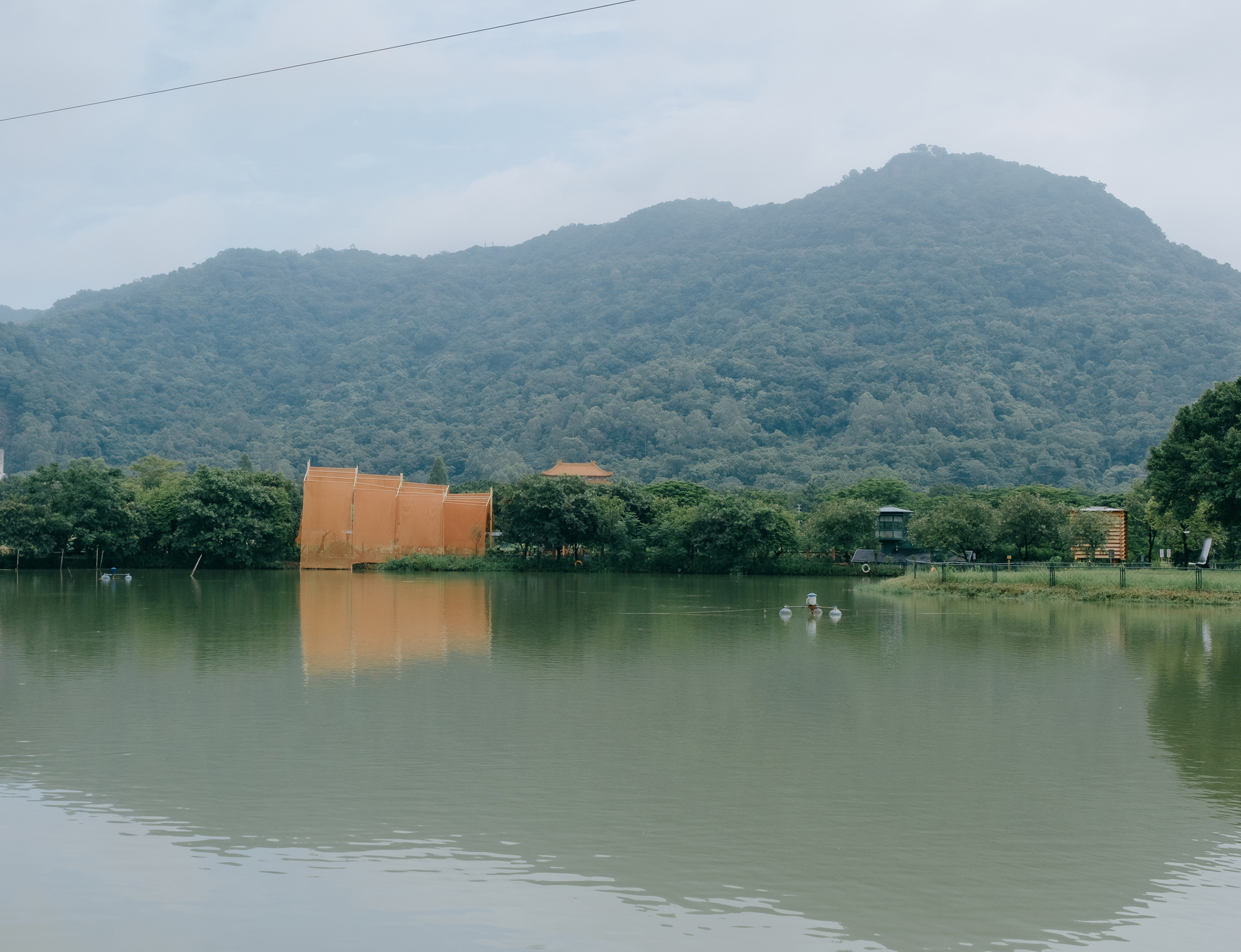
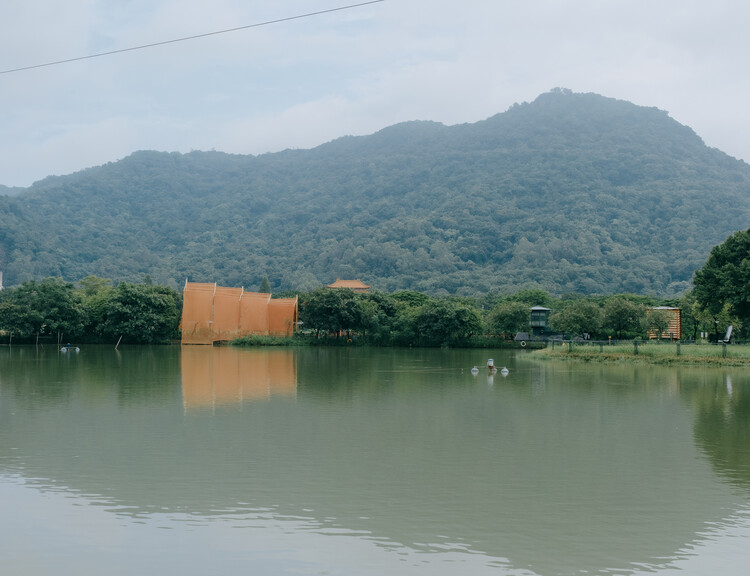
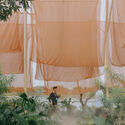
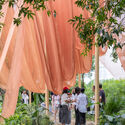
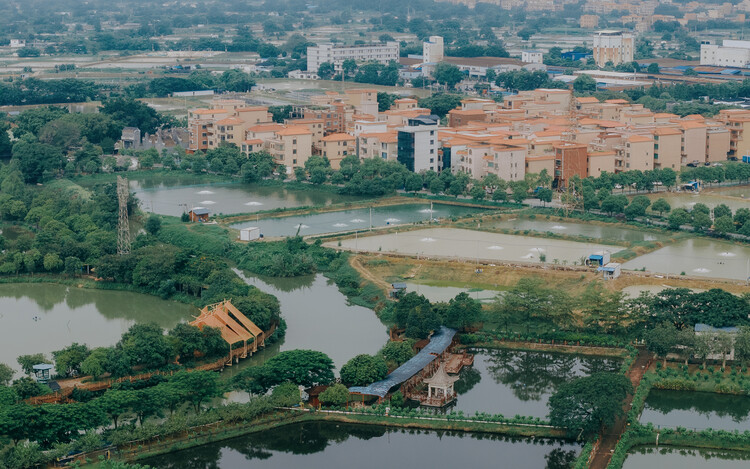
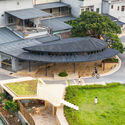
In the heart of Nanhai, a region historically celebrated for its delicate, symbiotic relationship between land and water, a new architectural intervention has taken root. Curated by Han Shuang and brought to life by the visionary designers at Multi-Architecture, Under the Drying Nets is more than a temporary structure—it is a spatial homage to local heritage, labor, and ecology. Commissioned as part of the "Art at Qiaoshan – Art Field Nanhai" initiative, the project anchors itself within the "Yugengyueyun Section—Fishing and Farming Cabanas 2.0" zone.
By engaging with the iconic "mulberry-dike-fish-pond" system—a legendary, self-sustaining agricultural model where mulberry leaves feed silkworms, silkworm waste feeds fish, and pond silt nourishes the dikes—Multi-Architecture has crafted an installation that transcends traditional building typologies. The design elevates the humble fishing net, traditionally used merely as a functional tool for the daily catch and left out to dry in the elements, into a profound architectural medium. This comprehensive feature explores the theoretical underpinnings, structural choreography, cultural resonance, and future trajectory of an installation that bridges the gap between historical preservation and contemporary spatial art.
Detailed Chronology and Design Evolution
The genesis of Under the Drying Nets traces back to a rigorous curatorial and contextual investigation conducted by Multi-Architecture in collaboration with the organizers of Art Field Nanhai. The project’s timeline reflects a careful, measured integration into the socio-ecological fabric of Qiaoshan.
Phase I: Contextual Mapping and Research (Early Conceptualization)
Before a single line was drawn or material sourced, the design team spent weeks immersing themselves in the geography and daily routines of Nanhai. The research was centered on understanding the sangji-yutang (mulberry-dike-fish-pond) system, an agricultural marvel recognized globally for its circular economy centuries before the term became mainstream.
Multi-Architecture sought to identify elements of local labor that carried high visual and emotional resonance. They observed that fishing nets—stretched across frames, hung from rafters, or laid out under the sun—formed temporary, ethereal partitions of space throughout the landscape. These nets caught not only fish, but light, wind, and shadow. This realization sparked the core concept: what if a permanent or semi-permanent architectural framework could be built entirely around the ephemeral act of drying nets?
Phase II: Prototyping and Materiality (Design Development)
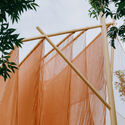
Translating the fluidity of a fishing net into an architectural enclosure required rigorous structural testing. The architects experimented with tension, load distribution, and material transparency. They needed to ensure that the structural skeleton would support the heavy, rhythmic draping of genuine fishing nets while maintaining a dialogue with the natural environment.
Unlike conventional pavilions that rely on solid walls or rigid panels, Multi-Architecture’s design treats the nets as dynamic building envelopes. The mesh density was meticulously calibrated; too tight, and the structure would block the sweeping breezes of the fish ponds; too loose, and the poetic interplay of shadow and light would be lost. Through iterative physical models, the team finalized a framework that allowed the nets to cascade through space, creating sheltered micro-climates under them.
Phase III: Installation and Public Activation (Execution)
The realization of the project on-site marked a harmonious convergence of local craftsmanship and contemporary installation art. Local artisans, whose families had fished and farmed these waters for generations, lent their expertise in handling the heavy-duty cordage and rigging systems.
Upon its completion for the "Fishing and Farming Cabanas 2.0" exhibition, Under the Drying Nets immediately transformed how visitors interacted with the landscape. Walking underneath the canopy of suspended nets, visitors were enveloped in a shifting interplay of dappled sunlight and textural patterns. The structure acts as a spatial filter, slowing down the passage of time and inviting contemplation on the labor-intensive heritage of Nanhai.
Supporting Context & Metrics: The Ecology of Qiaoshan
To fully appreciate the architectural achievement of Multi-Architecture’s installation, one must examine the socio-ecological metrics and historical frameworks that define the Nanhai district.
The Mulberry-Dike-Fish-Pond System (Sangji Yutang)
Dating back over the Ming and Qing dynasties, the Nanhai region perfected an intensive, zero-waste agricultural cycle. The metrics of this ecosystem are a masterclass in regional sustainability:
Land-to-Water Ratio: Traditionally balanced to ensure optimal nutrient runoff, where approximately 40% to 50% of the land area is dedicated to dikes supporting mulberry trees and agriculture, while the remaining 50% to 60% comprises deep fish ponds.
Nutrient Circularity: Silkworm excrement is channeled directly into the ponds to feed herbivorous fish. The nutrient-rich pond mud (tangni) is periodically dredged by farmers to fertilize the mulberry trees on the dikes, completing an efficient biological loop.
Human Labor Integration: The landscape is shaped entirely by human intervention guided by natural cycles. Fishing and farming are not separated industries here; they are synchronized daily rituals.
Environmental Impact: Low-carbon, highly permeable footprint designed to leave minimal disruption on the surrounding wetland and pond ecosystems.
Official Statements and Curatorial Perspectives
The conceptual weight of Under the Drying Nets has drawn widespread acclaim from critics, curators, and the architects themselves. The project speaks to a growing desire in contemporary design to look backward into localized traditions to find sustainable futures.
Curator Han Shuang emphasized the cultural urgency of the project during the exhibition launch:
"In a rapidly urbanizing delta like the Pearl River Delta, traditional landscapes are often viewed through a nostalgic, distant lens. Multi-Architecture has achieved something far more radical here. They haven’t just placed a sculpture in a field; they have extracted the very DNA of local labor—the drying net—and elevated it into a spatial ceiling. When you stand under these nets, you are standing under the collective memory of generations of Nanhai fishermen and farmers."
Representatives from Multi-Architecture elaborated on the technical and philosophical dimensions of the design:
"Our goal was to design with restraint. The fishing net is already a masterpiece of functional design: it is lightweight, durable, highly tensile, and visually permeable. By creating an architectural skeleton that allows these nets to perform spatially, we dissolve the boundary between the artificial and the natural. The structure breathes with the wind, filters the harsh southern sun, and frames the horizon of the fish ponds in an entirely new way. It is architecture as a frame for everyday poetry."
Future Outlook: Legacy, Preservation, and Adaptive Regionalism
As temporary art festivals increasingly grapple with issues of legacy and ecological footprint, installations like Under the Drying Nets point toward a progressive path forward for rural and peri-urban interventions.
Catalyzing Rural Revitalization
The integration of high-level contemporary architecture into agricultural zones like Qiaoshan serves a dual purpose. First, it brings cultural tourism and economic revitalization to traditional farming communities without erasing their identity. Second, it educates a new generation of urban visitors on the elegance of historical production methods. By reframing the tools of labor—the fishing net—as objects of high design, the project fosters a deep sense of local pride among residents.
Scalability and Adaptive Frameworks
Multi-Architecture’s structural methodology opens up new possibilities for lightweight, nomadic, or semi-permanent architecture in sensitive ecosystems. Because the installation relies on tensioned mesh and modular armatures rather than heavy concrete foundations, it can be easily disassembled, reconfigured, or adapted for future agricultural and cultural events across the region.
As climate change and shifting global economies challenge traditional agricultural models, interventions like Under the Drying Nets demonstrate that architecture can act as a bridge. It honors the wisdom of the past while offering flexible, imaginative spaces for the communities of tomorrow. In Nanhai, beneath the quiet sway of the drying nets, the ancient dialogue between land, water, and human hands finds a renewed, resonant voice.