

Executive Overview
In a milestone achievement for British conservation, white-tailed eagle chicks have successfully fledged from wild nests in England for the fourth consecutive year. This remarkable ecological development marks a profound leap forward in the long-term ambition to restore Britain’s largest bird of prey to its historic southern landscapes. The ongoing reintroduction initiative—a collaborative endeavor spearheaded by Forestry England and the Roy Dennis Wildlife Foundation—has now witnessed a total of nine chicks born in the wild since the project commenced in 2019.
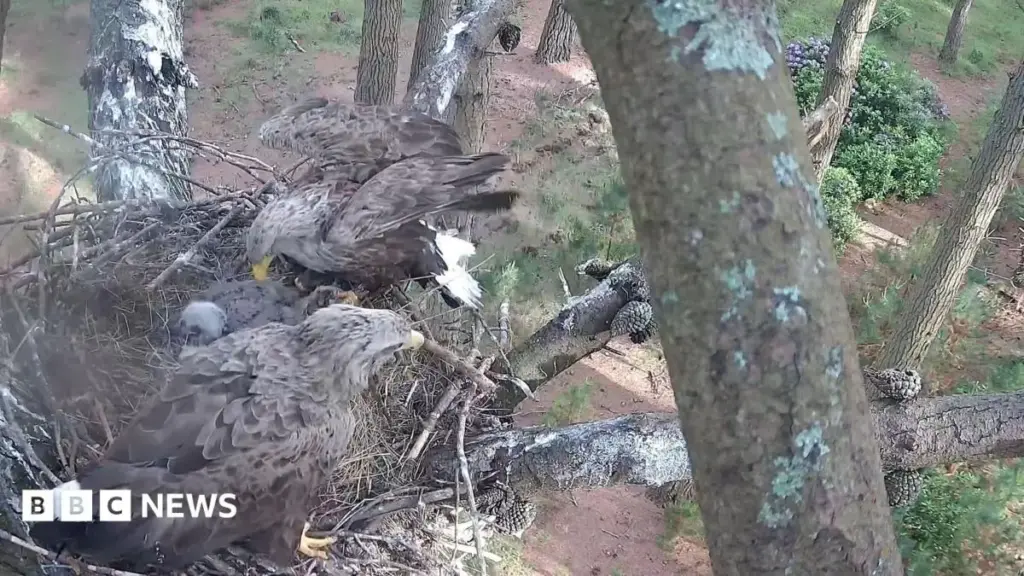
The latest breeding season saw two out of five established pairs successfully raise young. One robust chick fledged from a remote nest in Dorset, while a pair of healthy siblings emerged from a nest site in Sussex. These births are more than just a localized success; they represent a powerful validation of a meticulously planned, multi-year restoration strategy designed to reverse centuries of human-induced extinction.
The white-tailed eagle (Haliaeetus albicilla), often referred to as the "flying barn door" due to its impressive wingspan of up to 2.5 meters, was systematically hunted to extinction in England by the late 18th century, driven by relentless persecution, habitat loss, and agricultural anxieties. The last known native pair in southern England bred in 1780. Today, the steady return of these apex predators to the skies above Dorset and Sussex signals a profound cultural and ecological shift. It demonstrates that modern conservation, backed by scientific rigor and broad community engagement, can successfully heal historical scars on the landscape.
Detailed Chronology: The Journey to Recovery
The triumphant fledging of these latest chicks is the culmination of years of painstaking field operations, international cooperation, and meticulous monitoring. To understand the gravity of this milestone, one must trace the timeline of the reintroduction program from its conceptual roots to its current, expanding operational footprint.
2019–2020: Establishing the Foundation
The reintroduction project officially broke ground in 2019 when Forestry England and the Roy Dennis Wildlife Foundation began releasing young white-tailed eagles imported from Scotland—where a previous Scottish reintroduction program had already found success—into undisclosed, secure locations on the Isle of Wight. The choice of the Isle of Wight and the broader Solent region offered an ideal strategic hub, providing extensive marine and estuarine environments rich in fish and avian prey, coupled with relative isolation during the birds’ critical early adaptation period.
During these formative years, the primary objective was simple yet perilous: ensure the survival of the initial cohorts as they learned to navigate the British landscape, avoid human infrastructure, and secure sustainable food sources. Conservationists monitored the birds via satellite telemetry, tracking their wide-ranging exploratory flights across the UK.
2021–2022: The First Wild-Born Generations
The project crossed a major psychological and biological threshold in 2021 when a pair of the introduced eagles attempted to breed—and succeeded. This historic nesting event produced the first wild-born white-tailed eagle chick in southern England in over 240 years.
Subsequent years saw incremental, highly encouraging growth. By 2022 and 2023, consecutive breeding seasons confirmed that the birds were not only surviving their transition to adulthood but were actively integrating into the English ecosystem as breeding adults. Each successive year of successful fledging added critical momentum to the project, proving that the initial breeding pairs were not anomalies, but the vanguard of a self-sustaining population.
2024: Geographic Expansion and Resilience
The 2024 breeding season brought both geographic diversification and extraordinary displays of avian resilience. With nesting pairs now established across multiple counties, the production of chicks in both Dorset and Sussex highlighted the expanding territorial range of the population.
Particularly poignant was the success of a male adult bird who managed to father and help raise healthy young despite operating with only a single leg—an injury he sustained five years prior. Conservationists have lauded this feat as "remarkable," illustrating the sheer tenacity of these magnificent raptors.
Furthermore, 2024 marked a logistical evolution for the broader initiative: in partnership with the Exmoor National Park Authority, an additional six young white-tailed eagles were released at Exmoor National Park. This expansion beyond the original southern stronghold signifies a deliberate strategy to establish multiple interconnected sub-populations across England, enhancing the genetic resilience and long-term viability of the species.
Supporting Context & Metrics: Data Behind the Reintroduction
A rigorous examination of the white-tailed eagle reintroduction project reveals a comprehensive, data-driven framework designed to ensure transparency, scientific validity, and ecological safety.
Quantitative Metrics of the Program
- Total Releases to Date: 56 young white-tailed eagles have been successfully released into the wild across the course of the initiative.
- Wild-Born Success: Nine chicks have now successfully hatched and fledged in the wild since the project’s inception in 2019.
- Active Breeding Pairs: The population currently features five established pairs of breeding age, with two of these pairs successfully reproducing during the most recent cycle.
- Geographic Footprint: Core breeding activities are currently centered in southern counties including Dorset and Sussex, supported by foundational releases originating from the Isle of Wight and, as of 2024, newly established release sites in Exmoor National Park.
- Historical Context: The species suffered total extirpation in England due to targeted human persecution, culminating in the extinction of the last native southern breeding pair in 1780.
The Ecological Role of the White-Tailed Eagle
As apex predators, white-tailed eagles occupy the highest trophic level in their ecosystems. Their presence exerts a top-down influence on local biodiversity. Primarily piscivorous (fish-eating), these raptors also consume waterfowl, rabbits, and carrion. By scavenging dead animals and regulating prey populations, they contribute significantly to nutrient cycling and ecosystem health.
Moreover, the return of the white-tailed eagle serves as a powerful ecological indicator. Because these birds require large, undisturbed territories, clean waterways with abundant fish stocks, and mature woodlands for nesting, the successful establishment of wild populations testifies to the recovering health of England’s lowland aquatic and terrestrial habitats.
Official Statements and Expert Perspectives
The milestone has drawn widespread acclaim from conservation leaders, project managers, and environmental authorities, all of whom emphasize that this success is a shared triumph born of cross-sector collaboration.
Roy Dennis OBE, founder of the Roy Dennis Wildlife Foundation and a towering figure in British raptor conservation, reflected on the significance of the achievement:
"This year’s breeding success is another important milestone in the return of this lost species to England; it shows what can be achieved by very skilled wildlife managers."
Dennis also underscored the complex socioeconomic dynamics inherent in large-scale species restoration, paying tribute to the vital human element that underpins the project’s operational safety:
"Restoring a species takes many years and requires the support of a wide range of communities and organisations, in particular landowners and farmers."
Highlighting the extraordinary nature of the recent nesting cycles, representatives from the foundation pointed to the resilience of individual birds—noting specifically the adult male who successfully reared young despite navigating life with a single leg for half a decade. This testament to survival against physical odds has captured the public imagination.
Steve Egerton-Read, the white-tailed eagle project officer for Forestry England, shared his optimism regarding the future trajectory of the fledged chicks:
"We are delighted that these three chicks made it through and will be closely watching their progress as they begin to explore the landscape."
Egerton-Read and his team utilize advanced telemetry to monitor the dispersal patterns of young eagles. As these juveniles transition into independent hunters, they typically embark on extensive exploratory flights across the United Kingdom—sometimes visiting Scotland, Wales, or continental Europe—before eventually returning to southern England to establish their own territories at around four to five years of age.
Future Outlook: Challenges and Horizons Ahead
While the fourth consecutive year of successful wild fledging is a cause for celebration, project organizers and conservation scientists remain acutely aware of the challenges that lie ahead. Restoring a long-lived, wide-ranging apex predator to a densely populated modern landscape requires constant vigilance, adaptive management, and sustained public engagement.
Mitigating Human-Wildlife Conflict
The historical extinction of the white-tailed eagle was driven by direct human persecution, rooted in fears over livestock predation and game management. Modern conservationists have made stakeholder engagement a foundational pillar of the reintroduction strategy. Forestry England and the Roy Dennis Wildlife Foundation work closely with local farmers, landowners, and rural communities to address concerns transparently.
While white-tailed eagles primarily feed on fish and waterbirds, they occasionally scavenge mammalian carrion or take lambs under specific circumstances. Ongoing education programs, rapid-response communication channels, and proactive habitat management are crucial in ensuring that rural communities feel supported and informed, thereby safeguarding the eagles from illegal poisoning, shooting, or nest disturbance.
Genetic Diversity and Population Viability
In the coming decades, ensuring the long-term genetic health of England’s white-tailed eagle population will be paramount. With 56 birds released and a growing cohort of wild-born chicks, the genetic base is steadily broadening. However, maintaining connectivity between the southern English population, Scottish reintroduction populations, and continental European populations will help prevent inbreeding depression and secure a resilient, self-sustaining metapopulation across the British Isles.
Expanding Horizons: Exmoor and Beyond
The integration of Exmoor National Park into the release program in 2024 represents a strategic blueprint for the future. By establishing new coastal and upland release hubs, conservationists are encouraging a dispersed, resilient distribution of eagles rather than concentrating them in a single vulnerable zone.
As these magnificent birds continue to reclaim their ancestral domains, their presence will increasingly enrich the British countryside. For birdwatchers, conservationists, and rural communities alike, the sight of a white-tailed eagle soaring over the English channel, the rolling hills of Dorset, or the expansive vistas of Exmoor is no longer a ghost of the 18th century, but a living, breathing reality of modern ecological restoration.



