By Trellis Expert Contributors
Special Report / Sustainability & Technology
Executive Overview
Over the past decade, the global corporate sustainability ecosystem has achieved a high degree of sophistication. We have constructed an intricate architecture of climate targets, net-zero roadmaps, granular carbon accounting frameworks, and disclosure mandates designed to scrutinize climate delivery far more effectively than ever before.
Yet, a glaring contradiction sits at the heart of this architecture: it scrutinizes climate delivery far more effectively than it enables it.
The explosive rise of artificial intelligence has laid bare this structural flaw in dramatic fashion. Across the technology sector, major hyperscalers like Amazon, Google, and Microsoft have reported rising electricity-related emissions, even as they aggressively invest in clean energy and reaffirm their long-term climate commitments. The market is increasingly forced to ask an existential question: Can corporate climate commitments survive the AI boom?
Look more broadly across sectors, and an even more fundamental systemic dilemma emerges: What happens when every company faces the exact same foundational constraints—such as grid congestion, power scarcity, or capital deployment bottlenecks—and is left to solve them entirely on their own?
This report examines how the frantic dash for AI infrastructure is exposing the painful costs of fragmented corporate execution. It explores why current sustainability standards, which evaluate what happens inside individual organizations, are fundamentally misaligned with constraints that sit entirely outside them. Finally, it outlines a path forward for corporate leaders to transition from isolated competition over scarce resources to building shared execution capacity.
Detailed Chronology: The Collision of AI Demand and Climate Targets
To understand how the corporate world reached this inflection point, it is necessary to trace the convergence of the digital revolution and the decarbonization movement over the past fifteen years.

Phase 1: The Era of Voluntary Commitments (2010–2018)
During the early 2010s, corporate sustainability was defined largely by voluntary commitments. Corporations began setting ambitious, long-term carbon reduction targets, often looking toward 2030, 2040, or 2050 horizons. Sustainability reporting was nascent, and organizations were evaluated primarily on their stated ambition and high-level strategy. During this period, emissions footprints were relatively stable, and enterprise workloads scaled predictably alongside incremental improvements in data center energy efficiency.
Phase 2: The Scrutiny and Disclosure Boom (2019–2023)
As public concern over climate change intensified, stakeholders—including investors, regulators, and civil society—grew impatient with vague promises. The sustainability ecosystem pivoted aggressively toward accountability. Standards bodies (such as the Science Based Targets initiative and the GHG Protocol) standardized greenhouse gas accounting, forcing companies to calculate Scope 1, 2, and 3 emissions with rigorous detail.
The implicit theory of change during this era was straightforward: if you measure emissions transparently and hold individual companies strictly accountable for their reduction targets, market forces will naturally compel those organizations to decarbonize their operations.
Phase 3: The Generative AI Inflection Point (2023–Present)
The sudden, exponential growth of generative artificial intelligence shattered this tidy model. Training and operating massive large language models requires computational power on an unprecedented scale. Data centers transformed from modest facilities into massive industrial energy consumers demanding gigawatt-scale power supplies.
Demand for electricity began growing far faster than local grids or renewable energy pipelines could expand. Faced with commercial imperatives to win the AI race, hyperscalers were forced to secure power and grid access individually. In many instances, this meant turning to fossil-fuel-fired generation to bridge immediate power gaps. Power abruptly shifted from being a background operational input to becoming a hyper-competitive battleground in its own right.
Supporting Context & Metrics: The Anatomy of a Systemic Bottleneck
The AI boom acts as an extreme manifestation of a broader, systemic issue: the mismatch between internal accountability and external constraints.
When critical enabling infrastructure—such as clean power generation, transmission lines, and skilled supply chains—is scarce, firms inevitably begin competing for the conditions that the market depends upon. This is entirely rational commercial behavior for any individual enterprise, but it makes collective climate action exceedingly difficult.
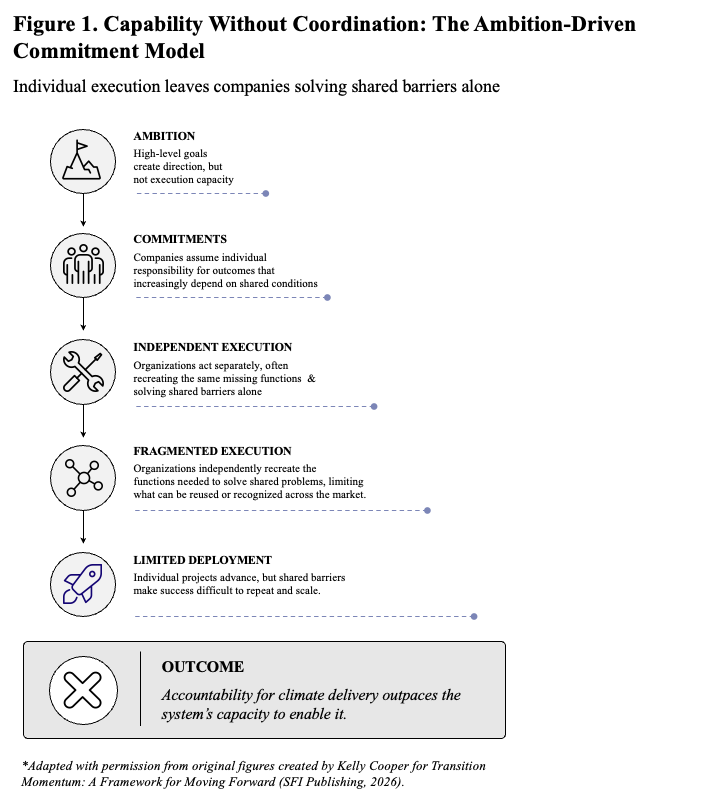
[Traditional Sustainability Model]
Individual Company Sets Target -> Measures Scope 1/2/3 -> Evaluated Internally
                                      ^
                                      | (Fails when constraints sit outside)
                                      v
[The Reality of Systemic Constraints (e.g., AI Power Demand)]
Grid Bottlenecks / Power Scarcity -> Companies Compete Individually -> Fossil Fuels Utilized -> Emissions Rise
The Cost of Fragmentation
Our research involving more than 200 practitioners across the climate deployment space reveals that AI simply accelerates a pattern seen across the entire sustainability landscape:
- Disconnected Demand and Capital: Massive pools of capital exist, yet they struggle to find deployable, de-risked projects at scale.
- Duplicated Effort: Organizations repeatedly reinvent the wheel on technical diligence, legal standards, and validation processes.
- Misallocated Risk: Risks frequently sit where individual corporate actors are simply unequipped to absorb them.
- Informal Workarounds: When durable execution infrastructure is missing, companies resort to fragmented, bespoke workarounds.
When markets are forced to rely on fragmented execution, the macro-level costs accumulate rapidly:
- Stalled Deployment: Projects move slowly through bureaucratic and regulatory mazes.
- Capital Waste: Billions of dollars are squandered on duplicated efforts and administrative overhead.
- Delayed Emissions Reductions: Climate progress stalls not due to a lack of ambition or capital, but due to a lack of coordinated execution capacity.
- Reputational and Political Vulnerability: Persistent gaps between corporate net-zero promises and rising actual emissions expose companies to accusations of greenwashing and political backlash.
Official Perspectives and Market Responses
Industry leaders and policy analysts are increasingly recognizing that internal carbon accounting alone cannot overcome macro-level infrastructure shortages.
"We have built a sustainability ecosystem that scrutinizes climate delivery far more effectively than it enables it," note sustainability analysts tracking the tech sector. "More internal effort cannot solve a systemwide limitation."
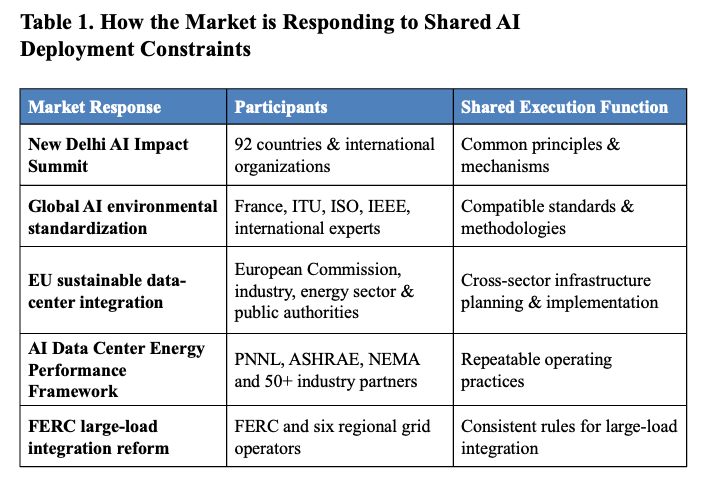
In response to the power crunch driven by AI, early models of cross-sector collaboration are beginning to take shape. Governments, regulatory bodies, infrastructure operators, and technology firms are slowly initiating common rules, repeatable practices, and coordinated approaches to shared energy constraints.
For instance, several major technology corporations have begun collaborating directly with utility providers and nuclear energy operators to fund long-term grid modernization and clean energy procurement structures that benefit broader regional grids rather than merely securing private off-grid fossil fuel contracts. This shift underscores a vital commercial lesson: competing more effectively over a shared constraint does not remove it; building shared deployment capacity does.
Future Outlook: Building the Other Half of the System
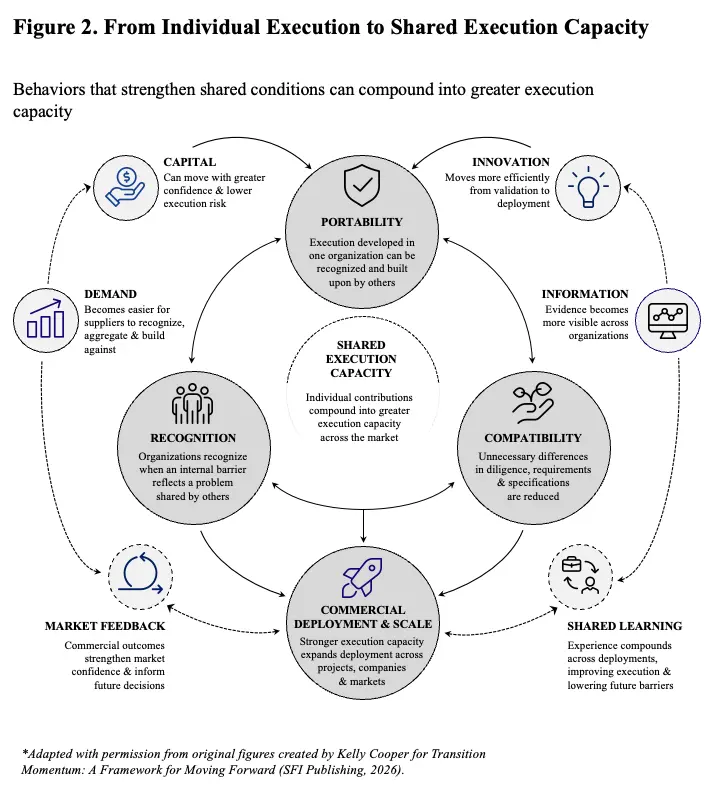
The sustainability ecosystem spent the past decade successfully building the architecture for corporate commitments, disclosures, and accountability. The next decade demands a fundamental pivot. The challenge is no longer about setting loftier ambitions or devising more complex measurement tools; it is about building the other half of the system—the shared infrastructure required to execute those ambitions.
Practical Steps for Practitioners
Corporate sustainability leaders, procurement managers, and executives cannot unilaterally fix national power grids, restructure global capital markets, or dictate how tech giants compete. However, they can fundamentally alter whether the execution inside their organizations adds to system-wide fragmentation or helps shared solutions emerge.
Practitioners can implement four strategic shifts starting from where they sit:
1. Define the Shared Problem
- The Question to Ask: Are we solving something unique to our business, or are we merely rebuilding a function the market is missing?
- The Action: Look for workarounds shared across your suppliers, technology providers, financiers, and customers. Identify where industry-wide bottlenecks are forcing redundant internal efforts.
2. Stop Adding Unnecessary Fragmentation
- The Question to Ask: What do we require to be different that doesn’t actually create distinctive commercial value or reduce material risk?
- The Action: Challenge bespoke diligence processes, customized technical specifications, and proprietary reporting requirements when credible, standardized alternatives already exist in the market.
3. Choose Solutions That Strengthen the System
- The Question to Ask: Will our chosen solution only get our company across the finish line, or will it make the next deployment easier for others?
- The Action: Favor technological, financial, and operational approaches that create public goods or standardized frameworks that others can recognize, adopt, and build upon.
4. Make Execution Carry Across Organizational Boundaries
- The Question to Ask: What are we doing internally that another credible actor could recognize, accept, or utilize rather than recreate from scratch?
- The Action: Begin by harmonizing a single diligence process, technical specification, industry standard, or shared demand signal with sector peers.
Conclusion
The AI boom has served as a stress test for modern corporate sustainability, exposing the severe limitations of an accountability model that holds individual companies responsible for macroeconomic and infrastructure-level challenges.
When shared constraints stand directly in the path of immense commercial opportunity—as seen in the race for clean energy to power artificial intelligence—markets quickly discover the immense economic value of removing those barriers collectively.
The ultimate question for corporate leaders and policymakers is profound: If commercial urgency can mobilize markets to build shared execution capacity around artificial intelligence, what will create comparable incentives to build the collaborative deployment capacity required to solve the broader climate crisis?
Answering that question requires moving beyond the era of isolated corporate commitments. It requires designing an ecosystem where cooperation is economically rational, fragmentation is actively dismantled, and the infrastructure for delivery is built together.