

Rare books possess a unique capacity to bridge the chasms of centuries, linking the meticulous intellects of Enlightenment-era scholars with the high-tech digital preservation efforts of the modern scientific community. In celebration of its 20th anniversary, the Biodiversity Heritage Library (BHL) has highlighted a remarkable acquisition by the Field Museum’s Marie Louise Rosenthal Library: a foundational, three-volume masterpiece of biogeography, Geographische Geschichte des Menschen, und der allgemein verbreiteten vierfüßigen Thiere, nebst einer hieher gehörigen Zoologischen Weltcharte. Published between 1778 and 1783 by the German geographer, zoologist, and mathematician Eberhard August Wilhelm von Zimmermann, this rare text—alongside its fold-out zoological world map—represents a monumental leap forward in humanity’s understanding of global mammalian distribution.
Yet, the significance of this acquisition extends far beyond its historical weight or visual splendor. The journey of Zimmermann’s work through the annals of science offers a captivating narrative of institutional collaboration, taxonomic evolution, and regulatory dispute. The text’s validation hinged on a 1954 ruling by the International Commission on Zoological Nomenclature (ICZN), a decision directly shaped by the advocacy of Field Museum scientists Wilfred H. Osgood and Philip Hershkovitz. Today, thanks to a coordinated preservation effort, both Zimmermann’s rejected 1777 Latin prototype (Specimen zoologiae geographicae) and his officially sanctioned 1778–1783 German revision are fully digitized and globally accessible via the BHL. This article explores the rich convergence of historical zoology, taxonomic bureaucracy, and digital archiving that defines this extraordinary chapter in natural history.
Detailed Chronology: The Evolution of Zimmermann’s Zoogeography
To appreciate the gravity of Zimmermann’s contributions, one must trace the historical trajectory that transformed 18th-century natural history from a descriptive catalog of curiosities into a rigorous, spatial science.
The 1777 Latin Prototype and Its Shortcomings
In 1777, Eberhard August Wilhelm von Zimmermann published Specimen zoologiae geographicae, quadrupedum domicilia et migrationes sistens in Latin. While ambitious in scope, aiming to map the domestic habitats and migration routes of quadrupeds, the volume suffered from a critical methodological flaw under modern standards of taxonomy: it failed to consistently apply binomial nomenclature—the two-part naming system established by Carl Linnaeus. Instead of relying exclusively on standardized genus-species epithets, Zimmermann frequently deployed a fluid mix of generic descriptors, polynomials, and vernacular terms.
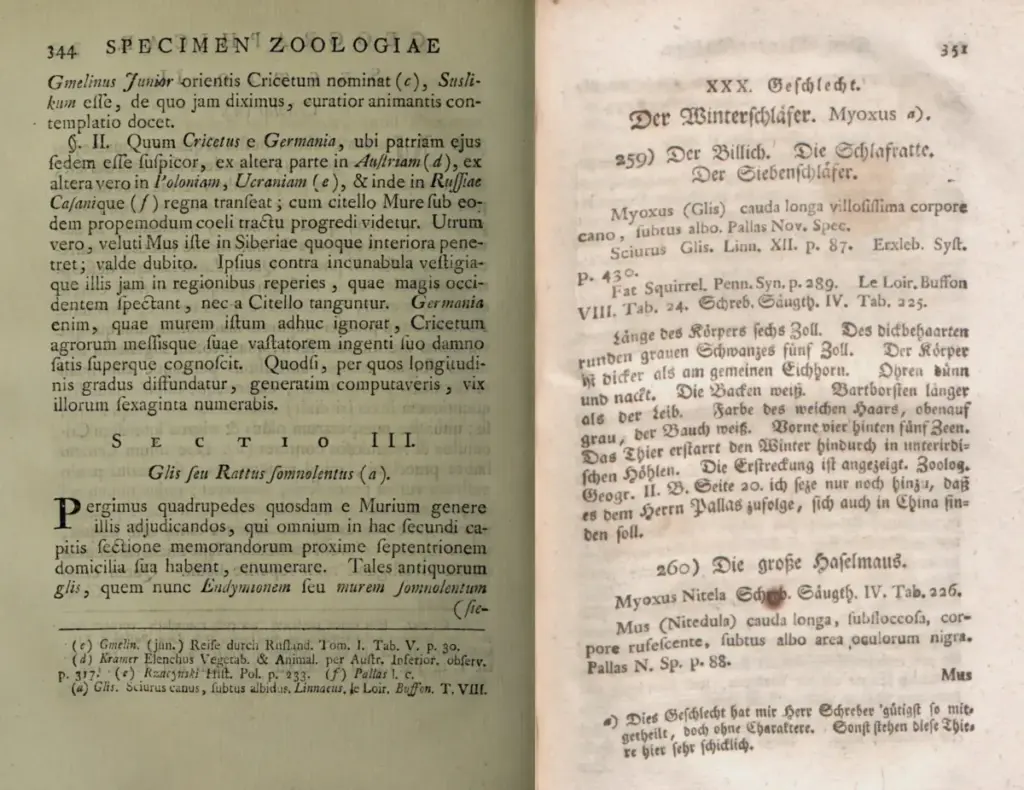
For example, when describing a species of dormouse in the 1777 edition, he labeled it Glis seu Rattus somnolentus. Such non-standard designations created severe ambiguities for later taxonomists trying to establish priority of species names. Consequently, when the rules of modern zoological nomenclature were formalized, this early work fell short of regulatory thresholds, setting the stage for a dramatic administrative reckoning nearly two centuries later.
The 1778–1783 German Revision and the Birth of Modern Binomials Recognizing the limitations of his earlier Latin text, Zimmermann significantly revised, expanded, and updated his thesis in a three-volume German work published between 1778 and 1783: Geographische Geschichte des Menschen, und der allgemein verbreiteten vierfüßigen Thiere, nebst einer hieher gehörigen Zoologischen Weltcharte.
In this comprehensive opus, Zimmermann rigorously adopted binomial nomenclature, establishing a standardized taxonomy that remains legally and scientifically valid today. Several prominent binomial names still attributed to Zimmermann debuted in these pages, including:

- Cervus muntjak (the muntjac deer)
- Lutra minima (now recognized as Chironectes minimus, the water opossum)
- Canis zerda (now recognized as Vulpes zerda, the fennec fox)
Furthermore, the transition from the 1777 text to the 1778–1783 volumes can be vividly observed in shifts like his reclassification of the dormouse. Where the 1777 edition used Glis seu Rattus somnolentus, the 1780 volume (Volume 2) utilized the binomial Myoxus glis—paving the way for the species’ modern designation as Glis glis.
The Cartographic Breakthrough: Tabula Mundi Geographico Zoologica
Accompanying the Geographische Geschichte was a folding map of extraordinary historical importance: the Tabula Mundi Geographico Zoologica sistens Quadrupedes hucusque notos sedibus suis adscriptos. Widely celebrated as the first true world map of zoological geography, the map visually integrated the spatial distribution of mammals with contemporary global cartography.
Crucially, the 1783 iteration of the map incorporated groundbreaking geographical data from late-18th-century maritime explorations, most notably the voyages of Captain James Cook and his crew aboard the HMS Endeavour. The map reflects:
- The European "discovery" of the Sandwich Islands (Hawaii).
- A vastly improved, more accurate rendering of the western coastline of North America.
- The inclusion of the Seychelles east of mainland Africa, just over a decade after French colonial settlement began there.
On this map, quadrupeds are plotted directly over their respective geographic ranges using a mix of genera, specific epithets, common names, and full binominals. Readers can locate the Castor (beaver) and Bison across northern North America, the Tigris (tiger) spanning Asia, and the Kanguro (kangaroo) marking its presence in New Holland (Australia)—the latter animal having been newly introduced to European science by botanist Daniel Solander during Cook’s voyage.
Supporting Context & Metrics: Navigating the Digital and Physical Archives
The inclusion of these texts within modern research infrastructures like the Biodiversity Heritage Library relies on rigorous evaluation protocols practiced by rare book curators and digital archivists.
Institutional Collection Criteria
When staff at the Field Museum’s Marie Louise Rosenthal Library consider acquiring a rare title, they subject candidates to a stringent multi-variable matrix:

- Scope Alignment: Does the work fall squarely within natural history and zoological literature?
- Historical & Scientific Value: Does it introduce paradigm shifts, foundational data, or rare first descriptions?
- Institutional Rarity: How many global institutions hold physical copies of the work?
- Digital Redundancy: Is a high-quality digital surrogate already accessible via open-access repositories like the BHL?
When evaluated against this matrix, Zimmermann’s 1778–1783 German opus emerged as a prime candidate. It was historically pivotal for mammalian biogeography, exceedingly scarce in institutional collections, and entirely absent in digitized format from the BHL prior to recent efforts.
The BHL at 20 Impact Metrics
As the Biodiversity Heritage Library marks its 20th anniversary, its role as the world’s largest open-access digital repository for biodiversity literature cannot be overstated. By rescuing works from physical obscurity, BHL enables:
- Global Access: Researchers in remote academic hubs can inspect 18th-century type specimens and cartography without handling fragile paper.
- Cross-Disciplinary Discovery: Historians of science, cartographers, and modern mammalogists can trace the lineage of taxonomic names instantly.
- Permanent Archival Integrity: Pairing rejected foundational texts (like the 1777 Specimen) with accepted revisions (the 1778–1783 Geographische Geschichte) creates an unbroken audit trail of scientific thought.
Official Statements and Institutional Rulings
The path to securing Zimmermann’s German edition in the modern zoological canon was smoothed by mid-20th-century administrative interventions that underscore the tight-knit global community of museum scientists.
ICZN Opinion 257 (1954)
In 1954, the International Commission on Zoological Nomenclature formally addressed the status of Zimmermann’s early works. Through Opinion 257, published in Opinions and Declarations Rendered by the International Commission on Zoological Nomenclature, the Commission delivered a decisive ruling:
- The 1777 Latin Edition: Rejected for "nomenclatorial purposes" because it failed to satisfy Article 25 of the Règles internationales de la nomenclature zoologique (the predecessor to today’s International Code of Zoological Nomenclature). It was formally placed on the Official Index of Rejected and Invalid Works in Zoological Nomenclature.
- The 1778–1783 German Edition: Affirmed and validated because it consistently applied binomial nomenclature. It was placed on the Official List of Works Approved as Available for Zoological Nomenclature.
The Field Museum’s Direct Advocacy
Remarkably, this sweeping international ruling was heavily influenced by experts at the Field Museum of Natural History in Chicago. Archival records housed within the ICZN’s published case statements reveal that Opinion 257 stemmed largely from direct correspondence between:
- Francis Hemming, Secretary of the ICZN.
- Wilfred H. Osgood, a prominent mammalogist and leader at the Field Museum, who vigorously advocated for the formal recognition and availability of Zimmermann’s Geographische Geschichte.
- Philip Hershkovitz, then Curator of Mammals at the Field Museum, who stepped in to consult and support Osgood’s evidentiary position.
Through this transatlantic lobbying, Field Museum scientists ensured that the correct historical work was cemented into the bedrock of modern zoological law, protecting countless mammal species names from prospective taxonomic instability.

Future Outlook: The Living Legacy of 18th-Century Science
The successful acquisition and digitization of Eberhard August Wilhelm von Zimmermann’s Geographische Geschichte des Menschen, und der allgemein verbreiteten vierfüßigen Thiere—now permanently archived and accessible on the Biodiversity Heritage Library—serves as a powerful reminder of how historical scholarship continuously evolves.
In an era dominated by rapid computational genomics and satellite telemetry, it is easy to overlook the physical paper maps and hand-typeset Latin descriptions that birthed modern ecology and biogeography. Yet, as demonstrated by the 1954 ICZN ruling and the ongoing rediscovery of rare texts, an 18th-century publication never truly ceases to exist within the scientific record. Instead, it remains a living document, subject to reevaluation, digital enrichment, and renewed appreciation by future generations of scientists.
By supporting institutions like the Field Museum and digital preservation initiatives like the BHL, the global community ensures that these foundational treasures remain open, connected, and ready to inspire the next wave of discoveries across the natural world.



