

Executive Overview
VALENCIA, Spain — In a landmark ruling that reverberates across the European legal and environmental landscape, a court in Valencia has fully acquitted 11 Greenpeace activists who faced severe criminal charges over a peaceful 2021 protest. The defendants had been accused of "aggravated public disorder" for boarding a ship and temporarily blocking a fossil gas shipment at the Port of Sagunto. The case drew intense international scrutiny after the Public Prosecutor’s Office initially sought a staggering five-year prison sentence for each individual—a demand widely condemned as one of the most punitive measures ever pursued in Europe against non-violent climate protesters.
Although the prosecution reduced its demand to two and a half years as the trial progressed, today’s judgment completely rejected the state’s core allegations. The presiding court found that the prosecution utterly failed to substantiate claims that the activists engaged in violence, intimidation, or any actions capable of disrupting the public peace.
While environmental organizations have celebrated the ruling as a resounding victory for freedom of expression and the right to peaceful assembly, human rights advocates and legal experts emphasize that the outcome does little to erase the psychological toll, mounting legal fees, and severe disruptions forced upon the defendants over years of litigation. The case has crystallized a growing global debate: Are modern legal systems increasingly being weaponized by state and corporate interests to suppress civic dissent and criminalize urgent climate activism? With UN Special Rapporters monitoring the proceedings and international observers raising alarms about shrinking civic spaces, the Sagunto ruling serves as both a shield for civil liberties and a sobering warning about the escalating friction between state authorities and environmental defenders.
Detailed Chronology: The Sagunto Action and Its Legal Aftermath
October 2021: The Protest at the Port of Sagunto
The genesis of this high-stakes legal battle dates back to October 2021. Amid mounting warnings from scientists regarding Europe’s dangerous addiction to fossil fuels, Greenpeace Spain orchestrated a direct-action protest to spotlight the continent’s vulnerability to foreign energy imports.
Operating from the environmental flagship vessel MY Esperanza, a multinational coalition of 11 Greenpeace activists—representing 18 different nationalities—intercepted a commercial tanker carrying liquefied natural gas (LNG) originating from the United States. Deploying themselves strategically, the activists successfully blocked the vessel from docking at the Port of Sagunto for roughly 12 hours.
Throughout the 12-hour blockade, the demonstration was executed with meticulous regard for safety and transparency. Activists maintained open, respectful communication lines with maritime and port authorities, ensuring that the peaceful nature of the protest remained uncompromised. No individuals were injured, no public or private property was damaged, and overall maritime traffic within the port suffered no catastrophic or unsafe disruptions. Despite the peaceful execution of the protest, the Spanish government moved swiftly to penalize the organization, issuing administrative fines totaling €160,000—penalties that remain under active legal appeal.
The Escalation: From Direct Action to the Criminal Docket
What typically might have resulted in administrative citations or minor trespassing charges rapidly escalated into a high-profile criminal prosecution. The Public Prosecutor’s Office elected to pursue charges of aggravated public disorder, leveling accusations so severe they carried a potential five-year prison sentence per individual.
For the environmental community, this move signaled a deeply concerning escalation in how European states treat civil disobedience. Legal scholars and human rights defenders noted that a five-year prison term was historically reserved for violent criminals, making the state’s posture toward non-violent climate activists unprecedentedly harsh.
The Trial and Judicial Scrutiny
During the courtroom proceedings, testimonies from a diverse array of witnesses—including law enforcement officers, maritime authority officials, and independent journalists—consistently corroborated the defense’s position. Every official body confirmed that the 2021 action was strictly non-violent, posed zero threat to human life or property safety, and remained orderly throughout.
The sheer disproportion of the state’s demands did not go unnoticed globally. The trial attracted high-level attention from international watchdogs, most notably United Nations Special Rapporteurs, who attended the courtroom sessions as official observers to monitor the health of democratic freedoms in Spain.
The Acquittal
In its final judgment, the Valencia court delivered a decisive verdict: all 11 activists were acquitted of all criminal charges. The court ruled definitively that the prosecution could not demonstrate that the peaceful blockade met the legal thresholds for aggravated public disorder, establishing that the demonstration lacked any element of violence or intimidation capable of genuinely altering the public peace.
Supporting Context & Metrics: The Global War on Civic Space
To fully understand the significance of the Sagunto acquittal, one must examine the broader socioeconomic and geopolitical context in which it occurred. The protest took place against the backdrop of Europe’s historical reliance on fossil gas—a vulnerability brutally exposed months later by geopolitical shifts in Eastern Europe. The activists’ core message in 2021 was simple: locking European energy infrastructure into long-term fossil gas dependencies threatens not only the global climate stability but also regional energy security.
However, the legal onslaught against the Sagunto 11 is not an isolated incident. Across the globe, environmental defenders face an increasingly hostile legislative and judicial environment. According to human rights organizations and environmental legal defense groups, democratic nations are increasingly deploying "lawfare"—the misuse of legal systems, restrictive assembly laws, and exorbitant punitive fines—to drain the resources of grassroots movements and neutralize climate activism.
- The Financial and Emotional Toll: While the 11 activists walked away free of criminal records, the institutional friction caused by the trial is profound. Years of legal anxiety, thousands of euros in preparatory expenses, and the constant threat of a multi-year prison sentence create what legal experts term a "chilling effect." This phenomenon deters ordinary citizens from stepping forward to exercise their constitutional rights to protest, knowing that even if they are ultimately vindicated by a court, the journey itself is designed to exhaust them.
- Administrative Retaliation: Beyond the criminal trial, the Spanish state has pursued heavy administrative penalties, including the aforementioned €160,000 in fines currently winding their way through the appeals process. This dual-track prosecution—combining heavy-handed criminal charges with crippling financial penalties—exemplifies the systemic pressure facing modern ecological movements.
- International Alarm: The participation of UN Rapporteurs underscores that the trial in Valencia was viewed globally as a test case for European adherence to international human rights standards concerning freedom of expression and peaceful assembly.
Official Statements and Expert Perspectives
The verdict has elicited strong reactions from legal minds, human rights advocates, and environmental leaders worldwide.
Greenpeace International
Daniel Simons, Senior Legal Counsel for Strategic Defence at Greenpeace International, framed the ruling as both a triumph and a cautionary tale:
"This is a win for freedom of expression, and a rebuke to the attempt to repress peaceful climate activism. But an acquittal does not erase the years of anxiety, legal costs, and disruption to activists’ lives. This charge never should have been brought in the first place. The only threat to public order here was Europe’s continued reliance on fossil gas imports. We hope the prosecution does not appeal, and turns its attention towards those endangering, not defending life on this planet."
United Nations Human Rights Experts
Highlighting the systemic implications of the case, Gina Romero, United Nations Special Rapporteur on the Rights to Freedom of Peaceful Assembly and of Association, issued a stark warning regarding the global erosion of civic freedoms:
"The Sagunto case demonstrates how easily the legal system can be used to deter people from exercising a fundamental right, even when the law agrees in the end they did nothing wrong. It’s part of a broader, global pattern of using the legal system, criminal charges, punitive fines, and restrictive laws to shrink civic space. I will continue to raise the alarm and raise my voice to ensure that peaceful protest is not treated as a crime — in Spain or anywhere else."
Legal Defense
Jose Manuel Marraco, the veteran Spanish attorney who has defended Greenpeace activists for 35 years, reflected on the moral and systemic dimensions of the case:
"I have been defending Greenpeace activists for 35 years, and it is an honour to do so. When people put themselves on the line to protect our planet, it is a generous act, not a criminal offence. The State should avoid the chilling effect that criminalisation and long-running proceedings have."
Public Mobilization
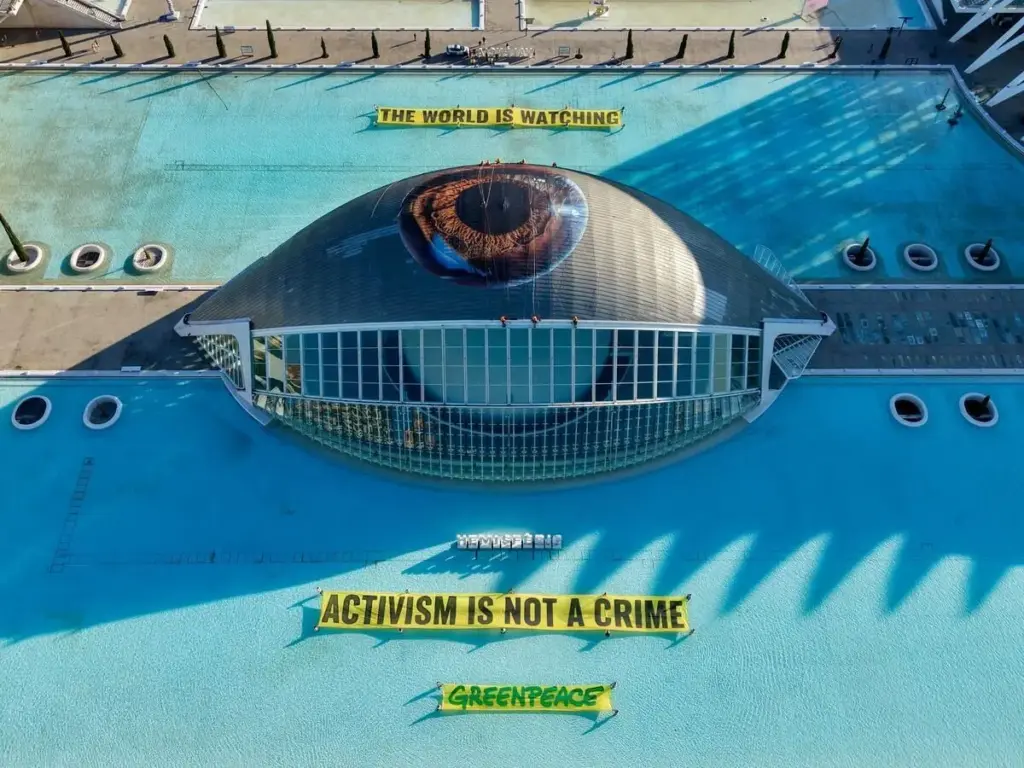
In the days leading up to the verdict, Greenpeace Spain orchestrated a high-visibility public awareness campaign to draw attention to the stakes of the trial. Activists unveiled a massive, 530-square-meter art installation shaped like a giant human eye on the roof of Valencia’s iconic Hemisfèric building. Accompanied by stark banners declaring "The world is watching" and "Activism is not a crime," the installation served as a visual anchor for national and international solidarity with the Sagunto defendants.
Future Outlook: What the Ruling Means for Climate Activism
As the legal dust settles in Valencia, civil rights organizations and environmental advocates are assessing the long-term ramifications of the court’s decision.
- A Precedent for Future Protests: The Valencia court’s clear distinction between disruptive direct action and actual violent public disorder provides a vital judicial precedent. It reaffirms that peaceful civil disobedience—even when inconvenient to corporate and state operations—retains constitutional protections within democratic frameworks.
- The Threat of Prosecution Appeals: While the immediate criminal threat has evaporated, legal teams remain vigilant regarding whether the Public Prosecutor’s Office will attempt to appeal the verdict to higher courts. An appeal would prolong the legal limbo, intensifying the aforementioned chilling effect.
- Escalation of Ecological Direct Action: Paradoxically, rather than dampening the spirit of environmental movements, heavy-handed state crackdowns frequently catalyze broader public engagement. As climate impacts accelerate globally—manifesting in extreme weather, ecosystem collapses, and delayed political transitions—grassroots organizations show no signs of backing down.
Ultimately, the Sagunto case stands as a watershed moment for European jurisprudence. It underscores the vital tension of our era: a judicial system straining to balance the protection of corporate commerce and public order against the moral imperative of citizens demanding a habitable planet. For now, the 11 activists of Sagunto are vindicated, but the broader war over the boundaries of climate protest is far from over.



