By Jim Giles
Published by Trellis Group
Executive Overview
The landscape of corporate governance and environmental advocacy is undergoing a profound and accelerating shift. According to comprehensive new data released by the business think tank The Conference Board, shareholder resolutions targeting environmental issues have experienced a precipitous decline through the first half of 2026. This downward trajectory highlights a cooling enthusiasm—or perhaps a strategic recalibration—among institutional investors, activist shareholders, and retail investors alike when it comes to leveraging the proxy process to force corporate climate action.
Most notably, the data reveals that it has now been a full two years since a majority of shareholders at a major U.S. corporation voted in favor of an environmental resolution. This milestone underscores a stark reality: boardroom battles over climate change, greenhouse gas (GHG) emissions disclosures, and ecological stewardship are increasingly ending in defeat for proponents, or worse, failing to make it onto proxy ballots altogether.
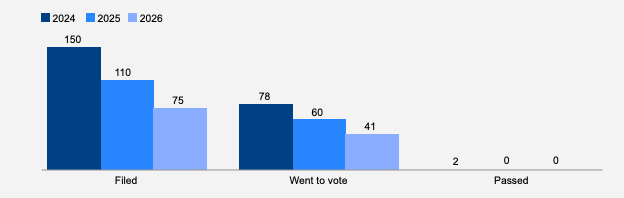
The numbers themselves tell a compelling story of retreat. During the first six months of 2026—the critical window in which the vast majority of large U.S. companies hold their annual general meetings and field proxy votes—shareholders at Russell 3000 companies filed just 75 environmental proposals. To put this figure in perspective, it represents exactly half of the 150 environmental proposals filed over the same period in 2025, and an even steeper drop from prior years.
This contraction is not occurring in a vacuum. It mirrors a broader cooling across all categories of environmental, social, and governance (ESG) shareholder proposals, though the drop in environmental metrics has outpaced the general market trend. As the pressure from shareholder resolutions evaporates, corporations—particularly those that have historically lagged in their sustainability transitions—are finding themselves with significantly more leeway to slow-walk or altogether abandon proactive environmental targets.
This in-depth report examines the mechanics behind the 2026 proxy season, analyzes the broader quantitative trends identified by The Conference Board and its research partners, explores the real-world consequences of lost accountability mechanisms, and assesses what this chilling effect means for the future of corporate sustainability.
Detailed Chronology: The Road to the 2026 Proxy Slump
To understand how the corporate proxy landscape arrived at this juncture, it is necessary to examine the trajectory of shareholder activism over the past several cycles. The years leading up to 2024 represented a high-water mark for environmental shareholder proposals, driven by mounting public pressure, regulatory signaling from bodies like the Securities and Exchange Commission (SEC), and an influx of capital into sustainable investment funds.
The 2024 Apex and the Power of Precedent
During the 2024 proxy season, environmental resolutions were a dominant fixture at annual general meetings. Investors armed with trillions of dollars in assets under management (AUM) utilized the shareholder resolution mechanism not merely to signal discontent, but to structurally alter corporate behavior.
A prime example of this mechanism’s efficacy occurred in 2024, when a targeted environmental proposal successfully passed at fast-food giant Jack in the Box. The resolution compelled the corporation to establish its inaugural, formalized targets for greenhouse gas emission reductions. Prior to the resolution, the company had lacked concrete, time-bound climate commitments. The 2024 vote served as a proof-of-concept for climate activists: a reminder that filing, lobbying for, and winning a proxy vote could directly rewrite a major corporation’s operational blueprint.
However, victories of this magnitude have become vanishingly rare. The last time a majority of shareholders at a large U.S. enterprise successfully voted to approve an environmental resolution was in mid-2024. Since then, the pendulum has swung decisively back toward corporate management and institutional investors wary of regulatory backlash, litigation, and perceived overreach.
The 2025 Correction
By the spring of 2025, the cracks in the environmental shareholder movement were beginning to show. While institutional heavyweights like BlackRock, Vanguard, and State Street had previously signaled sympathy—if not outright support—for climate-related disclosures, macroeconomic headwinds, shifting political winds, and concerted anti-ESG campaigns began to alter their voting behavior.
During the first half of 2025, environmental filings at Russell 3000 companies dropped noticeably from 2024 levels, settling at 150 proposals. Corporations responded by engaging more aggressively with proponents, often offering watered-down compromises or voluntary disclosures to convince activists to withdraw resolutions before they ever reached a floor vote.
The 2026 Precipice
The first half of 2026 has brought this contraction into sharp focus. With only 75 environmental proposals filed across the Russell 3000 index, the volume has been halved in a single year. This decline reflects a strategic retreat by major institutional proponents who recognize that the current voting environment is overwhelmingly hostile to environmental mandates. With proxy advisory firms like Institutional Shareholder Services (ISS) and Glass Lewis facing intense scrutiny over their historical stances on ESG, and with corporate boards emboldened by legal challenges to mandatory climate disclosures, filing a resolution has increasingly come to be seen as a low-yield endeavor.
Supporting Context & Metrics: Analyzing the Data
The findings on environmental proposals are drawn from an extensive joint research initiative conducted by The Conference Board, in collaboration with data provider ESGAUGE, leadership advisory firm Russell Reynolds Associates, and the Rutgers Center for Corporate Law and Governance. Their aggregate analysis of the 2026 proxy season paints a comprehensive picture of shifting corporate governance dynamics.
Overall Shareholder Proposal Trends
While environmental resolutions experienced a 50% year-over-year decline in the first half of 2026, the broader market for shareholder proposals also contracted, albeit at a slower rate.
- Total Shareholder Proposals (2024): 923 proposals filed across tracked indices.
- Total Shareholder Proposals (2026): 622 proposals filed.
- Percentage Decrease: A drop of approximately 32.6% over a two-year span.
This data indicates that while the overall appetite for shareholder activism is waning due to governance fatigue, legal friction, and changing boardroom dynamics, the retreat from environmental proposals is significantly more acute than the general market trend. Environmental resolutions are falling off the docket faster than governance or social proposals, signaling a targeted deprioritization of climate and ecological concerns by the investor class.
The Anti-ESG Counter-Movement: All Bark, Little Bite
A critical narrative within the broader proxy landscape over the last three years has been the rise of anti-ESG shareholder activism. Political pressure from conservative state treasurers, advocacy groups, and legal coalitions has fueled an effort to push back against corporate sustainability initiatives.
According to The Conference Board’s data:
- Anti-ESG groups filed 102 proposals during the tracked periods in both recent cycles.
- The volume of anti-ESG filings has remained roughly flat since 2024, suggesting that the counter-movement has plateaued rather than experienced exponential growth.
- Crucially, not a single proposal filed by an anti-ESG group has succeeded in securing majority shareholder approval over the past three years.
Despite generating significant media coverage, boardroom friction, and political theater, anti-ESG proposals remain overwhelmingly symbolic. Institutional investors—fiduciaries bound by long-term risk management principles—continue to view anti-ESG resolutions as economically unviable or misaligned with risk-mitigation strategies. Nevertheless, the presence of these proposals has poisoned the well, forcing many corporations to adopt a defensive posture toward all environmental resolutions, viewing them through a polarizing political lens rather than an economic one.
Official Statements and Industry Insights
The implications of the 2026 proxy season have sent ripples through the corporate governance community. Legal experts, institutional investors, and governance analysts are sharply divided on whether this trend represents a temporary cooling period or a permanent structural shift.
Speaking on the conditions driving the 2026 proxy season, governance experts involved in The Conference Board’s research note that corporate boards have become markedly more adept at preempting shareholder resolutions. Through proactive engagement, enhanced voluntary reporting, and the adoption of flexible, non-binding sustainability frameworks, companies are effectively pulling the rug out from under activist investors.
"When corporations can point to voluntary ESG reports or localized carbon-reduction initiatives—even if those metrics fall short of what strict environmental advocates demand—it becomes exceptionally difficult to convince institutional fiduciaries to vote in favor of prescriptive shareholder resolutions," notes one governance analyst familiar with the ESGAUGE data sets.
Furthermore, legal challenges to climate disclosure mandates—such as those spearheaded by business coalitions against state and federal reporting rules—have created a chilling effect. General counsels are increasingly advising their boards to reject any resolution that seeks to codify binding environmental targets, citing potential litigation risks, compliance burdens, and competitive disadvantages.
Future Outlook: What Lies Ahead for Corporate Sustainability?
As the second half of 2026 unfolds, the vital question facing corporations, investors, and policymakers is what comes next. If the shareholder resolution mechanism is no longer a viable lever for driving corporate environmental performance, how will accountability be maintained?
1. The Rise of Bilateral Engagement
With formal proxy battles increasingly resulting in defeat or withdrawal, institutional investors are shifting their tactics away from public resolutions and toward private, behind-the-scenes engagement. Rather than filing embarrassing proposals that risk failing on the voting floor, major asset managers are opting for quiet, direct dialogues with corporate executives. While this approach avoids public confrontation, critics argue it lacks transparency, leaving civil society and retail investors in the dark regarding what commitments are actually being secured.
2. Regulatory Shifts and Compliance Baselines
As shareholder resolutions decline, the burden of driving environmental progress shifts back to regulatory bodies. However, with the regulatory environment facing its own political headwinds and legal challenges, relying on federal or state mandates is increasingly fraught with uncertainty. Companies that choose to roll back their sustainability commitments in the absence of shareholder pressure may find themselves exposed to long-term physical and transition risks associated with climate change—risks that do not simply vanish because a proxy vote was defeated.
3. The Danger of Backsliding
The most immediate casualty of the 2026 proxy slump is accountability for laggards. As demonstrated by the Jack in the Box case in 2024, binding shareholder resolutions have historically served as the primary catalyst for companies lagging behind industry peers to finally establish baseline carbon targets. With environmental filings down 50% and zero majority votes recorded in two years, the pressure on the bottom quartile of corporate emitters has evaporated. Companies that have made little to no progress on sustainability are now operating in a permissive environment largely free from investor coercion.
Conclusion
The 2026 proxy season will likely be remembered as a watershed moment when the post-pandemic surge in corporate environmental activism officially hit a brick wall. Whether this contraction is a cyclical pause driven by political polarization and market fatigue, or the dawn of a permanent era of corporate retrenchment, remains to be seen. What is clear, however, is that the tools activists have relied upon to green the American corporate machine are losing their edge—leaving the future of corporate sustainability increasingly vulnerable to the shifting whims of boardroom politics.