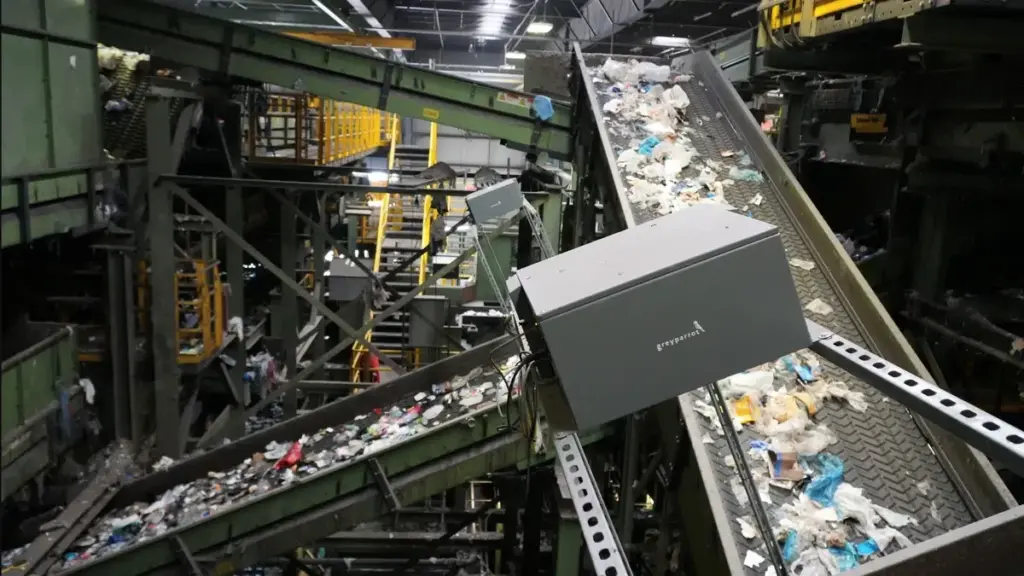
The intersection of artificial intelligence and municipal solid waste management has reached a critical juncture. Circular Services, a premier infrastructure developer for circular economy systems backed by Closed Loop Partners, is actively expanding its operational trials of Greyparrot’s advanced Analyzer AI software at its state-of-the-art Materials Recovery Facility (MRF) in Sunset Park, Brooklyn, New York.
Initially installed in the first quarter of the year for passive operational monitoring, the AI-driven camera and analytics platform is poised for a major operational ramp-up this fall. The collaboration centers on identifying, tracking, and capturing valuable recyclable commodities that routinely bypass traditional sorting mechanisms. Most notably, recent data extracted from the Sunset Park facility by Greyparrot’s monitoring systems reveals a staggering statistic: approximately 89% of all aluminum passing through the plant is recoverable. This represents a daily volume of roughly 91,000 aluminum cans currently lost to residual waste streams or inefficient sorting parameters.
This partnership arrives at a time of acute national urgency for the recycling sector. Recent joint industry reports from the Aluminum Association and the Can Manufacturers Institute indicate that aluminum beverage can recycling rates have slumped to historic lows not seen in decades. By deploying real-time waste intelligence, Circular Services and Greyparrot aim to reverse this trend, uncovering hidden domestic commodity supplies and driving operational efficiency gains between 10% and 20% across MRF processing lines.
Beyond the immediate operational benefits at the Brooklyn site, this strategic partnership serves as a testing ground for potential enterprise-wide deployment across Circular Services’ expansive portfolio of 38 MRFs throughout North America. As regulatory pressures mount, ESG commitments tighten, and commodity markets fluctuate, the integration of computer vision and machine learning into waste management infrastructure is rapidly transitioning from an experimental luxury to an essential operational backbone.
Detailed Chronology: From Pilot Installation to Enterprise Scaling
The deployment of Greyparrot’s technology at the Sunset Park MRF represents the culmination of years of technological maturation and an enduring institutional relationship between Closed Loop Partners—which backs Circular Services—and the London-headquartered AI innovator.
Phase 1: Foundation and Initial Integration (Early 2026)
In the first quarter of 2026, Circular Services integrated Greyparrot’s Analyzer AI camera systems directly above the sorting lines at the Sunset Park facility. According to Jamie Lowrey, Vice President of East Recycling Operations for Circular Services, this marked the company’s maiden voyage utilizing Greyparrot’s specific AI software suite within its domestic facility network.
During this initial phase, the system operated in a passive monitoring capacity. Rather than actively altering physical sorting equipment or diverting materials in real-time, the AI cameras continuously scanned the fast-moving river of mixed recyclables. Utilizing advanced computer vision models trained on billions of waste objects, the software cataloged material composition, identified contamination levels, flagged operational bottlenecks, and quantified the volume of valuable commodities passing uncaptured through the facility.
Phase 2: Unveiling the Aluminum Deficit (Mid-2026)
By analyzing continuous streams of visual data from the Sunset Park plant, Greyparrot’s analytics engine uncovered substantial inefficiencies in how lightweight metals are processed. The system calculated that 89% of the aluminum moving through the facility was recoverable, amounting to an astounding 91,000 aluminum cans per day.
This revelation coincided with broader industry milestones for Greyparrot. In July 2026, the company closed a robust $27 million Series B funding round led by technology investor Omar Mir. Greyparrot announced that the capital injection would be explicitly earmarked for expanding its AI, data science, and product development teams. At the time of the funding announcement, Greyparrot’s global network had surpassed 1 trillion waste detections across all deployed applications, with its MRF-specific systems identifying over $2.5 billion in cumulative recoverable commodity value worldwide.
Phase 3: The Autumn Operational Push and Enterprise Pilots (Fall 2026)
Building on the insights gathered during the passive monitoring phase, Circular Services and Greyparrot are launching a comprehensive series of active operational projects at the Sunset Park MRF this fall.
Rather than relying solely on retrospective data reports, facility managers will begin utilizing real-time system alerts generated by the AI. These alerts will provide instantaneous feedback regarding commodity quality and detailed production metrics, allowing plant operators to dynamically adjust mechanical sorters, manual picking lines, and operational speeds. Furthermore, the success of these autumn projects is expected to lay the operational blueprint for rolling out Greyparrot’s technology across Circular Services’ broader portfolio of 38 MRFs nationwide.
Supporting Context & Metrics: The Economics of Waste Intelligence
To fully understand the gravity of the Circular Services and Greyparrot collaboration, one must examine the macroeconomic and environmental pressures currently transforming the waste and recycling sector.
The Aluminum Recycling Crisis
Aluminum is universally celebrated by environmental scientists and economists as a "forever metal." It can be recycled infinitely without any degradation of its mechanical properties. Moreover, producing aluminum from recycled scrap rather than virgin bauxite ore yields staggering environmental dividends: recycling aluminum is up to 95% more energy-efficient than primary production, translating directly into massive reductions in greenhouse gas emissions and industrial energy consumption.
Despite these clear advantages, the American recycling system has struggled to capture adequate volumes of post-consumer aluminum. Research published jointly by the Aluminum Association and the Can Manufacturers Institute highlighted that aluminum beverage can recycling rates in the United States have fallen to multi-decade lows.
Millions of tons of valuable aluminum are lost annually due to municipal collection challenges, container contamination, and suboptimal recovery rates at legacy MRFs. The revelation at Circular Services’ Sunset Park facility—that 89% of the aluminum entering the plant is recoverable—illustrates that the shortage is not necessarily an absolute lack of consumer participation, but rather a systemic failure of capture mechanisms within processing infrastructure.
The Power of Waste Intelligence
Traditional MRF operations have long relied on periodic, manual waste composition audits (often referred to as "sort audits"). These audits involve physically pulling samples from conveyor belts, manually sorting them by hand, and weighing the fractions. While historically necessary, manual audits are notoriously labor-intensive, hazardous, expensive, and statistically limited, representing mere snapshots in time that fail to capture the fluid, highly variable nature of modern municipal solid waste streams.
Greyparrot’s Analyzer AI fundamentally disrupts this paradigm by providing continuous, automated, high-resolution auditing. Key metrics defining the technology’s impact include:
Efficiency Gains: Facilities deploying Greyparrot’s camera-based sorting intelligence typically experience overall efficiency improvements ranging from 10% to 20%.
Scale of Detection: With global deployments surpassing 1 trillion waste detections, the AI model’s accuracy in identifying brand, material type, form, and hazardous items continuously self-improves through machine learning loops.
Valuation of Loss: Greyparrot’s aggregate data analytics have identified billions of dollars in globally lost recyclable value, reframing waste streams not as disposal burdens, but as overlooked domestic resource mines.
Official Statements and Industry Perspectives
Leadership from both organizations have emphasized the transformative potential of marrying advanced AI analytics with heavy-duty recycling infrastructure.
Ambarish Mitra, co-founder of Greyparrot, underscored the philosophical and practical shift represented by the partnership in a joint release issued by the companies:
"Waste intelligence makes that visible for the first time, and what it shows is domestic supply hiding in plain sight."
Mitra’s sentiment speaks directly to the core thesis of modern circular economy advocates: society does not suffer from a lack of raw materials, but rather from a lack of visibility and precision in how existing materials are tracked and recovered.
Jamie Lowrey, Vice President of East Recycling Operations at Circular Services, echoed the forward-looking strategy of the enterprise, noting that the ongoing trials at Sunset Park are designed to test the limits of what automated reporting and real-time alerts can achieve for facility management. In an emailed statement, Lowrey confirmed that successful outcomes from the Brooklyn projects could serve as the catalyst for widespread deployment across Circular Services’ entire fleet of 38 materials recovery facilities.
A spokesperson for Circular Services elaborated on the specific mechanics of the upcoming autumn initiative:
"[We] will be running several projects in partnership with Greyparrot this fall where we will assess the impacts from the system’s alerts to our facility management about commodity quality and its detailed reporting on production."
Future Outlook: Scaling the Circular Economy
The partnership between Circular Services and Greyparrot does not exist in a vacuum; it is part of a broader, aggressive expansion strategy by both entities within the sustainable infrastructure ecosystem.
Closed Loop Partners, the investment firm backing Circular Services, has cultivated a multi-year working relationship with Greyparrot. Last year, the partners released an influential collaborative report detailing the application of Greyparrot’s AI technology to identify and recover food-grade polypropylene (PP) within MRF environments—a notoriously difficult polymer to sort manually due to strict safety and regulatory standards for food contact materials.
Simultaneously, Circular Services has been aggressively scaling its physical infrastructure and service offerings. Demonstrating its commitment to comprehensive diversion models, Circular Services recently announced its acquisition of Re:Dish, a prominent reusable food service ware company catering to large-scale institutional and corporate clients. By integrating reusables management with high-tech materials recovery, Circular Services is positioning itself as a vertically integrated powerhouse capable of managing waste across the entire lifecycle of consumer goods.
What Lies Ahead for MRF Technology?
As the pilot projects at the Sunset Park MRF conclude their autumn evaluation phases, the broader waste management industry will be watching closely. If Greyparrot’s real-time alerts and production reporting successfully translate into measurable increases in aluminum capture and operational throughput, it will establish a new economic baseline for MRF modernization.
The integration of artificial intelligence into waste processing is no longer a futuristic concept discussed in academic symposiums; it is actively reshaping the industrial landscape of Brooklyn and setting a precedent for nationwide implementation. By turning passive cameras into active optimization engines, Circular Services and Greyparrot are proving that the path to a true circular economy relies as much on data transparency as it does on mechanical sorting—unlocking billions of dollars in hidden value and securing domestic supply chains for generations to come.