An ordinary family beach walk along the picturesque shoreline of Portmuck Harbour in Islandmagee, Northern Ireland, has inadvertently paved the way for a potentially groundbreaking archaeological and paleontological discovery. Ten-year-old George, out exploring the coastal cliffs and geological formations with his parents, noticed an unusual protrusion emerging from an earthen bank. What initially caught the young fossil hunter’s eye was not the common sedimentary rock of the area, but rather a set of distinct, organic patterns embedded within the strata.
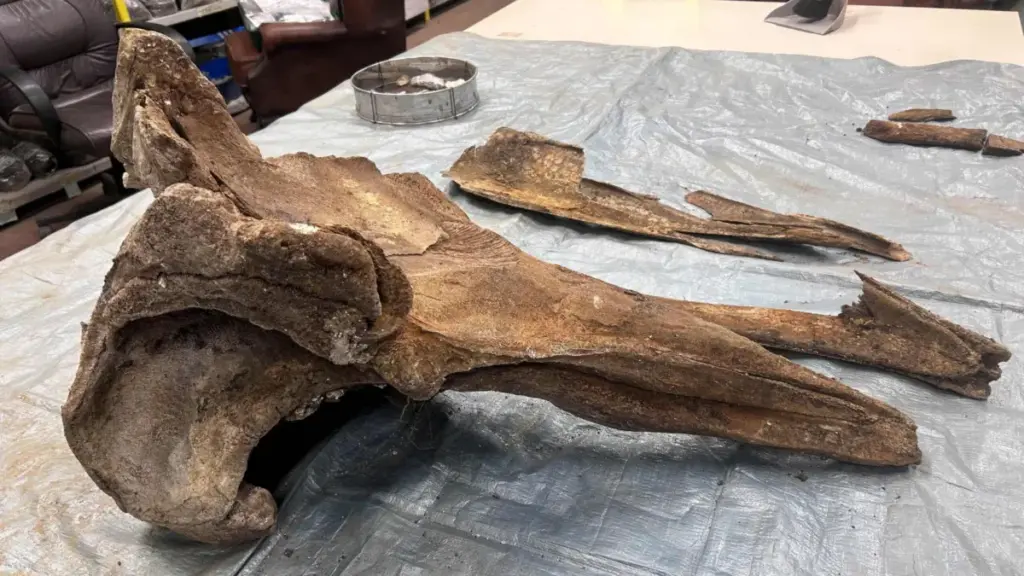
That chance encounter revealed a remarkably preserved, heavy fossilized skull of a marine creature. Following meticulous extraction efforts by local archaeologists, experts now believe the fossil belongs to a Cuvier’s beaked whale, an offshore, deep-diving marine mammal that has never before been recorded in this region of Ireland.
Even more intriguing is the artifact’s estimated chronology. Flint tools unearthed in the immediate vicinity of the burial site suggest that the fossil could date back 3,000 years to the Bronze Age. This startling timeline has raised an extraordinary hypothesis among researchers: could this isolated whale skull be the preserved remnants of a prehistoric human feast—effectively a Bronze Age "Sunday roast"?
As specialists from the Natural History Museum in London step in to assist local geologists and archaeologists, this once-in-a-lifetime discovery is opening up fresh lines of inquiry into ancient human-marine interactions along the prehistoric coastlines of Northern Ireland.
Detailed Chronology: From a Boy’s Curious Eye to Professional Excavation
The Discovery at Portmuck Harbour
The events leading up to the excavation began on a seemingly routine afternoon. Ten-year-old George and his family were strolling along the rugged shoreline of Portmuck Harbour, a location historically significant for fossil hunters. (Notably, this is the same coastal stretch where Ireland’s rare dinosaur bones were uncovered in the late 19th and late 20th centuries).
Scanning the earthen banks and rock formations, George’s attention was drawn to a weathered structure protruding from the sediment.
"It was just the weird patterns on it," George recounted to interviewers. "The bits that stuck out, it just didn’t look like a rock. I thought it was a bone, but I just wasn’t too sure. So I asked my dad and he said it was definitely a fossil."
At the time of its initial discovery, only the very back portion of the cranium was visible. Centuries of subterranean preservation had shielded the rest of the anatomy from the elements. It was only when professional excavation teams arrived that the full scale of the specimen became apparent—revealing an intact beak measuring roughly one foot in length attached to the massive rear skull structure.
The Extraction and Transport to Belfast
Recognizing the significance of the find, local archaeological teams were rapidly mobilized to secure the site before coastal erosion could destroy the exposed bone.
Katy McMonagle, one of the field archaeologists who spearheaded the extraction operation, described the immense physical challenge of recovering the specimen. Due to the fossilization process and the density of the surrounding marine bone, the object was exceptionally heavy and difficult to maneuver out of the earthen bank.
Following a careful extraction process, the skull was safely transported to a specialized secure warehouse facility in Belfast. There, it faces an intensive regimen of conservation work. Conservators estimate that a full week or more will be required just to clean the exterior surfaces of sediment without compromising the fragile matrix of the ancient bone, preparing it for comprehensive analysis by marine mammal specialists.
Supporting Context & Metrics: Unlocking the Prehistoric Puzzle
The Anatomy of a Deep-Water Giant
To understand why this discovery has left specialists astounded, one must examine the biology of the creature in question. Through photographs of a well-preserved ear region sent to the Natural History Museum in London, the institution’s Keeper of Mammalian Zoology swiftly identified the skull as belonging to a beaked whale—most likely a Cuvier’s beaked whale (Ziphius cavirostris).
Key contextual metrics surrounding the species highlight the anomaly of its presence in Islandmagee:
Habitat: Cuvier’s beaked whales are characteristically pelagic, deep-water, offshore creatures. They inhabit oceanic trenches and deep underwater canyons, rarely venturing into shallow coastal waters.
Stranding Behavior: When these animals do appear near the shoreline, it is almost exclusively because they are severely ill, disoriented, or already deceased.
Geographical Baseline: Modern records show virtually no historical precedent for live or naturally stranded Cuvier’s beaked whales in the immediate waters around Northern Ireland, with typical sightings restricted to deep oceanic trenches near the Azores or the Bay of Biscay.
The Archaeological Enigma: A Skull Without a Skeleton
Perhaps the most perplexing aspect of the Portmuck discovery is the archaeological context of the find. Ian Enlander, a geologist collaborating with the Irish Whale and Dolphin Group, emphasized the unusual nature of recovering a cranium completely devoid of the rest of the skeletal structure.
Typically, when a marine mammal washes ashore naturally, wave action and scavenging predators disperse the skeleton along the intertidal zone over time. Finding an isolated, deliberately buried skull deep within an earth bank presents a radically different scenario.
Coupled with the discovery of prehistoric flint tools in direct association with the fossil layer, researchers are forced to consider deliberate human intervention. Flint technology recovered from the dig site places the human activity squarely within the Bronze Age—roughly 3,000 years ago.
Official Statements & Expert Analysis
The interdisciplinary nature of this find has brought together geologists, archaeologists, and museum curators, all of whom recognize the historical weight of the discovery.
Ian Enlander on the Bronze Age Hypothesis
Ian Enlander, reflecting on the moment he examined the fossil in situ before its removal, voiced his excitement regarding its uniqueness:
"I think it is going to turn out to be unique, a once-in-a-lifetime thing," Enlander stated.
Discussing the mysterious circumstances of the burial, Enlander put forward the intriguing possibility of prehistoric consumption:
"It looks as if it has been handled, perhaps deliberately buried. I suppose the great wish would be that the archaeologists examine the skull and find evidence of butcher marks, that Bronze Age people have been there, trying to decapitate it and utilising the rest of the body perhaps as Sunday roast. And then for whatever reason, preserving the skull."
The Natural History Museum’s Contribution
The rapid turnaround by the Natural History Museum in London underscores the scientific importance of the find. By analyzing high-resolution photographs of the whale’s inner ear bones—crucial elements often used for structural comparison and potential carbon dating—curators were able to confirm the taxonomic classification within 24 hours of notification. Their expertise provides a vital baseline for the ongoing investigations in Northern Ireland.
A Young Discoverer’s Perspective
For ten-year-old George, the whirlwind of media attention, interactions with professional scientists, and museum involvement has been an unforgettable educational journey.
"Yeah, that’s really hard to imagine," George said, reflecting on the ancient creature. "To think about what it looked like, what it was, what it sounded like. We have a bit of an idea, but we’re not 100% sure yet."
Offering words of encouragement to other children interested in science, he added:
"It’s been so cool, it shows you what you can find and then to see what happens after you find something—what the experts do with it, how they figure it out, how they do that. Just keep your eyes open and see, you might find something good as well. Be curious. You never know what might happen."
Future Outlook: What Lies Ahead for the Portmuck Whale?
As the fossil undergoes painstaking cleaning and conservation in Belfast, several critical phases lie ahead for the research team:
Microscopic Analysis for Cut Marks: Specialized archaeologists will inspect the bone surfaces under high magnification to search for anthropogenic modifications—specifically tool marks left by Bronze Age flint implements indicating skinning, butchery, or decapitation.
Radiocarbon Dating: Organic residues or collagen extracted from the bone and associated ear structures will undergo rigorous radiocarbon dating to narrow down the exact chronological window of the whale’s death and burial.
Isotopic Profiling: Environmental isotopes within the bone may reveal dietary and migratory patterns of the Cuvier’s beaked whale from 3,000 years ago, offering insights into ancient North Atlantic marine ecosystems.
Permanent Display Considerations: Once scientific analysis is complete, discussions will determine whether the fossil will find a permanent educational home in a local Northern Ireland museum, inspiring future generations of young explorers.
What began as a quiet family stroll along Portmuck Harbour has evolved into a major cross-disciplinary investigation. Whether the skull represents the remnants of an ancient coastal feast or a mysterious ritual deposition from antiquity, the Portmuck whale fossil promises to rewrite our understanding of early human-marine interactions on the Irish coast.