

By the Investigative Desk
Published in partnership with global climate and technology watchdogs
Executive Overview
For years, Silicon Valley has successfully marketed artificial intelligence not merely as a technological revolution, but as a planetary savior. Tech conglomerates routinely argue that advanced machine learning models will optimize global energy grids, accelerate climate science, streamline supply chains, and unlock solutions to the existential threat of global warming. Among the chief proponents of this narrative is NVIDIA, the reigning titan of the AI hardware market. Through carefully curated corporate sustainability reports and high-profile keynote addresses, the company presents its high-performance graphics processing units (GPUs) as indispensable tools for a greener, more efficient future.
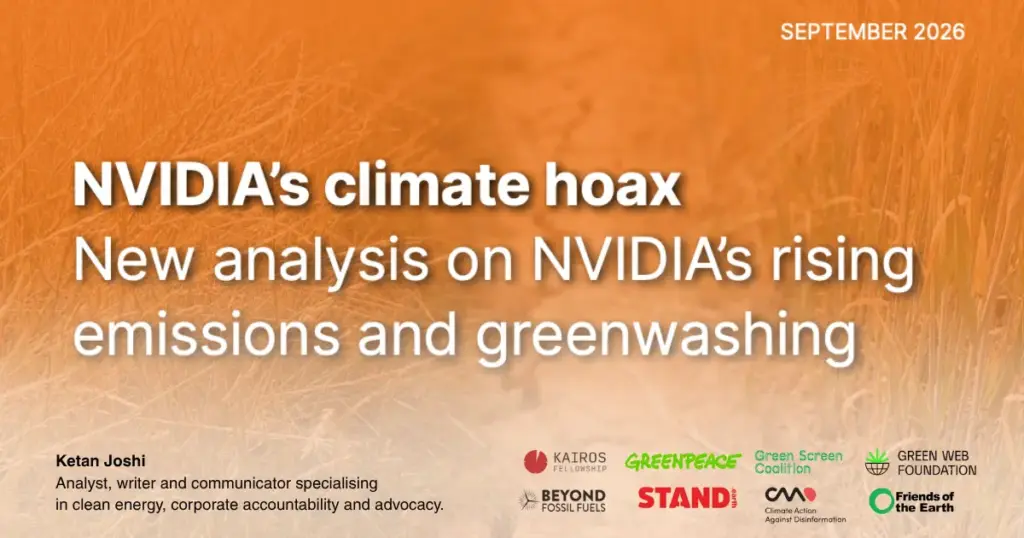
However, a groundbreaking explosive new investigative report—NVIDIA’s AI Climate Hoax, authored by analyst and writer Ketan Joshi for Greenpeace International alongside a consortium of civil society partners—shatters this carefully crafted illusion. The research reveals a starkly different reality hidden behind the corporate greenwashing: an unprecedented explosion in greenhouse gas emissions, a heavy reliance on fossil-fuel-heavy manufacturing supply chains, and a systemic deflection of ecological accountability.
According to the findings, NVIDIA’s indirect Scope 3 emissions—those generated across its vast, complex value chain—have skyrocketed by a staggering 725% since 2020. Furthermore, the report calculates that the undisclosed, operational emissions stemming directly from the millions of NVIDIA chips sold and deployed globally could generate up to 21 million tonnes of carbon dioxide equivalent ($CO_2e$) in 2025 alone. Far from acting as a climate savior, NVIDIA’s hardware is serving as the primary combustion engine for a new era of hyper-energy-consuming data centers, exacerbating local environmental degradation, and shifting ecological burdens onto lower-income nations in a modern manifestation of "tech colonialism."
Detailed Chronology: The Escalation of NVIDIA’s Carbon Footprint
To understand how NVIDIA arrived at this environmental precipice, it is necessary to examine the timeline of the generative AI boom and its parallel corporate positioning.
2020–2021: The Paving of the Foundation
At the dawn of the decade, NVIDIA was primarily recognized as a dominant force in computer graphics, gaming hardware, and early-stage enterprise machine learning. While the company maintained standard carbon disclosure metrics, its overall footprint was dwarfed by the massive cloud infrastructure providers (such as Amazon Web Services, Microsoft Azure, and Google Cloud). During this period, Scope 3 emissions—which include upstream manufacturing and downstream use of sold products—began to tick upward as remote work and digital transformation accelerated global demand for semiconductors. Yet, corporate sustainability communications remained heavily focused on product energy efficiency (performance-per-watt metrics), establishing a rhetorical foundation that would later be weaponized to mask absolute emissions growth.
2022–2023: The Generative AI Gold Rush and the H100 Era
The launch of OpenAI’s ChatGPT in late 2022 fundamentally altered the technological landscape. As global enterprises rushed to build out Large Language Models (LLMs), NVIDIA’s H100 GPU became the undisputed gold standard of computational hardware.
To meet this insatiable market demand, NVIDIA rapidly scaled up its manufacturing partnerships, heavily reliant on East Asian semiconductor foundries like Taiwan Semiconductor Manufacturing Company (TSMC). However, because these regional manufacturing hubs continue to draw heavily from fossil-fuel-dominated electricity grids, every chip minted carried a mounting ecological penalty. Despite this, NVIDIA’s public messaging doubled down on the narrative of "climate enablement," arguing that the computational power of its chips would ultimately optimize away more carbon than they consumed.
2024–2025: Exponential Growth and Discrepancies in Reporting
By 2024, the discrepancy between NVIDIA’s climate rhetoric and its physical reality reached a tipping point. Financial markets celebrated historic market valuations for the chipmaker, fueled by multi-billion-dollar data center builds across the globe. Behind closed doors, however, internal and independent supply chain analyses revealed that indirect emissions were compounding at an exponential rate.
The Greenpeace International briefing captures this trajectory, documenting a 725% surge in Scope 3 emissions since the baseline year of 2020. As utility companies scrambled to power sprawling new artificial intelligence campuses—such as a proposed mega-facility in Ohio backed by one of the world’s largest natural gas-fired power plants—the structural incompatibility between AI hyper-scaling and global climate targets became undeniable.
2026: The Reckoning and the "Climate Hoax" Exposé
The publication of NVIDIA’s AI Climate Hoax in September 2026 marks a major turning point in corporate accountability. By systematically dissecting NVIDIA’s sustainability claims, the report exposes the mechanics of how the tech giant obscures its true environmental cost. Supported by a coalition of international environmental watchdogs, the briefing forces a public reckoning over whether the rapid expansion of artificial intelligence can be squared with planetary boundaries.
Supporting Context & Metrics: Deconstructing the Greenwashing Tactics
The Greenpeace report identifies three primary greenwashing pillars utilized by NVIDIA to deflect scrutiny and maintain its environmental social license.
1. The Net Climate Benefit Myth
NVIDIA frequently asserts that the computational efficiencies unlocked by its hardware result in a net-positive outcome for global carbon emissions. This argument relies on theoretical future savings—such as smart grid optimization, weather modeling, and material science breakthroughs—while ignoring immediate, guaranteed, and massive absolute emissions today. The report notes that emissions are cumulative and atmospheric; speculative future efficiencies do not cancel out the gigawatts of fossil-fueled electricity being consumed by data centers in the present.
2. Misrepresenting Data Center Demand Response
A favored talking point among tech advocates is that data centers can act as flexible "demand response" assets, stabilizing local grids by shutting down or ramping down during peak hours, thereby allegedly incentivizing renewable energy buildout. The investigation debunks this, revealing that hyperscale AI data centers require continuous, 24/7 base-load power (often referred to as "firm power") to train complex neural networks. Rather than driving clean energy transitions, these facilities frequently lock in long-term power purchase agreements with fossil-fuel generators—exemplified by the reliance on massive natural gas plants in regions like Ohio.
3. Masking Consumption Behind Efficiency Gains
While NVIDIA rightfully boasts about engineering chips that deliver vastly superior performance-per-watt compared to previous generations, this efficiency does not translate to absolute energy savings. In economics, this phenomenon is known as Jevons Paradox: as technology becomes more efficient, the cost of using it drops, leading to a dramatic increase in total consumption. Because NVIDIA’s chips have made AI training cheaper and more powerful, companies have responded by building exponentially larger data centers and training vastly larger models, driving total energy consumption to historic highs.
Official Statements and Collaborative Findings
The research was spearheaded by Ketan Joshi, an internationally recognized analyst and writer specializing in clean energy and corporate accountability. Joshi’s prior work, including Energy Vampires (published earlier in 2026 with Greenpeace Australia Pacific), laid the groundwork for understanding the insatiable appetite of modern computing infrastructure.
"NVIDIA has built a masterclass in corporate illusion," notes the core findings of the report. "By hyper-focusing on incremental chip-level efficiency, they have successfully blinded the public to the staggering, compounding reality of their value-chain emissions. You cannot claim to be a climate savior while powering the fossil-fueled industrial buildout of the 21st century."
The investigation was conducted in deep collaboration with a coalition of prominent civil society, tech, and climate justice organizations:
- Kairos Fellowship
- Stand.earth
- Beyond Fossil Fuels
- Friends of the Earth
- Climate Action Against Disinformation (CAAD)
- Green Screen Coalition
- The Green Web Foundation
Together, these organizations emphasize that the environmental fallout of the AI boom is inextricably linked to geopolitical and socio-economic inequities. Because NVIDIA outsources its energy-intensive manufacturing to East Asian supply chains, it effectively offloads the localized ecological burden—including heavy air pollution, water depletion, and severe strain on local electrical grids—onto lower-income nations and communities, while concentrating financial wealth in Western corporate headquarters. This dynamic is classified by researchers as a modern form of "tech colonialism."
Future Outlook: Demands and Pathways to Accountability
As the global community confronts the escalating impacts of climate change, the tech sector’s unchecked expansion can no longer operate in a regulatory vacuum. The findings in NVIDIA’s AI Climate Hoax serve as both an indictment and an ultimatum.
Civil society organizations have laid out clear, non-negotiable demands for NVIDIA and the broader artificial intelligence industry:
- Immediate Operational Transparency: NVIDIA must fully disclose and account for the downstream operational emissions of all sold chips, bringing transparency to the estimated 21 million tonnes of $CO_2e$ projected for 2025 and beyond.
- Absolute Emissions Reductions: The company must abandon reliance on speculative carbon offsets and greenwashed accounting tricks, committing to absolute greenhouse gas reductions across its entire value chain.
- Supply Chain Decarbonization: NVIDIA must expand its renewable energy targets to achieve 100% renewable power across its entire manufacturing and assembly supply chain—particularly within its East Asian foundry networks—by no later than 2030.
- Direct Investment in Global Renewable Capacity: Rather than partnering with fossil fuel utilities to power new data center hubs, technology giants must directly finance and deploy new, additional global renewable energy generation capacity to match their load.
The era of unchecked technological exceptionalism is drawing to a close. If artificial intelligence is to play a constructive role in human society, its architects must first ensure that the infrastructure powering it does not undermine the very habitability of the planet.
About the Report
The full 2026 investigative report, NVIDIA’s AI climate hoax: New analysis on NVIDIA’s rising emissions and greenwashing, is publicly available via Greenpeace International.



