

Executive Overview
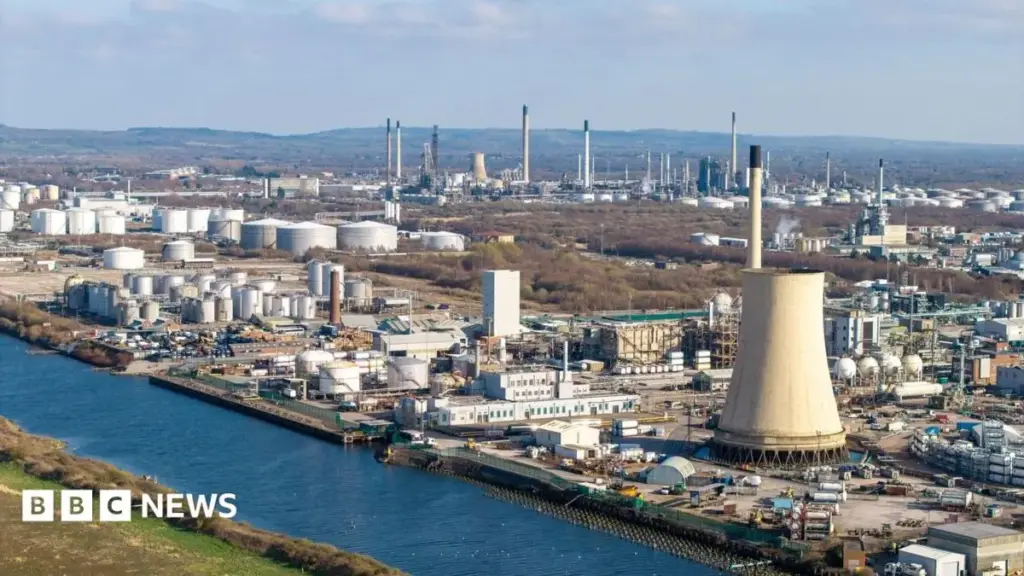
One of the United Kingdom’s cornerstone energy facilities is facing intense regulatory scrutiny and public outcry following revelations that it repeatedly discharged toxic pollutants into local waterways and the sensitive Mersey Estuary. Exclusive investigative documents obtained by the BBC and compiled by environmental journalism organization SourceMaterial reveal that EET Fuels—the operator of the Stanlow oil refinery in Ellesmere Port, Cheshire—breached environmental regulations dozens of times across 2023 and 2024.
The Stanlow refinery is of critical strategic importance to the UK’s energy infrastructure. As one of only four remaining operational refineries in the country, it processes a staggering 10 million tonnes of crude oil annually, supplying approximately 18% of the nation’s road transport fuels, including petrol for cars and diesel for freight trucks. However, this industrial output appears to have come at a steep ecological cost.
According to confidential Environment Agency (EA) documents and regulatory logs, the facility exceeded permitted thresholds for chemical and oil releases hundreds of times over a two-year window. These violations culminated in formal determinations that EET Fuels broke its operating permit conditions on 58 distinct occasions—a threshold that constitutes potential criminal offenses. The discharged toxins include hazardous substances such as benzene, cyanide, and heavy industrial oils, which have found their way into local watercourses like Thornton Brook and the River Gowy, ultimately pouring into the ecologically fragile Mersey Estuary.
This unfolding crisis compounds existing legal jeopardy for the operator. EET Fuels, formerly trading as Essar, pleaded guilty earlier this year to 12 separate charges of breaching environmental law between 2018 and 2020, with sentencing scheduled for next month. Critics, conservationists, and watchdog organizations argue that the persistent nature of these violations underscores systemic regulatory failures, casting doubt on the government’s ability to deter corporate environmental crimes within high-risk industrial sectors.
Detailed Chronology of Violations and Incidents
The trail of contamination at the Stanlow facility is marked by a series of specific, well-documented pollution events that highlight systemic vulnerabilities in the refinery’s containment and waste management systems.
The July 2023 Groundwater Contamination
In July 2023, the refinery suffered a significant permit breach when heavy rainfall triggered a leak of oil-contaminated rainwater from the site. Local residents quickly raised the alarm, bombarding the Environment Agency with complaints regarding noxious, petroleum-based odors permeating the atmosphere. Subsequent environmental investigations confirmed that the escaped oil had not only entered surface water pathways but had also seeped deep into local groundwater supplies.
While the EA categorized the event as "significant," EET Fuels defended its position by downplaying the scale of the disaster. The company stated that the oil loss was "on a low scale" and insisted it was "strictly localised to two boreholes, all well within the Stanlow site itself." Nevertheless, the incident drew sharp criticism from regulators for failing to prevent hazardous materials from escaping containment during standard seasonal weather events.
The September 2024 Major Spill and Regulatory Lapses
More than a year later, on September 12, 2024, a far more severe incident unfolded at the Cheshire facility. An internal EA incident report revealed that over a continuous 36-hour period, more than a tonne of crude oil was released from the refinery. The toxic plume flooded into Thornton Brook before migrating rapidly downriver into the sensitive habitats of the Mersey Estuary.
Despite clear legal mandates requiring operators to notify authorities and provide accurate spill estimates within 24 hours of an emergency, EET Fuels took nearly two weeks to submit a reliable calculation of the volume of oil lost. This reporting delay constituted a secondary breach of regulatory compliance.
The spill triggered a multi-agency emergency response involving the EA, Natural England, local port authorities, and regional Fisheries Authorities. Emergency meeting documents show that Natural England quickly identified the existential threat posed to local flora and fauna. In a briefing, regulatory officers warned: "What has gone in there is going to have some impact on the vegetation and salt marsh and there is probably still a risk of ingestion by birds."
Aerial drone surveys deployed to assess the catastrophe revealed a heartbreaking scale of destruction. The footage tracked a brown, oily discolouration stretching for more than a mile down the river, suffocating reedbeds and washing over mudflats populated by vulnerable wildlife, including the red-listed dunlin.
To mitigate the disaster, emergency responders deployed a floating barrier system to contain the crude oil. Because the impacted stretch of the river was largely inaccessible by land, public health risks were initially deemed low. However, out of an abundance of caution, authorities ordered the immediate closure of local cockle beds within the Estuary while water samples underwent rigorous testing by the Food Standards Agency (FSA). Although the shellfish eventually received a clean bill of health, the commercial beds remained shuttered for five weeks, severely disrupting local livelihoods.
Supporting Context & Metrics: Environmental Impact and Industrial Permitting
To truly grasp the gravity of the discharges from Stanlow, one must examine both the quantitative data revealed by regulatory agencies and the fragile ecological framework of the receiving environment.
The Quantifiable Scale of Pollution
Environmental permits granted to major industrial facilities like Stanlow are designed to establish clear boundaries. They legally permit the release of controlled, highly diluted amounts of industrial byproducts into the air and water, provided the operator utilizes Best Available Techniques (BAT) to minimize ecological degradation. However, the data uncovered by SourceMaterial indicates that Stanlow routinely obliterated these safety margins:
- Sulphur Dioxide: Released into the atmosphere at levels up to seven times the maximum legal limit.
- Cyanide: Discharged into local watercourses, including the River Gowy, at concentrations exceeding permitted thresholds by more than eight times.
- Heavy Oils: Unleashed into aquatic ecosystems at rates surpassing authorized limits by more than thirteen times.
The Mersey Estuary: A Delicate Ecological Haven
The ultimate receptacle for these industrial discharges is the Mersey Estuary, a designated Site of Special Scientific Interest (SSSI). For decades, the Estuary was viewed as a biological dead zone, devastated by the legacy of heavy industrial manufacturing across Northwest England. In recent years, however, millions of pounds and countless hours of grueling conservation work by organizations like the Cheshire Wildlife Trust have breathed new life into the river system.
Charlotte Harris, Chief Executive of the Cheshire Wildlife Trust, emphasized the global significance of the habitat:
"Species like dunlin, blacktail, godwit and red shank will travel all around the world to feed and roost in the land around the River Mersey. We’ve seen the Atlantic salmon return to the river and also the critically endangered European eel makes its way up the Mersey and into the River Gowy to breed each year as well."
Harris warned that industrial pollutants do not respect localized boundaries. Due to the high-energy, dynamic nature of estuarine river systems, chemical toxins spread far, wide, and at alarming speeds, threatening decades of hard-won conservation gains.
Official Statements and Regulatory Friction
The fallout from the 2024 oil spill and the revelations of systematic permit breaches have exposed apparent friction, confusion, and institutional buck-passing among the UK’s primary environmental watchdogs.
EET Fuels’ Defense and Investment Strategy
In response to the mounting media pressure and investigative findings, EET Fuels has vigorously defended its current operational integrity, arguing that past legal infractions do not reflect present-day standards.
In an official statement provided to the BBC, the company maintained:
"Selectively chosen, historical permit exceedances from prior years in no way represent the current operational status, improving environmental performance, or governance of the refinery today."
Furthermore, EET Fuels highlighted substantial capital investments aimed at modernizing its infrastructure. The company asserted that it has backed its environmental commitments with "decisive action," pouring over £24 million into major wastewater infrastructure alone. According to corporate metrics, these upgrades have driven a measurable upward trend in Environment Agency compliance ratings, lifting the facility from an abysmal "F" rating in 2023 to an "E" rating in 2024 as major capital improvement projects came online.
Natural England and the Environment Agency: An Inter-Agency Disconnect
While the Environment Agency launched an independent, ongoing criminal investigation into the September 2024 oil spill (while evaluating its response to the 2023 infractions), Natural England initially launched its own inquiry before abruptly dropping it.
Publicly, Natural England stated that while the incident was regrettable, its impact on the SSSI was ultimately deemed "minor." However, leaked internal emails tell a more controversial story. Correspondence reveals that Natural England abandoned its investigation after reviewing Stanlow’s environmental permit and concluding that the document failed to set explicit numerical limits on the quantity of oil that could be discharged via its storm overflows—despite the inherent pollution risks.
An internal message from Natural England officers to the EA read:
"Thank you for sending the permit… which verify Stanlow’s stance that the storm overflow is permitted and further with no limit set to the quantity of oil released. With this in place, Natural England have decided not to take any further action."
This revelation drew sharp condemnation from environmental campaigners. James Wallace, Chief Executive of the charity River Action, argued that such bureaucratic maneuvers point to a systemic "downgrading of pollution incidents" where mounting evidence is willfully ignored by the bodies tasked with defending nature.
Future Outlook and Accountability
As the UK grapples with a broader national crisis concerning the state of its waterways—ranging from raw sewage discharges by water utility companies to industrial contamination by energy giants—the Stanlow case serves as a critical test for the nation’s environmental enforcement regime.
EET Fuels is scheduled to appear in court next month for sentencing regarding the 12 environmental charges stemming from its 2018–2020 permit breaches. Legal observers note that the eight-year gap between the initial infractions and final sentencing highlights a sluggish judicial and regulatory pipeline that struggles to deliver swift, deterrent-grade justice.
Critics argue that current penalties and regulatory oversight remain toothless against multinational energy corporations. James Wallace did not mince words regarding the broader systemic failure:
"We need to see consistent law enforcement, and we need to see the threat of punitive measures by all industries, whether it’s the water industry or oil refineries. The fact this case took up to eight years to reach the courts calls into question the effectiveness of the regulators in deterring environmental pollution."
Echoing these sentiments, Charlotte Harris of the Cheshire Wildlife Trust stressed that penalizing polluters after the fact is insufficient if the underlying structural issues are left unaddressed:
"When a business does impact a river like this, it is absolutely vital that they’re held to account. But going further than that, it shouldn’t be happening in the first place. We really do need to get a grip of how we treat our river systems."
For the residents of Ellesmere Port, the fishermen of the Northwest inshore waters, and the conservationists fighting to preserve the fragile biodiversity of the Mersey Estuary, the outcome of the ongoing Environment Agency criminal investigations and the upcoming court sentencing will be a vital indicator of whether polluters can truly be held accountable in post-industrial Britain.



