As the global scientific community marks the 20th anniversary of the Biodiversity Heritage Library (BHL), digitization initiatives continue to unearth remarkable, overlooked narratives from the annals of natural history. A recent collaborative undertaking between the Academy of Natural Sciences of Drexel University and BHL has brought to light the extraordinary life and work of Carrie Aaron (historically misattributed simply as "Mrs. Aaron"). Through the digitization of 83 historical field journals and scientific notebooks, librarians, archivists, and students have rescued a pioneering 19th-century entomologist from historical obscurity.
This enterprise transcends a routine archival scan; it serves as an investigative case study in the power of digital metadata correction. By rectifying inadequate legacy finding aids, modern information professionals have formally established Carrie Aaron’s identity on platforms such as Wikidata and the BHL Creator database. Her surviving manuscripts—featuring prize-winning essays on mosquito eradication, correspondence with prominent entomologists, and vivid travelogs of early 20th-century California—offer a profound lens into the gender dynamics, scientific ambitions, and ecological insights of Victorian- and Edwardian-era natural science.
Detailed Chronology: Unearthing the Life and Legacy of Carrie Aaron
To fully appreciate the scope of the recent archival discoveries at the Academy of Natural Sciences, one must trace the trajectory of Carrie Aaron’s engagement with the natural sciences across several decades. Her historical footprint, preserved across field notebooks and personal letters, highlights an evolving relationship with institutional entomology.
1880s–1901: Entomological Inquiries and Mosquito Eradication
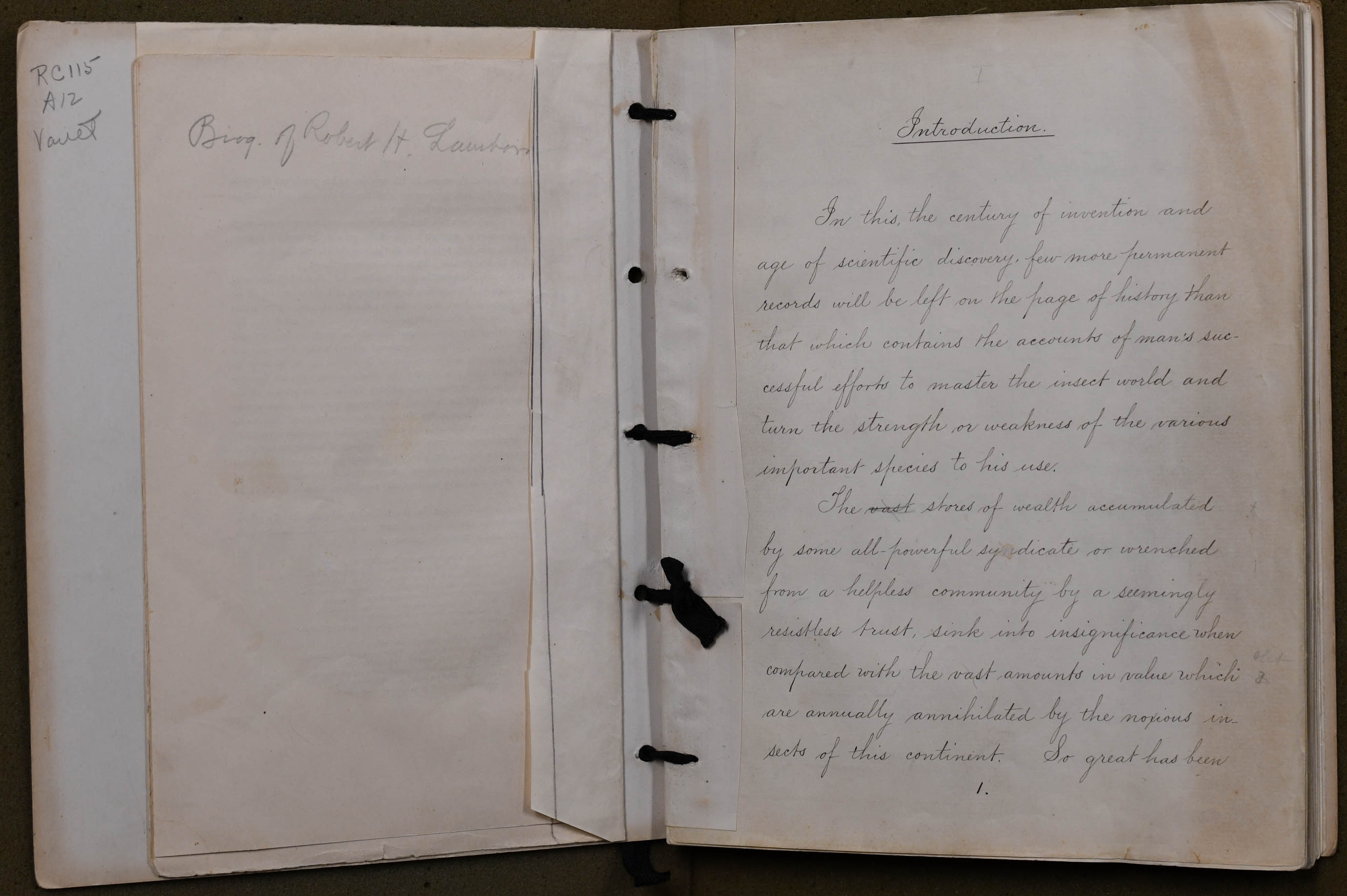
Carrie Aaron’s most prominent contribution to early applied entomology materialized through her essay concerning the eradication of mosquitoes. The intellectual genesis of this work traces back to Dr. Robert Henry Lamborn, a financier and industrialist. While overseeing the construction of the Lake Superior Railroad, Lamborn suffered intensely from the relentless onslaught of mosquitoes. Motivated by this personal tribulation, Lamborn established a public essay competition offering financial prizes for the three most comprehensive and scientifically grounded strategies for mitigating the mosquito pest.
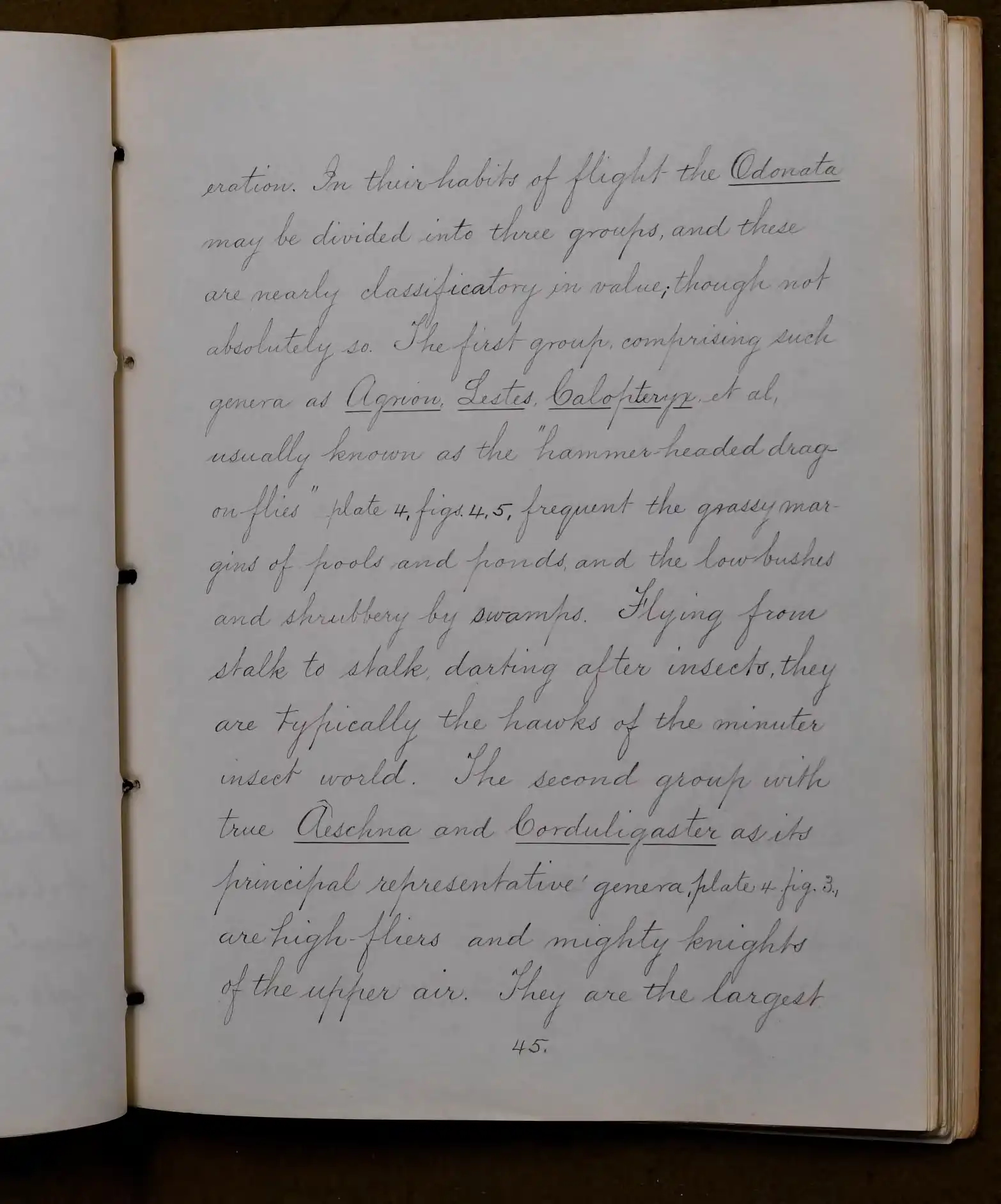
Seizing the challenge, Aaron produced a meticulous, beautifully handwritten manuscript titled A notebook containing an entomological essay by Carrie Aaron. Within its pages, she evaluated multiple biological and mechanical measures to reduce mosquito populations. Notably, she highlighted the predatory efficacy of dragonflies—or "hammer-headed dragonflies"—which she vividly characterized as "the hawks of the minuter insect world."
Her investigative rigor pushed boundaries in ways that modern biosafety protocols would prohibit. Historical records indicate that Aaron and her research associates attempted to inoculate themselves with the fluids of mosquitoes, seeking to test reactions to the insect’s secretions. While this self-experimentation proved unsuccessful—attributable, as Aaron wryly noted, to the "inferiority of the needle as an injector, compared with the delicate hypopharynx"—it underscored an aggressive, hands-on empirical methodology.
Aaron’s essay was ultimately selected for publication alongside other winning submissions in the seminal volume Dragon Flies vs. Mosquitoes: Can the Mosquito Pest be Mitigated? under the title "The Dipterous Enemies of Man."
January 1900: Disillusionment with Institutional Societies
Despite early accolades—including a congratulatory letter from renowned entomologist Henry Skinner, who assured her that her scientific reputation was secure—Aaron grew increasingly alienated from the male-dominated professional societies of her era.
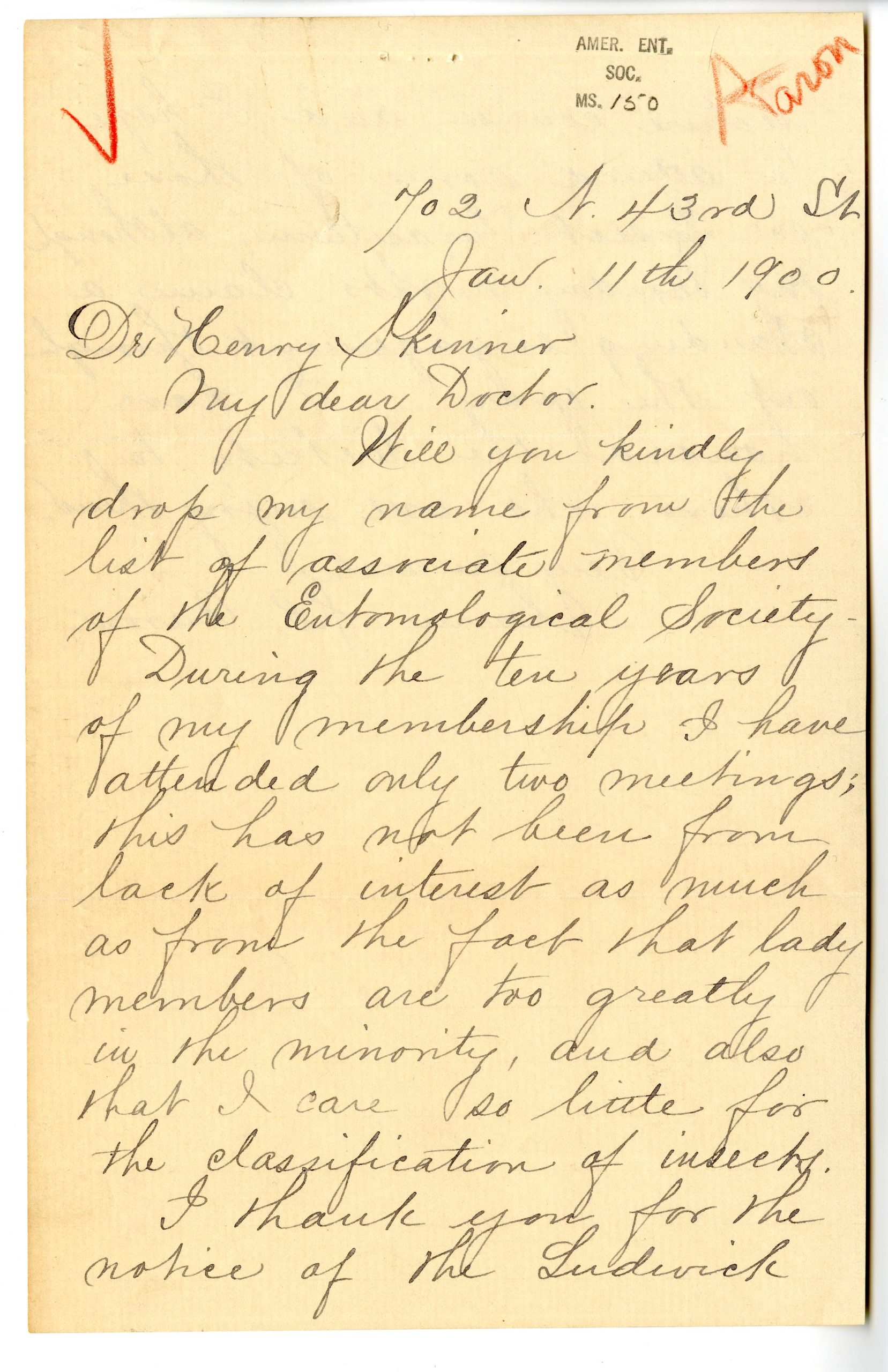
On January 11, 1900, Aaron penned a candid letter to Skinner requesting the formal removal of her name from the list of associate members of the American Entomological Society (AES). Her rationale was unapologetically clear:
"During the ten years of my membership I have attended only two meetings; this has not been from lack of interest as much as from the fact that lady members are too greatly in the minority, and also that I care so little for the classification of insects."
This pivotal document exposes the systemic barriers and cultural alienation that historically sidelined women in formal scientific bodies, pushing them to pursue independent intellectual inquiries outside traditional academy halls.
1900–1923: Sustained Correspondence and Intellectual Networks
Although Aaron formally distanced herself from the AES membership rolls, she maintained deep, lifelong intellectual friendships with key figures within the institution. Her correspondence with Henry Skinner endured for over three decades. A subsequent letter written in 1923 explicitly expressed her profound gratitude for their "more than thirty year sympathetic friendship," demonstrating that personal scholarly networks persisted long after institutional ties dissolved.
1926: Western Travels and Encounters with Early Women Curators
Decades after her formal exit from active entomological publishing, Aaron’s inquisitive spirit remained undiminished. During a sojourn in Southern California—a region she characterized as "the land of perpetual bloom and uninterrupted sounds of birds and insects"—she continued to document her museum explorations.
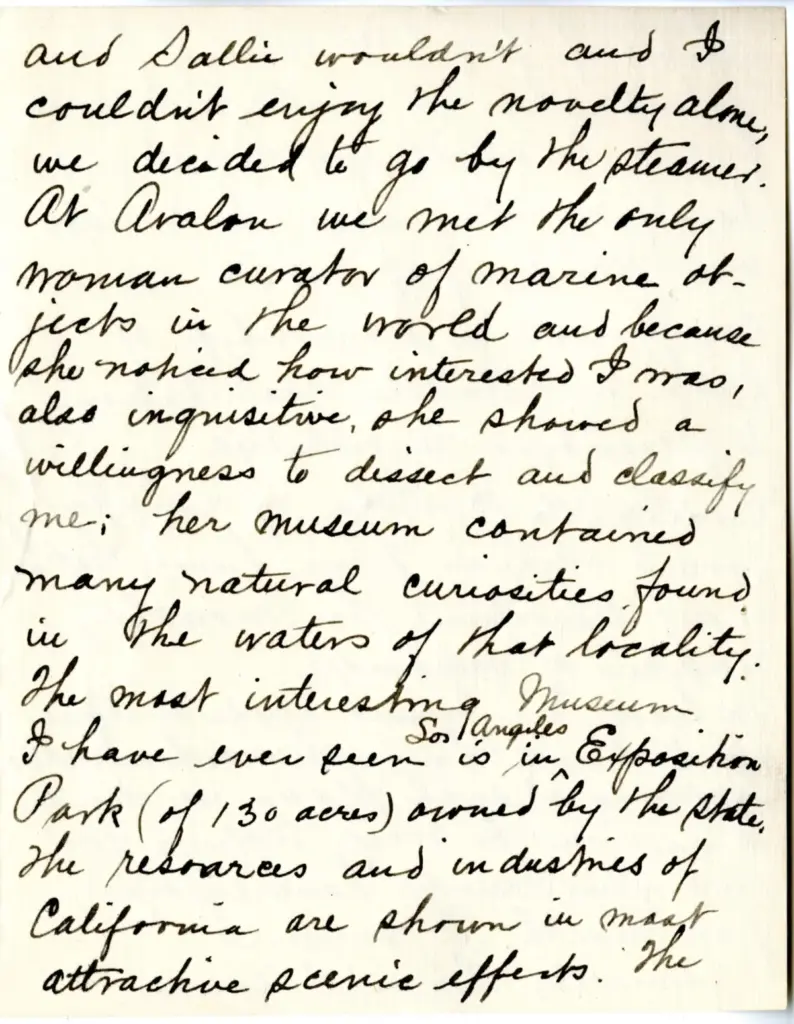
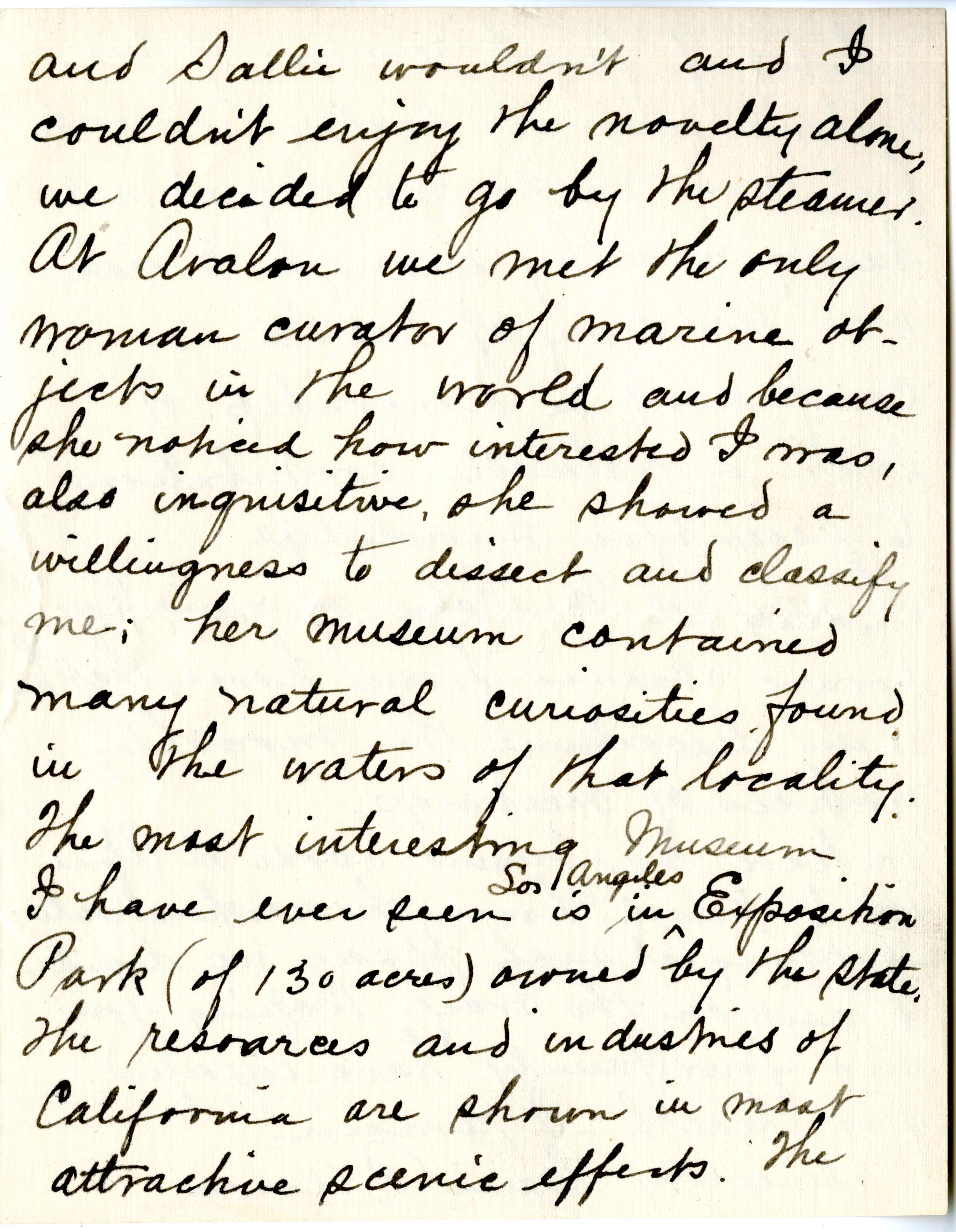
In a March 8, 1926, letter to Skinner, Aaron recounted a transformative encounter on Santa Catalina Island:
"At Avalon we met the only woman curator of marine objects in the world and because she noticed how interested I was, also inquisitive, she shared a willingness to dissect and classify me; her museum contained many natural curiosities found in the waters of that locality."
Furthermore, she detailed her profound admiration for the State-owned museum in Exposition Park, Los Angeles, praising its expansive exhibits on California’s natural resources and prehistoric fossil remains. This encounter sparked a lingering lament regarding her physical health: the displays "made me regret not being healthy enough to make our Academy of Nat. Sci. a competitor in ownership of such a valuable contribution to scientific knowledge."
Supporting Context & Metrics: The Mechanics of Digital Remediation
The rediscovery of Carrie Aaron is not merely a biographical triumph; it is a testament to the transformative impact of modern library science, digital humanities, and open-access biodiversity frameworks.
The BHL at 20 Initiative
Celebrating its twentieth anniversary, the Biodiversity Heritage Library has fundamentally revolutionized how researchers access historical literature. By aggregating global biodiversity documentation into a unified, open-access repository, BHL bridges the gap between dusty archives and digital screens. The inclusion of Aaron’s 1889–1901 notebook is part of a targeted Academy of Natural Sciences project that successfully digitized and transcribed 83 distinct historical field journals and manuscripts via BHL’s Field Journal Fixup initiative.
Metadata Invisibility and Rectification
Before the intervention of Academy Archivist Jessica Lydon and the Cataloging and Digital Resources Librarian, Carrie Aaron’s archival records suffered from a pervasive issue in library science: gender-based metadata erasure. The original finding aid cataloged her simply as "Mrs. Aaron," stripping away her individual identity, professional agency, and biographical context.
This historical oversight highlights a systemic vulnerability in legacy library catalogs, where married women were frequently subsumed under their husbands’ honorifics. By cross-referencing archival holdings, the library team:
Generated a dedicated BHL Creator ID for Carrie Aaron.
Linked the author profile directly to her Wikidata identifier (Q125503946).
Standardized finding aids across platforms, rendering her contributions discoverable to researchers worldwide.
Collaborative Digitization Pipelines
The project was accelerated by an interdisciplinary coalition of institutional staff, student interns, and philanthropic supporters. Drexel University student digitization assistants played a pivotal role in capturing high-resolution images of fragile cursive manuscripts. Concurrently, archival intern Will Le spearheaded the intensive digitization of the entire American Entomological Society (AES) correspondence collection—funded generously by Dr. William Day and the AES. These digital assets were successfully ingested into regional and national portals, including PA Photos and Documents, providing seamless, laptop-based access to historical letters that were once locked away in physical boxes.
Official Statements and Institutional Perspectives
The intersection of historical preservation and digital librarianship has elicited strong statements from the professionals spearheading these initiatives at the Academy of Natural Sciences of Drexel University and the Biodiversity Heritage Library.
Reflecting on the emotional and intellectual rewards of processing obscure archival materials, the Academy’s Cataloging and Digital Resources Librarian noted:
"I recently had the joy of working with scientists’ handwritten notebooks and field journals while completing a project to have 83 of them digitized and transcribed for BHL… When given the opportunity to write a blog post in celebration of BHL’s 20th anniversary, it was an easy choice among the Academy Library and Archives staff to write about Carrie Aaron."
Emphasizing the ripple effects of digital cataloging on unexpected historical inquiries, the librarian added:
"After working with archival notebooks and reading Carrie Aaron’s letters, I’m thrilled to see how digitization and public access to collections spur research into lesser-known individuals and uncover more potential research subjects! I don’t consider myself a historian, but it’s difficult to resist historical research when presented with easily accessible primary sources and when given the tools to link subjects across different platforms."
From a systemic standpoint, leadership within the Biodiversity Heritage Library emphasizes the core mission driving their two-decade-long campaign:
"For 20 years, BHL has helped uncover the people and stories hidden within biodiversity literature and archives, making them freely available for new generations to discover. Your support helps us continue digitizing, connecting, and sharing collections like Carrie Aaron’s notebook—and ensures that more overlooked voices and histories can be found."
Future Outlook: Unresolved Mysteries and Next Steps in Historical Research
The digital opening of Carrie Aaron’s papers does not signal the conclusion of an investigation; rather, it opens new pathways of historical inquiry that span across institutions, academic disciplines, and geographic boundaries.
The Quest for the "Only Woman Curator"
One of the most tantalizing loose ends generated by Aaron’s 1926 correspondence is her encounter on Santa Catalina Island with an anonymous individual whom she described as "the only woman curator of marine objects in the world."
Modern archivists and independent researchers at the Academy are now mobilized to solve this historical riddle. Identifying this pioneering female marine curator—who operated a localized museum in Avalon displaying aquatic specimens—will add another critical puzzle piece to our understanding of early female leadership in marine biology and museum curation during the early 20th century.
The Expanding Horizon of Open-Access Archives
The success of the Carrie Aaron project underscores the vital importance of sustained funding and institutional support for archival digitization. As initiatives like the BHL at 20 campaign continue to scale, the democratization of primary sources ensures that hidden figures—particularly women, amateur naturalists, and independent researchers whose contributions were marginalized by Victorian-era institutional gatekeeping—will be restored to their rightful place in scientific history.
By tearing down the barriers of physical distance and outdated metadata, the Academy of Natural Sciences and the Biodiversity Heritage Library have proven that historical archives are not static storehouses of the dead, but dynamic ecosystems of discovery waiting to inspire the next generation of scientists, historians, and digital humanists.