

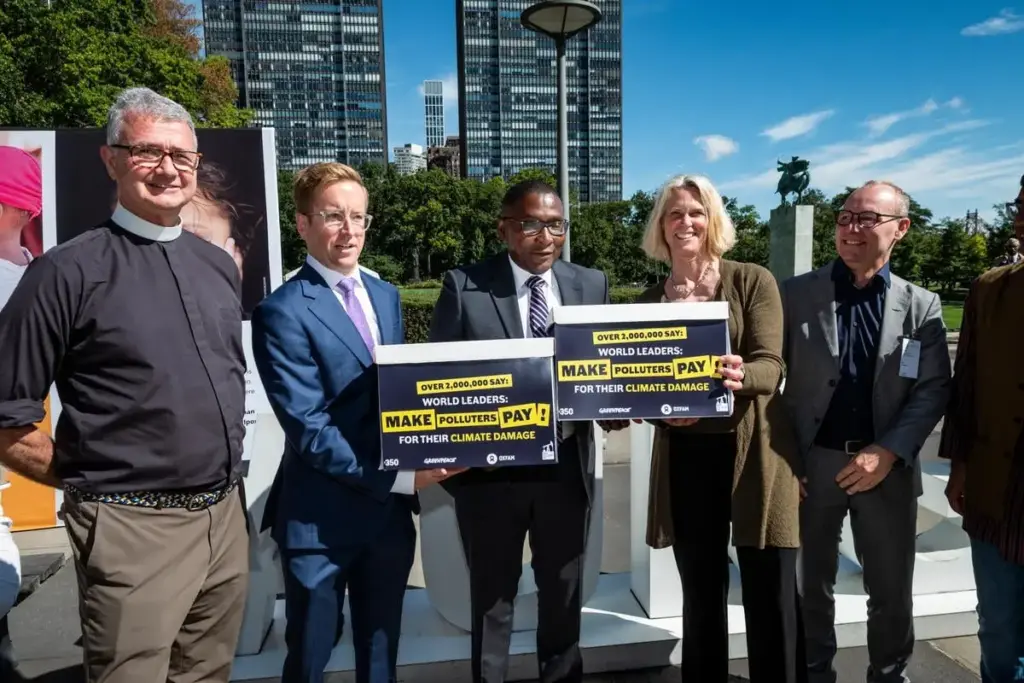
NEW YORK, U.S. — Against the backdrop of an increasingly fractured geopolitical landscape and a relentless onslaught of climate-induced disasters, global civil society has escalated its demands for planetary justice. In a coordinated, high-profile mobilization coinciding with the high-level debates of the United Nations General Assembly (UNGA), international campaigners delivered petitions bearing a combined total of over two million signatures to the heart of the UN headquarters.
The targeted message delivered to Selwin Hart, the UN Assistant Secretary-General for Climate Action, was unequivocal: governments must enact binding mechanisms to "Make Polluters Pay." As extraordinary heatwaves shatter historical records and unprecedented floods and wildfires lay waste to communities from the Global South to the industrialized North, the global coalition is demanding that fossil-fuel corporations and their super-rich beneficiaries be subjected to progressive taxation, targeted surtaxes, and punitive fines. The objective is clear—to force the energy giants to shoulder the mounting fiscal burden of recovery, adaptation, and the global transition to clean energy, rather than passing the catastrophic invoice onto ordinary citizens and beleaguered taxpayers.
This mobilization arrives at a critical inflection point in international climate diplomacy. With upcoming negotiations on international climate finance and global tax architectures looming large, the chasm between corporate enrichment and public impoverishment has never been starker. While the world’s largest oil and gas conglomerates continue to post historic, multi-billion-dollar windfalls, frontline communities are left to absorb the human and economic costs of ecological collapse. The petition delivery serves as both a moral indictment of corporate malfeasance and a direct challenge to world leaders: continue shielding the architects of the climate crisis, or stand with the vast majority of humanity demanding equity, accountability, and survival.
Detailed Chronology: The Road to the UNGA Mobilization
The journey toward the massive petition delivery in New York has been forged through years of mounting frustration, grassroots organizing, and compounding climate tragedies. To understand the gravity of the UNGA action, one must trace the timeline of escalating ecological breakdown and institutional reckoning that defined the lead-up to the event.
The Escalating Crisis of 2026
The urgency underpinning the multi-million-signature petition was supercharged by a catastrophic year of climate extremes. Entering 2026, scientific bodies issued dire warnings that the global community was dangerously close to permanently breaching the critical 1.5°C warming threshold established under the Paris Agreement—a ceiling that governments universally swore to defend.
By late summer, these warnings materialized into horrific reality. August 2026 was officially confirmed as the hottest month ever recorded in human history. Across the globe, populations endured relentless, life-threatening heatwaves, while torrential floods and apocalyptic wildfires displaced millions. Paradoxically, these disasters unfolded alongside persistent energy insecurity, a systemic vulnerability inextricably linked to the world’s continued, hazardous reliance on volatile oil and gas markets.
Organizing the Coalition
Recognizing that traditional lobbying efforts were insufficient to counter the immense political influence of the fossil-fuel lobby, the Make Polluters Pay International Coalition—operating in tandem with frontline environmental justice groups, international NGOs such as Greenpeace International, Oxfam, 350.org, and GreenFaith—spent months consolidating disparate grassroots petitions.
By mobilizing digital networks, local community assemblies, and faith-based organizations across continents, the coalition aggregated over two million signatures. These signatories formed a unified front, transcending geographic and cultural boundaries to demand that those who commodified and profited from carbon extraction be held legally and financially liable for the resulting carnage.
The UNGA Confrontation
The culmination of this months-long organizing effort took place inside the United Nations headquarters in New York. As heads of state, diplomats, and international policymakers convened to discuss global security, economic resilience, and sustainable development, the campaigners bypassed traditional diplomatic channels to bring the voices of two million citizens directly to the UN leadership.
The presentation of the petitions to Assistant Secretary-General Selwin Hart transformed a routine diplomatic gathering into a focal point for global climate justice. It underscored the profound disconnect between the high-minded rhetoric of international climate summits and the lived realities of communities crushed beneath the weight of climate debts.
Supporting Context & Metrics: Profits, Emissions, and the Injustice Gap
To fully grasp the necessity of the "Make Polluters Pay" campaign, one must examine the staggering economic and environmental metrics that characterize the contemporary fossil-fuel industry. The numbers reveal an ecosystem of staggering corporate enrichment built upon the systematic externalization of planetary risk.
The Half-Trillion-Dollar Windfall
In the wake of geopolitical shocks—most notably Russia’s invasion of Ukraine, which sent global energy prices skyrocketing—the world’s five largest publicly traded oil and gas majors (often referred to as the supermajors: ExxonMobil, Chevron, Shell, TotalEnergies, and BP) amassed an unprecedented half-trillion dollars in collective profits.
While ordinary consumers in both developed and developing nations suffered through crippling cost-of-living crises, inflated utility bills, and fuel poverty, these corporations prioritized share buybacks, executive compensation, and fossil-fuel expansion. According to projections highlighted by Oxfam International, the six biggest fossil-fuel titans alone are on track to rake in an astronomical $147 billion in profits within a single year.
+-------------------------------------------------------------------------+
|                  THE CLIMATE INJUSTICE EQUATION                         |
|                                                                         |
|  [5 Oil Supermajors]        -->  $500,000,000,000+ in Post-Ukraine Profits|
|  [Fossil Fuel Industry]     -->  $3 Billion in Daily Profits for 50 Years |
|  [Frontline Communities]    -->  Bear 100% of the Adaptation & Loss Costs |
+-------------------------------------------------------------------------+
The Human and Environmental Toll
The correlation between corporate carbon output and extreme weather events is no longer a matter of speculative science; it is quantifiable fact. Research indicates that the historical emissions of just five major oil companies were directly responsible for approximately one in every four heatwaves experienced globally since the year 2000.
Furthermore, data cited by faith-based climate organizations indicates that over the past half-century, the fossil-fuel industry has generated an average of $3 billion in daily profits while knowingly perpetuating pollution levels estimated to be responsible for one in every five deaths globally.
This creates what economists and human rights advocates term the "Injustice Gap":
- The Polluter: Enjoys historic profitability, heavily subsidized by state apparatuses, and insulated from the true costs of its business model.
- The Victim: Populations in the Global South—farmers, women, indigenous groups, and working-class families—who contributed virtually nothing to historical greenhouse gas emissions, yet forfeit their lives, homes, arable land, and economic futures to climate-driven devastation.
The Mechanics of the Demand
The Make Polluters Pay campaign is not merely asking for corporate charity; it is demanding systemic, binding legal and financial interventions. The coalition’s core fiscal proposals include:
- Climate Damages Taxes: Levies explicitly tied to the extraction and sale of fossil fuels, designed to internalize the environmental degradation caused by carbon products.
- Excess Profit Surtaxes: Emergency taxes deployed during periods of high energy price volatility to recapture windfall gains and redirect them into public coffers.
- Polluter Fines & Liability Laws: Enforceable legal penalties that hold corporations accountable for loss and damage, ensuring they fund climate adaptation, community relocation, and a just transition for displaced energy workers.
Official Statements: Voices from the Frontlines and the UN
The urgency of the New York mobilization was amplified by powerful statements from international leaders, civil society executives, and moral authorities, each dissecting the systemic failure of current climate governance and offering a roadmap for accountability.
The UN Perspective: A Call to Regulate, Legislate, and Litigate
Accepting the petitions on behalf of the United Nations, Selwin Hart, Assistant Secretary-General for Climate Action, delivered a scathing critique of the fossil-fuel industry while validating the moral authority of the global grassroots movement:
"The fossil fuel industry right now is earning extraordinary profits. Since Russia’s invasion of Ukraine, the five largest oil companies have earned half a trillion in profits. As the climate crisis accelerates, developing countries are being starved of the resources they need to protect their communities and to safeguard livelihoods from a crisis they did literally nothing to cause. This is unjust. This is the heart of climate injustice. Polluters must pay, and the UN supports this effort, we are with you."
Hart issued a direct call to action for civil society organizations and legal advocates worldwide, urging them to utilize every available instrument within domestic and international jurisprudence:
"We urge you to use every single legal and lawful tool at your disposal. Regulate, legislate and litigate. Civil society must use every tool at your disposal to hold the polluters accountable. You are on the right side of history."
Greenpeace International: "It Is Us, or Them"
Mads Christensen, Executive Director of Greenpeace International, framed the 2026 climate crisis as an existential battle between corporate greed and human survival:
"2026 is a year the whole world could feel. August was the hottest month ever recorded, and scientists confirmed we are close to breaking the 1.5°C limit governments swore to hold. The climate crisis is here, and it falls hardest on the people who did the least to cause it. The biggest oil companies keep chasing profit to the last barrel, fueling the very disasters wrecking lives, ready to burn everything behind them rather than change course."
Christensen emphasized that the financial burden of the climate crisis must be shifted away from ordinary households:
"The wealthiest polluters should be permanently taxed more to pay for the damage they cause, not the families and communities left to pick up the bill. Governments now face a clear choice, and too many are still on the wrong side of it: keep shielding the wealthiest polluters, or stand with the rest of us paying the price. This is how we take the profit out of destruction and protect the generations to come. It is us, or them."
350.org: Moving from Fringe Demand to Mainstream Imperative
Highlighting the evolution of the climate accountability movement, Anne Jellema, Executive Director of 350.org, noted that the demand for corporate restitution has broken through political barriers:
"For years, campaigners and communities on the frontlines have been saying the same thing: the companies that have profited from fossil fuels must pay their fair share of the costs of the crisis they helped create. Today, that demand is moving into the mainstream. We have watched homes burn, communities flood and families struggle with the rising costs of climate and energy crises, while fossil-fuel companies continue to make extraordinary profits. We pay. They profit. It’s time to change that. Now the voices of more than two million people are being brought to the United Nations. Governments have the power to make polluters pay, and they must use it."
Oxfam International: Dismantling the Billionaire-Polluter Alliance
Amitabh Behar, Executive Director of Oxfam International, zeroed in on the intersection of extreme wealth inequality and environmental devastation:
"Super-rich polluters are causing the most climate damage while the rest of us are left to pay the price. The emissions of just five oil giants were enough to cause around one in four heatwaves since 2000, and the six biggest are on track to rake in $147 billion this year. Meanwhile, farmers, women and families across the Global South are losing their lives, harvests and homes to a climate emergency they did not create. There is no fixing the climate crisis without taking on the billionaires and corporations cashing in on it. Frontline communities and millions of people have made their demand clear: make the richest polluters pay. Now world leaders must find the courage to protect billions of lives instead of polluters’ billions of dollars."
GreenFaith: A Moral and Theological Condemnation
Bringing an ethical and spiritual dimension to the discourse, Fletcher Harper, Executive Director of GreenFaith, classified the inaction of fossil-fuel corporations and complicit governments as a fundamental moral failure:
"Every religion teaches the same moral principle: you do not get to harm your neighbor and walk away. That is why religious leaders around the globe are calling for climate polluters to pay for the damage they have caused. For 50 years, the fossil fuel industry has enjoyed $3 billion in daily profits while knowingly creating pollution responsible for one in five deaths globally. Communities worldwide are absorbing the mounting costs of climate damage. Those expenses have not been paid by the polluters. They have been pushed onto families, communities, and taxpayers. In moral terms, that is theft."
Future Outlook: The Battlegrounds of Climate Finance and Global Taxation
As the dust settles on the UNGA petition delivery, the focal point of international climate politics shifts toward upcoming global negotiations on climate finance and international tax rules. The presentation of over two million signatures provides global civil society with a powerful mandate, but translating that popular pressure into binding legislative reality will require navigating formidable political obstacles.
The Legislative Horizon
Governments face an increasingly narrow window of time to pivot from voluntary carbon-reduction pledges to enforceable fiscal policies. Key legislative battlegrounds in the coming months will include:
- National Tax Reform: Pushing sovereign states to implement windfall profit taxes and climate surtaxes independent of sluggish international consensus.
- Global Tax Architecture: Engaging with international bodies, such as the United Nations tax committee framework, to establish equitable cross-border taxation rules that prevent multinational energy corporations from shielding assets in tax havens.
- Loss and Damage Implementation: Operationalizing international finance facilities designed to compensate developing nations for climate impacts, ensuring that capital is drawn from mandatory fossil-fuel levies rather than traditional overseas development aid budgets.
The Legal Frontier
Echoing Assistant Secretary-General Selwin Hart’s call to "regulate, legislate, and litigate," affected communities and legal NGOs are increasingly turning to the courts. Across multiple jurisdictions, climate litigation is entering a new, aggressive phase. Plaintiffs are no longer just suing governments for climate inaction; they are targeting fossil-fuel boards of directors and major shareholders directly, utilizing human rights frameworks, consumer protection laws, and tort liability to establish corporate responsibility for historical emissions.
Conclusion: A Definitive Choice
The convergence of two million petition signatures at the United Nations marks a psychological and political turning point in the global climate movement. The era of unchecked corporate impunity is facing an organized, resilient, and legally sophisticated global resistance.
World leaders assembled in New York are no longer operating in an informational vacuum; they have been served notice by their constituents. As the climate crisis accelerates and the economic toll mounts, governments are left with a stark, binary choice: continue subsidizing the destruction of the biosphere to protect the astronomical wealth of a few corporate executives, or muster the political courage to make polluters pay—securing a livable future for generations yet unborn.



