


Executive Overview
Amid the rhythmic crash of turquoise waves, the melodic chatter of endemic birds, and the soft rustle of coastal breezes, a profound global convergence unfolded in Indonesia’s West Papua. Dozens of Indigenous leaders, seated cross-legged on senats—traditional woven mats distinct to the Raja Ampat archipelago—gathered for the Heyul Pelei Koranu Fyak (The Grand Assembly of Raja Ampat Indigenous Communities). Running from August 20 to August 22, 2026, this landmark three-day summit transcended regional boundaries. It drew together local communities from across Papua and the wider Indonesian archipelago, alongside international Indigenous delegations from the Amazon basin, central Africa, and Malaysia.
Co-organized and supported by Greenpeace Indonesia and the local civil society organization Institut USBA, the assembly was convened with a singular, urgent mission: to forge unbreakable global solidarity in the defense of Indigenous lands, waters, and the irreplaceable biodiversity they harbor. As extractive industries—most notably nickel mining and illegal gold exploitation—encroach deeper into fragile ecosystems, this historic gathering served as both a cultural revival and a political line in the sand.
The culmination of the summit was the signing of the Arborek Declaration, a fiery manifesto demanding that governments worldwide recognize Indigenous ecological knowledge not merely as a quaint cultural artifact, but as the foundational scientific and practical solution to halting both the global biodiversity crisis and runaway climate change. With the upcoming UN Biodiversity Conference (CBD COP17) in Armenia fast approaching, the assembly has injected an unshakeable Indigenous mandate into global environmental policy discussions.
Detailed Chronology and the Road to Arborek
The seeds of the Heyul Pelei Koranu Fyak were planted long before delegates touched down on Arborek Island. To fully understand the gravity of the August 2026 assembly, one must trace the escalating friction between corporate extractivism and Indigenous stewardship in Southwest Papua.
Day One: Welcoming the World to the Coral Triangle
The assembly commenced on August 20, 2026, with traditional Papuan welcoming dances and musical performances that echoed across the shores of Arborek Island. Delegates from the Amazonian rainforests of Brazil, the dense basins of Cameroon, and the indigenous territories of Malaysia were formally welcomed by their Papuan hosts. Setting aside language barriers, the delegates quickly found common ground: their shared experiences of displacement, corporate greed, and state-sanctioned environmental degradation.
The first day focused heavily on storytelling and ceremonial bonding. Elders from Raja Ampat sat with international counterparts to share oral histories detailing how their ancestors managed marine and terrestrial resources without depleting them. These sessions laid the groundwork for the structural debates that would follow, grounding political demands in centuries-old philosophies of reciprocity with the natural world.
Day Two: Confronting the Extractivist Threat
On the second day, the discourse shifted sharply toward geopolitical and industrial threats. Delegates analyzed the lingering impacts of the #SaveRajaAmpat campaign—a high-profile youth and community-led movement that erupted last year to push back against destructive nickel mining operations.
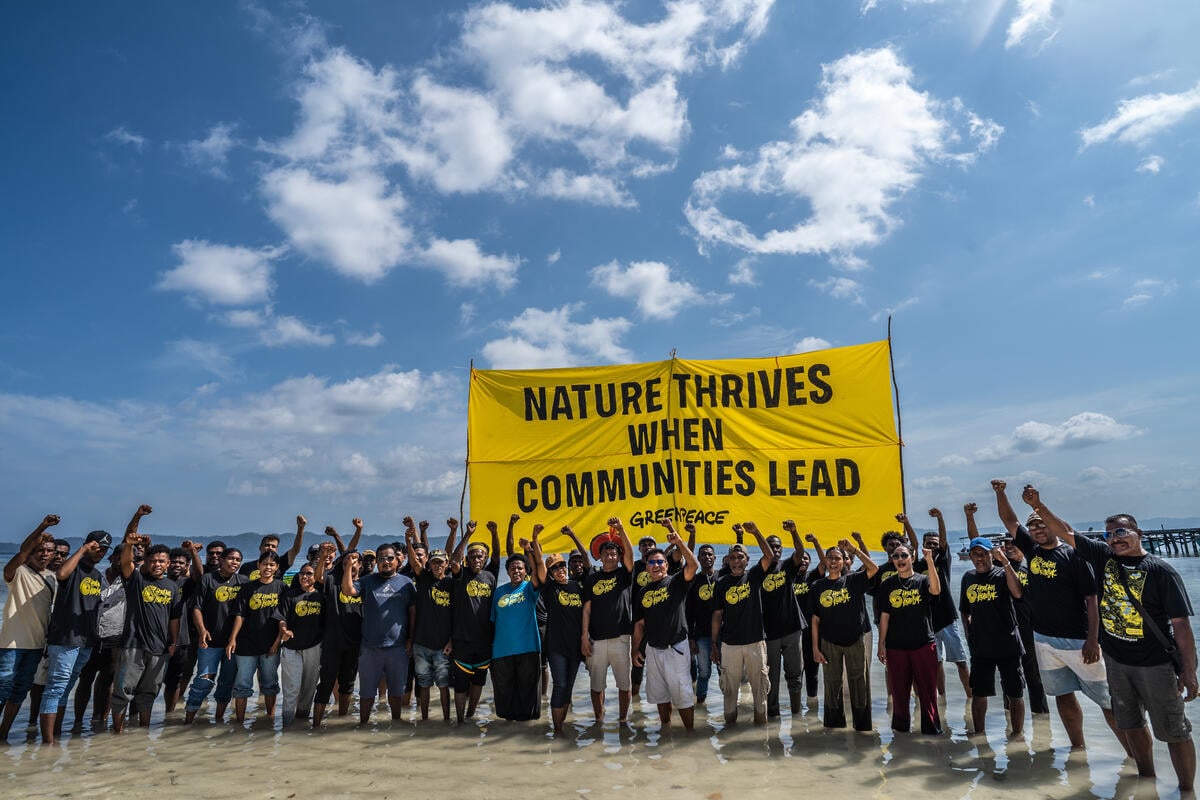
Raja Ampat, globally renowned as "the last paradise on Earth," sits directly within the Coral Triangle, an oceanic epicentre that hosts an astounding 75% of all known coral species on the planet. Yet, despite fierce public outcry and legal challenges, mining conglomerates continue to eye the archipelago’s mineral-rich soils, threatening the subterranean and marine webs of life.
Parallel sessions drew stark comparisons between the plight of Raja Ampat and the Amazon basin, where thousands of hectares of primary rainforest are actively being decimated by illegal gold dredging. Speakers detailed how extractivism operates globally through the same playbook: dispossessing Indigenous peoples, militarizing traditional lands, and leaving behind toxic tailings that poison rivers and coral reefs alike.
Day Three: The Birth of the Arborek Declaration
The summit culminated on August 22 with the drafting and unanimous signing of the Arborek Declaration. Modeled after the urgent demands raised during preceding events—including the Indigenous Senate Assembly—the declaration outlines a comprehensive blueprint for planetary survival.
The document explicitly challenges the top-down, fortress-conservation models historically favored by global powers. Instead, it positions Indigenous governance systems at the very vanguard of international environmental frameworks, setting the stage for direct advocacy at CBD COP17 in Armenia.
Supporting Context, Indigenous Wisdom, and Metrics
The urgency of the Arborek Declaration is underpinned by an undeniable body of scientific and anthropological evidence: ecosystems remain most resilient, biodiverse, and stable when the Indigenous communities who depend on them retain autonomous legal and physical control over their ancestral domains.
The Science of Indigenous Stewardship
Data consistently shows that lands managed by Indigenous Peoples sequester carbon at higher rates and suffer lower rates of deforestation than state-run or commercially exploited protected areas. This is not accidental; it is the result of sophisticated, adaptive governance systems refined over millennia.
In Raja Ampat, this philosophy is crystallized through sasi—an ancestral system of resource management. Sasi involves placing a temporary, culturally binding prohibition on the harvesting of specific natural resources (such as certain fish, sea cucumbers, or forest fruits) within a designated terrestrial or marine zone. This allows ecosystems a mandatory period of rest, recovery, and biological regeneration.
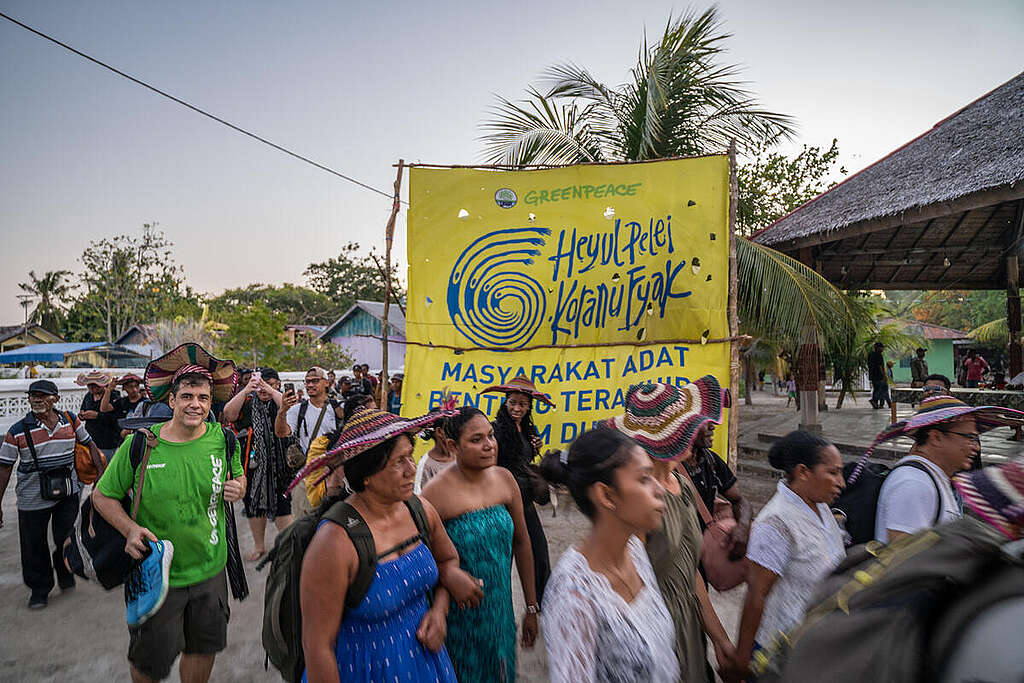
Papuan anthropologist George Mentasan, speaking passionately during the gathering, elaborated on the intricate web of traditional conservation mechanisms:
"There is the tradition of creating an ecological calendar; there is a taboo that requires us to speak in the local language upon visiting certain places; also there is a myth for not catching big fish. They are all our ancestors’ way to preserve nature. We have to protect our cultural diversity as it also safeguards Raja Ampat’s biodiversity."
Global Parallels: Voices from the Amazon
The structural similarities between the struggles in island Southeast Asia and continental South America were highlighted by Panh O Kayapo, an Indigenous Kayapo woman leader from the Brazilian Amazon. Kayapo underscored the disproportionate, frontline role that Indigenous women play in defending the biosphere against colonial extractivist forces:
"We are the Indigenous women who protect not only our children, but also our biome. I speak up about women’s role not only for our generation, but also for generations to come, for them to have a better future."
Kayapo’s testimony resonated deeply with Papuan women leaders, establishing an international sisterhood dedicated to resisting industrial expansion that prioritizes short-term financial dividends over human survival.
Official Statements and Policy Demands
As global leaders prepare for the upcoming UN Biodiversity Conference (CBD COP17) in Armenia to review progress made under the Kunming-Montreal Global Biodiversity Framework, the demands issuing from Arborek Island could not be more timely or politically explosive.
The 30×30 Target and the Human Cost of Conservation
A central pillar of the Kunming-Montreal framework is the 30×30 target—the global commitment to protect at least 30% of the world’s land and oceans by 2030. However, environmental justice organizations have long warned that poorly implemented conservation targets can lead to "green grabbing," where Indigenous communities are forcibly evicted from their ancestral territories under the guise of creating national parks or marine reserves.
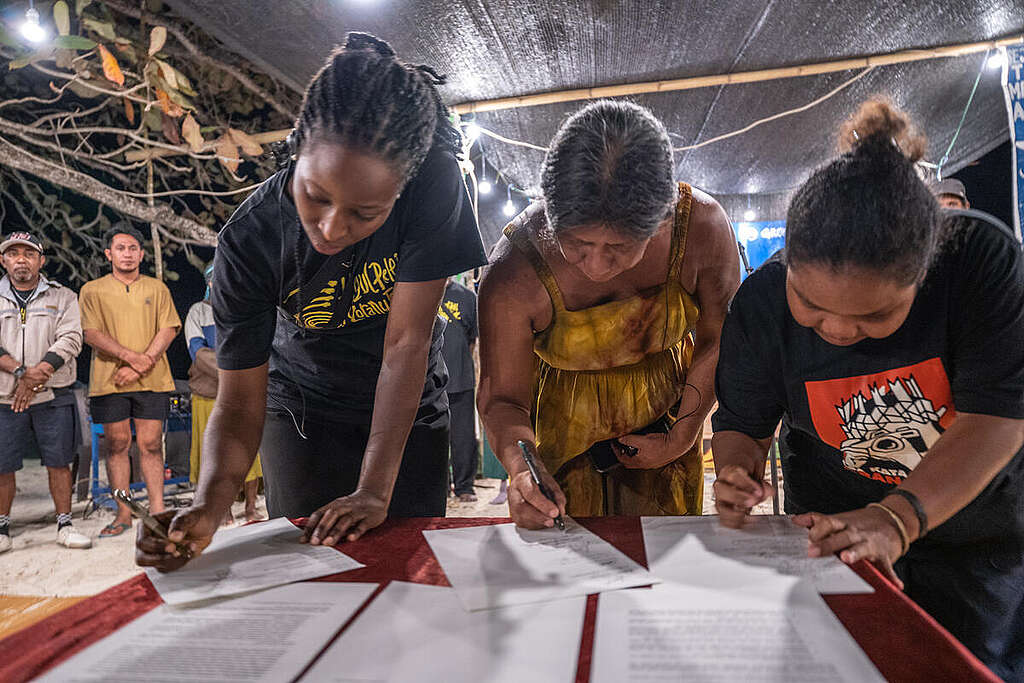
The Arborek Declaration asserts that nature protection must never come at the expense of the people who have faithfully cared for those territories for generations. Governments must strictly adhere to the principles of Free, Prior and Informed Consent (FPIC), ensuring that Indigenous communities retain absolute authority to decide how their lands and waters are managed.
Greenpeace’s Institutional Stance
Syahrul Fitra, Co-lead of Greenpeace’s Global Forest Solutions project, offered a scathing critique of current international conservation financing and governance models:
"Indigenous and Traditional Territories must be recognised on their own terms, rather than communities being forced into conservation models that do not reflect their rights, governance systems, or choices. Governments must also ensure direct access to biodiversity finance, so Indigenous Peoples and local communities have the resources to strengthen their own systems of protection and governance."
Fitra’s comments point to a systemic flaw in global climate and biodiversity funding: billions of dollars flow through centralized government bureaucracies and large international NGOs, rarely reaching the grassroots defenders who are actually keeping forests standing and coral reefs thriving on the ground.
Future Outlook: The Road to CBD COP17 and Beyond
The Heyul Pelei Koranu Fyak has fundamentally shifted the baseline for Indigenous advocacy in the Asia-Pacific region and beyond. By bridging the tactical experiences of communities in West Papua with those in the Amazon, Central Africa, and Malaysia, the assembly has catalyzed a truly borderless resistance network.
As the international community looks ahead to CBD COP17 in Armenia, the political weight of the Arborek Declaration will be impossible to ignore. Governments face a stark choice: continue down the destructive path of corporate extractivism and coercive, colonial conservation models, or honor Indigenous sovereignty and integrate ancient knowledge systems into modern environmental policy.
For the Indigenous peoples sitting on their senats under the canopy of Raja Ampat, the path forward is clear. They have drawn their line in the sand—and the coral. They are not merely asking for a seat at the table; they are reminding the world that they are the original architects of survival, and without them, there is no future left to save.



