

Executive Overview
Rare book acquisitions are rarely straightforward, but the journey of Eberhard August Wilhelm von Zimmermann’s three-volume treatise—Geographische Geschichte des Menschen, und der allgemein verbreiteten vierfüßigen Thiere, nebst einer hieher gehörigen Zoologischen Weltcharte—stands out as an exceptional narrative of institutional collaboration, historical detective work, and digital preservation. Published between 1778 and 1783, this monumental work of biogeography has formally entered the digital age through the Biodiversity Heritage Library (BHL). Its integration into the global digital commons marks a major milestone for the Field Museum’s Marie Louise Rosenthal Library and serves as a centerpiece for the ongoing celebration of "BHL at 20: Treasures from the Biodiversity Heritage Library."
Zimmermann’s work was far more than an ambitious survey of late-eighteenth-century mammal distribution; it sat at the center of a twentieth-century international regulatory battle over zoological nomenclature. Through historical correspondence involving prominent figures from the Field Museum—such as Wilfred H. Osgood and Philip Hershkovitz—and rulings by the International Commission on Zoological Nomenclature (ICZN), this foundational text narrowly escaped permanent scientific banishment. Today, the digitization of both Zimmermann’s rejected 19th-century Latin prototype and his authoritative, binomially sound German successor offers researchers an unprecedented case study in the evolution of biological classification. This report explores the historical weight, institutional maneuvering, cartographic triumphs, and modern digital rescue mission behind one of natural history’s most compelling bibliographic treasures.
Detailed Chronology: From Enlightenment Cartography to Modern Digital Access
To fully grasp the significance of Zimmermann’s work, one must trace a timeline spanning nearly 250 years of scientific discovery, regulatory dispute, and technological transformation.
- 1777 (The Latin Prototype): Eberhard August Wilhelm von Zimmermann publishes Specimen zoologiae geographicae, quadrupedum domicilia et migrationes sistens in Latin. While ambitious, the volume suffers from inconsistent naming conventions, frequently relying on descriptive phrases rather than strict binomial nomenclature.
- 1778–1783 (The Definitive German Edition): Zimmermann releases his heavily revised, expanded three-volume masterpiece, Geographische Geschichte des Menschen, und der allgemein verbreiteten vierfüßigen Thiere, accompanied by the groundbreaking fold-out map Tabula Mundi Geographico Zoologica. This edition successfully adopts binomial naming conventions and debuts several designations still valid today, including Cervus muntjak and Canis zerda.
- Mid-20th Century (The Nomenclature Crisis): As modern taxonomists work to stabilize scientific names, ambiguities arise regarding the validity of early works that skirted Linnaean conventions. Field Museum curators Wilfred H. Osgood and Philip Hershkovitz engage in pivotal correspondence with Francis Hemming, Secretary to the ICZN, advocating for the taxonomic validity and operational utility of Zimmermann’s 1778–1783 German text over its predecessor.
- 1954 (The ICZN Ruling): The International Commission on Zoological Nomenclature issues Opinion 257. The commission formally rejects the 1777 Latin Specimen for nomenclatural purposes—placing it on the "Official Index of Rejected and Invalid Works"—while officially approving the 1778–1783 Geographische Geschichte for inclusion on the "Official List of Works Approved as Available for Zoological Nomenclature."
- March (The Acquisition): Staff at the Field Museum’s Marie Louise Rosenthal Library identify a rare copy of the Geographische Geschichte available for purchase, utilizing a dedicated rare book fund to secure the scientifically and historically invaluable text.
- Present Day (Digital Resurrection): The complete three-volume German edition is successfully digitized and integrated into the Biodiversity Heritage Library (BHL), uniting it with its rejected predecessor and the historical ICZN opinions for open-access study worldwide.
Supporting Context & Metrics: Navigating the Scope of Zoological History
The acquisition and digitization of the Geographische Geschichte reflect stringent evaluation criteria implemented by natural history libraries. When collection managers at the Field Museum weigh potential rare book investments, they balance historical prestige against immediate research utility, conservation status, and digital redundancy.

Evaluating Rarity and Redundancy
Before committing funds from the Rosenthal Library’s specialized rare book endowment, curators ask several foundational questions:
- Does the text fall squarely within the institution’s core natural history collecting scope?
- Does it carry proven historical value and high scientific significance?
- Which global repositories currently house physical copies?
- Is a high-fidelity digital surrogate already accessible via open-access platforms like the BHL?
In the case of Zimmermann’s three-volume work, the digital landscape revealed a critical gap. While the 1777 Latin precursor (Specimen zoologiae geographicae) was already preserved within the BHL’s digital stacks, the vastly superior, expanded German edition remained largely confined to physical rare book vaults. By bridging this gap, the Rosenthal Library not only secured an impressive physical artifact but also closed a vital loop in the digital historical record.
Cartographic Evolution: Captain Cook and the Global Menagerie
A defining attribute of Zimmermann’s Geographische Geschichte is its accompanying fold-out map, the Tabula Mundi Geographico Zoologica sistens Quadrupedes hucusque notos sedibus suis adscriptos. Updated for the 1783 publication, this cartographic milestone absorbed the latest geographical revelations brought home by maritime explorers, most notably Captain James Cook and the crew of the HMS Endeavour.
- The Pacific Frontier: The map incorporates Cook’s charting of the Sandwich Islands (modern-day Hawaii).
- North American Coastlines: It delivers a noticeably more accurate and complete rendering of the western coast of North America.
- Colonial Footprints: The Seychelles are explicitly labeled east of the African mainland, reflecting French colonial ambitions established just thirteen years prior.
- Faunal Mapping: Quadrupeds are plotted directly over their indigenous geographic ranges. The map features terms ranging from strict Latin binomials to common names: Castor across northern North America, Tigris across Asia, and Kanguro positioned in New Holland (Australia)—acknowledging the kangaroo’s introduction to European science by botanist Daniel Solander aboard Cook’s Endeavour.
Official Statements & Institutional Insight: The Field Museum’s Advocacy
The journey of Zimmermann’s work from contested eighteenth-century literature to officially sanctioned nomenclature highlights the critical behind-the-scenes role played by museum scientists. The ICZN’s 1954 ruling did not happen in a vacuum; it was forged through active debate and formal correspondence between international regulators and Field Museum experts.

When Francis Hemming, Secretary to the ICZN, sought clarity on how to treat Zimmermann’s competing publications, he turned directly to the institutional knowledge housed within the Field Museum.
- Wilfred H. Osgood, a preeminent mammalogist at the Field Museum, provided compelling arguments for recognizing the taxonomic validity of the 1778–1783 German text.
- Philip Hershkovitz, serving as Curator of Mammals at the time, strongly reinforced Osgood’s position, helping steer the commission toward a pragmatic resolution that preserved essential historical binomials without destabilizing modern zoological record-keeping.
This institutional collaboration ensured the survival of several foundational binomial names still attributed to Zimmermann today, including:
- Cervus muntjak (the muntjac deer)
- Lutra minima (now recognized as Chironectes minimus, the water opossum or yapok)
- Canis zerda (now classified as Vulpes zerda, the fennec fox)
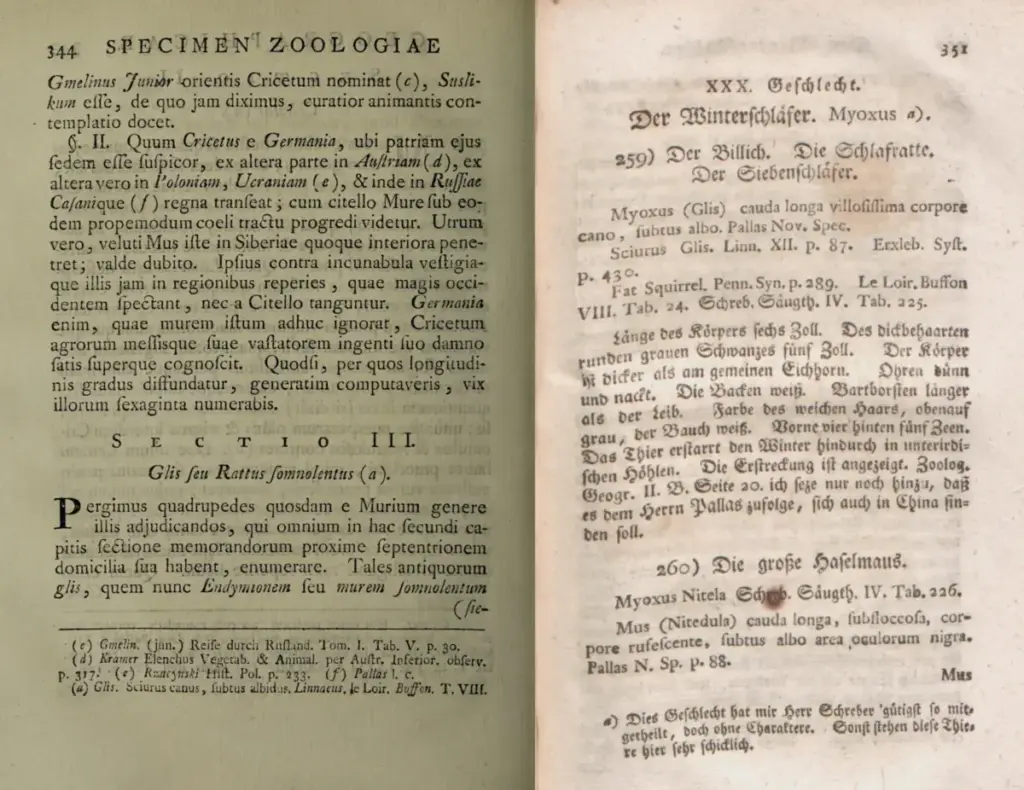
Furthermore, the transition from ambiguous nomenclature to strict Linnaean standards is starkly visible when comparing the texts. For instance, in his 1777 Specimen, Zimmermann struggled with consistency, designating a specific dormouse as Glis seu Rattus somnolentus. By volume two of the Geographische Geschichte (1780), he refined his approach to the clean binomial Myoxus glis (today understood within the genus Glis glis).
Future Outlook: The Ongoing Evolution of Open Access Science
The successful integration of Zimmermann’s Geographische Geschichte into the Biodiversity Heritage Library underscores a broader philosophical truth about the history of science: texts published centuries ago remain active, breathing components of the modern scientific record.

As the BHL marks its 20th anniversary through the "BHL at 20: Treasures from the Biodiversity Heritage Library" series, achievements like this highlight the transformative power of open-access preservation. By tearing down the geographic and financial barriers that traditionally restricted access to rare book vaults, initiatives like the BHL empower researchers, historians, and citizen scientists worldwide to examine the raw ingredients of modern taxonomy.
Having both the rejected 1777 prototype and the approved 1778–1783 German masterwork accessible side-by-side—complete with the formal ICZN opinions that arbitrated their fates—provides an extraordinary educational resource. It demystifies the bureaucratic and scientific machinery of biological classification, demonstrating that science is not merely a collection of static facts, but a rigorous, self-correcting dialogue unfolding across centuries. Through continued institutional partnerships, philanthropic support, and digital innovation, the global scientific community can ensure that historical treasures continue to inspire and inform the conservation challenges of tomorrow.



