

Executive Overview
Urbanism has long suffered from an insular identity crisis—too often treated as the exclusive domain of master planners, bureaucratic zoning boards, and pencil-pushing developers. Yet, the true DNA of a city is written in its alleys, its corner cafes, its makeshift community gardens, and the chaotic daily choreography of the millions who inhabit it. Enter Utopian Hours, the international festival of city-making that has spent the last ten years challenging, deconstructing, and radically expanding the parameters of how we conceive, build, and inhabit our urban centers.
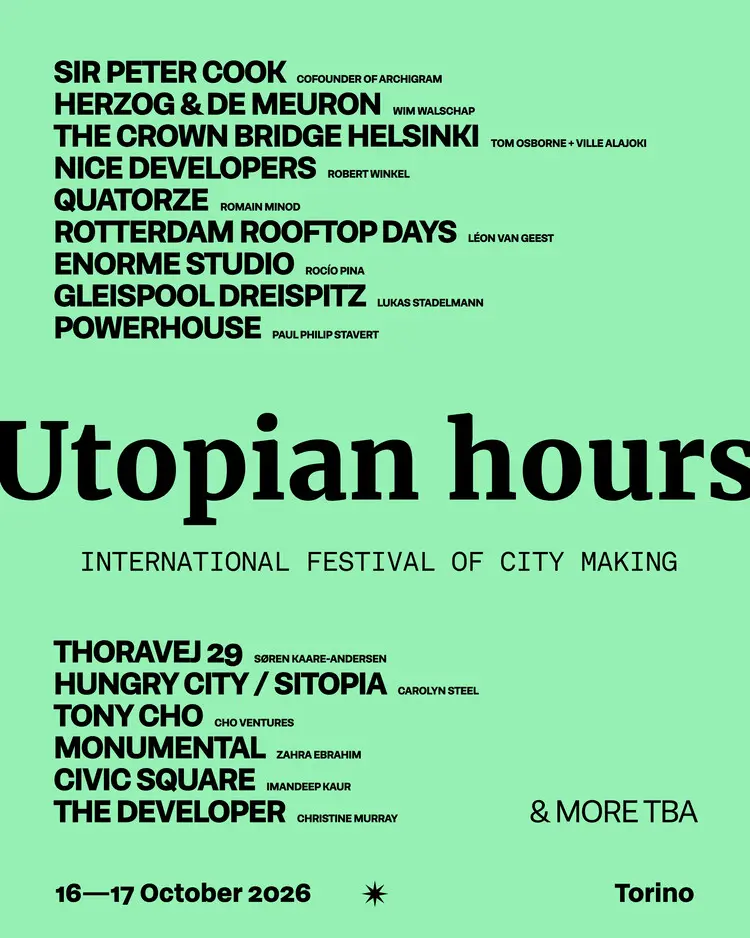
Following a triumphant opening chapter in Rotterdam last May, the festival prepares for Part 2 of its landmark Ten Years Edition, returning to its intellectual roots in Torino, Italy. Over an intensive two-day immersion, the festival converges architects, urban practitioners, developers, community organizers, policymakers, and civic catalysts to interrogate the critical questions defining the next era of urban life. Who ultimately holds the pen when cities are written? How can we radically repurpose existing infrastructure rather than endlessly expanding outward? What does the climate crisis demand of our public squares and transit networks? And, perhaps most pressingly, how can everyday citizens wrest agency back from top-down municipal mechanisms?
The premise driving Utopian Hours is deliberately expansive and democratizing. Cities are not forged by architectural blueprints alone. They are shaped by real estate capital and municipal investment, but just as profoundly by public libraries and museums, vibrant nightlife and corner bars, public restrooms and civic plazas, robust food systems and transit grids—and, ultimately, the human pulse that animates them all.
Setting an appropriately visionary tone for this milestone edition, the festival opens at the very outer edge of architectural imagination. Just one week before celebrating his milestone 90th birthday, Archigram co-founder and visionary provocateur Sir Peter Cook will take the stage in Torino for an exclusive masterclass. It is a fitting anchor for a festival that has spent a decade asking not just what cities are, but what they could be.
Detailed Chronology: Ten Years of Challenging the Urban Paradigm
To understand the weight of the upcoming Torino gathering, one must trace the trajectory of Utopian Hours over the past decade. Conceived by the Turin-based urban agency Stratosferica, the festival emerged not as a traditional academic symposium, but as a disruptive cultural intervention aimed at bridging the gap between municipal decision-makers and the urban grassroots.
The Formative Years (2016–2018)
In its infancy, Utopian Hours set out to dismantle the dry, technical jargon of urban planning. Recognizing that cities like Torino were grappling with post-industrial transitions, the festival introduced international best practices to Italian audiences. Early editions focused heavily on tactical urbanism—quick, low-cost, scalable interventions that reclaimed asphalt for pedestrian life. Speakers ranged from cycling advocates from Copenhagen to placemaking pioneers from New York, establishing the festival’s trademark cross-disciplinary DNA.
Scaling the Global Conversation (2019–2022)
As the festival matured, its geographic scope widened dramatically. It transitioned from a localized Italian showcase into a globally recognized nexus for urban innovation. Even amidst the disruptions of the early 2020s, Utopian Hours pivoted effectively, creating hybrid digital-physical platforms that connected urbanists from Tokyo to São Paulo. Discussions shifted from basic tactical interventions to systemic challenges: housing affordability, the spatial impacts of the gig economy, and the urgent need to decarbonize urban mobility.
The Decadal Milestone: Rotterdam to Torino (2025–2026)
Marking its tenth anniversary, the festival adopted a two-part international structure. Part 1, hosted in Rotterdam last May, leaned into the Dutch city’s masterclass in water management, resilient delta urbanism, and avant-garde density. Now, Part 2 brings the decadal celebration back to Torino. The 2026 iteration is designed as a retrospective and a forward-looking manifesto rolled into one, featuring interactive workshops, guerrilla urbanism exhibitions, and high-level debates on the future of European and global cities.
Supporting Context & Metrics: The State of Global Urbanism in 2026
The return of Utopian Hours to Torino arrives at a critical juncture in global demographic and environmental history. By 2026, over 56% of the global population resides in urban areas, a figure projected to approach 70% by 2050. This unprecedented concentration of humanity brings with it existential pressures that make the festival’s core inquiries more urgent than ever.
The Climate Imperative and Public Space
Urban centers currently account for roughly 70% of global carbon emissions and consume over two-thirds of the world’s energy. As extreme weather events—from urban heat islands to flash floods—increasingly threaten metropolitan populations, the traditional conceptualization of public space as mere aesthetic landscaping is obsolete. Parks are now stormwater retention basins; asphalted plazas are cooling corridors; and transit systems are the primary battlegrounds for achieving net-zero municipal goals.
Utopian Hours addresses these metrics not through dry statistical presentations, but by examining real-world case studies where tactical climate adaptation has been successfully integrated into community fabric.
The Crisis of Civic Agency
Parallel to the climate emergency is a crisis of democratic participation in urban development. In many hyper-gentrifying cities across the globe, the commodification of real estate has alienated long-term residents from the decision-making process. Mega-developments driven by private equity frequently prioritize high-yield ROI over social infrastructure.
The festival tackles this head-on by amplifying grassroots organizers and municipal leaders who are successfully pioneering participatory budgeting, community land trusts, and co-design frameworks. The central question for 2026 is clear: How can cities scale development without sacrificing their civic soul?
Official Statements & Theoretical Frameworks
The philosophical backbone of Utopian Hours remains rooted in the belief that urban spaces should provoke wonder, foster equity, and mirror the diverse complexities of human society.
Luca Ballarini, founder of Stratosferica and the creative force behind the festival, has consistently emphasized the necessity of playfulness in urban design. In past statements framing the festival’s ethos, Ballarini noted:
"We do not build cities merely to survive the logistics of modern existence; we build them to dream, to collide with difference, and to discover unexpected joy. When urban planning becomes exclusively an exercise in engineering and real estate yields, the soul of the city evaporates. Utopian hours are those moments where we suspend the cynical realities of municipal bureaucracy and dare to redesign our environment around human desire."
This philosophy finds its ultimate living embodiment in the festival’s keynote headliner for the 2026 Torino edition: Sir Peter Cook. As a founding member of Archigram in the 1960s, Cook co-created visionary, sci-fi-infused architectural concepts such as the Plug-In City and the Walking City. These projects challenged the static, monumental nature of mid-century modernism by proposing dynamic, adaptable, and technologically integrated urban ecosystems.
Reflecting on his upcoming masterclass on the cusp of his 90th birthday, Cook’s legacy serves as a vital counterweight to contemporary risk-averse development. In an era dominated by value-engineering and restrictive zoning, Cook’s lifelong crusade reminds the architectural community that the most enduring cities are born from unbridled imagination.
Future Outlook: Where Do We Go From Here?
As Utopian Hours concludes its ten-year milestone celebration in Torino, the festival is not merely looking back at a decade of achievement—it is laying down the scaffolding for the next era of city-making.
The insights synthesized from the Rotterdam and Torino dialogues point toward several distinct trajectories for urbanism over the coming decade:
- The De-Motorization of the Core: The complete reimagining of inner-city transit away from private automobile dominance toward hyper-connected micro-mobility, pedestrian corridors, and autonomous public transit fleets.
- Adaptive Reuse as Default: Moving away from carbon-heavy demolition and new construction. The next decade of urbanism will prioritize the radical retrofitting of obsolete commercial real estate, parking structures, and industrial assets into mixed-use civic hubs.
- Radical Citizen Inclusion: Transitioning from passive public consultations to active, tech-enabled co-governance models where local communities hold binding equity and decision-making power over neighborhood master plans.
- Biophilic and Resilient Infrastructure: Integrating nature not as a decorative afterthought, but as core engineering infrastructure capable of buffering cities against climate volatility.
Ultimately, Utopian Hours reaffirms a fundamental truth: cities are never finished. They are unfinished canvases, continuously negotiated by the people who walk their streets, protest in their squares, and dream in their cafes. As the festival enters its second decade, its mission remains as vital as ever—to ensure that the future of the city is shaped not just by those who finance it, but by those who live it.



