

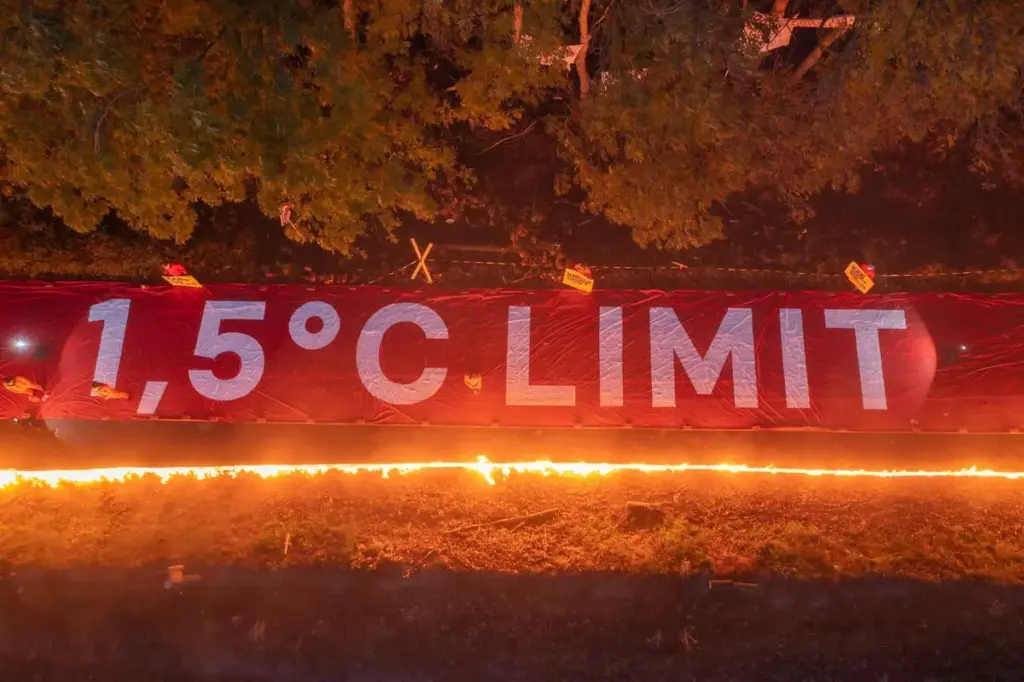
AMSTERDAM — In what may prove to be a historic turning point for international climate policy, the United Nations Environment Programme (UNEP) has issued an unequivocal warning: the global average temperature rise is set to exceed the critical 1.5°C threshold, a milestone likely to be breached within the next few years.
This stark projection has triggered an immediate and coordinated response from environmental advocates, indigenous leaders, and international scientists. Campaigners argue that concerted, large-scale interventions to phase out fossil fuels and halt global forest destruction must become the non-negotiable driving force of domestic and international government policy. As the planet reels from an intensification of extreme weather events—including catastrophic heatwaves, unprecedented wildfires, and a strengthening “super” El Niño—the international community faces a profound reckoning over the pace, scale, and execution of climate mitigation.
Executive Overview
The latest UNEP findings mark a watershed moment in multilateral climate reporting. For the first time, an official United Nations assessment explicitly details a 1.5°C “overshoot, peak, and decline” pathway. While the report outlines that temporary breaches of the target are now practically unavoidable, it emphasizes that the severity and duration of this overshoot remain within human control.
The findings arrive against a backdrop of escalating climate volatility that has heightened global anxiety. The convergence of severe meteorological anomalies has underscored the reality that climate change is no longer a distant threat on the horizon, but an active, compounding crisis. In response, environmental organizations such as Greenpeace are urging global leaders to leverage upcoming diplomatic platforms—including the United Nations General Assembly and the COP31 climate talks—to dramatically raise national ambitions.
Simultaneously, grassroots and geopolitical coalitions, such as the Santa Marta "coalition of doers," are being called upon to spearhead aggressive domestic measures. These groups face the complex task of driving concrete progress toward a just, equitable transition away from fossil fuels amidst an increasingly turbulent geopolitical landscape.
Detailed Chronology: From Ambition to Overshoot
To understand how the global community arrived at the threshold of a 1.5°C overshoot, it is necessary to examine the trajectory of international climate agreements and scientific warnings over the past decade.
The Paris Agreement and the 1.5°C Benchmark
Adopted in 2015 at COP21, the Paris Agreement committed signatory nations to holding the increase in the global average temperature to well below 2°C above pre-industrial levels, while pursuing efforts to limit the temperature increase to 1.5°C. Over subsequent years, mounting scientific evidence compiled by the Intergovernmental Panel on Climate Change (IPCC) revealed that crossing the 1.5°C threshold would dramatically increase the probability of triggering irreversible climate tipping points, such as the collapse of major ice sheets, the dieback of the Amazon rainforest, and the large-scale disruption of ocean circulation systems.
The Escalation of Extreme Weather (2023–2026)
The years leading up to the UNEP announcement were characterized by record-shattering global temperatures. The onset of a potent El Niño weather pattern, combined with unrelenting greenhouse gas emissions, pushed global temperatures into uncharted territory. Severe, prolonged heatwaves swept across North America, Europe, and Asia, while catastrophic wildfires devastated ecosystems from the Mediterranean to the boreal forests of Canada. These cascading crises provided grim empirical validation for climate models warning that the window to prevent a temporary breach of the 1.5°C limit was rapidly closing.
The UNEP "Overshoot, Peak, and Decline" Assessment
The release of the new UNEP report formalizes what scientists have feared: emissions trajectories are currently insufficient to prevent the world from crossing the 1.5°C line in the near term. The report outlines a three-phase scenario:
- The Overshoot: Global temperatures exceed 1.5°C for a period of decades.
- The Peak: Through aggressive, immediate mitigation and carbon removal, global temperatures peak—with the best-case scenario under current commitments pointing to a peak of roughly 1.8°C.
- The Decline: Over the course of the latter half of the 21st century, atmospheric greenhouse gas concentrations are reduced sufficiently to bring global average temperatures back down to or below 1.5°C.
However, scientists caution that a successful "decline" phase is far from guaranteed and relies entirely on unprecedented, immediate policy action.
Supporting Context & Metrics: Legal Obligations and Scientific Realities
The debate over the 1.5°C threshold is no longer confined to political negotiations or environmental advocacy; it occupies an increasingly robust legal and empirical framework.
Legal Imperatives: The International Court of Justice
Limiting global warming to 1.5°C has transitioned from a political aspiration to a binding legal obligation. In a landmark Advisory Opinion, the International Court of Justice (ICJ)—backed by a formal UN General Assembly resolution—confirmed that the 1.5°C limit constitutes a legal duty for all sovereign states.
Crucially, the ICJ ruling establishes that high carbon-emitting nations carry a distinct historical responsibility to act fastest and most decisively. These industrialized economies are legally compelled to support the most vulnerable communities on the front lines of the climate crisis, reinforcing the principles of climate justice and equitable resource distribution.
The Intergenerational Burden
Scientific analyses accompanying the UNEP report highlight the severe intergenerational injustice inherent in an overshoot scenario. Dr. Jerry Jose, Senior Scientist at the Greenpeace International Science Unit, emphasized the compounding risks of extended warming:
"Among the many stark warnings, the UNEP report presents the intergenerational burden climate change will impose on future communities in an overshoot scenario. The risks of permanent change escalate as our climate warms. In addition, the multiple decades needed for a decline in the global temperature back to 1.5°C would exacerbate already uneven impacts, many of which have the potential to continue well beyond stabilization."
Dr. Jose noted that deep, sustained mitigation in the near term is essential to constrain both the peak and the duration of the overshoot. Because the multi-decade cooling period is not a guaranteed outcome, current generations are shouldering an unprecedented ethical responsibility to make decisions that safeguard the viability of Earth’s systems for centuries to come.
Official Statements and Stakeholder Perspectives
As governments digest the implications of the UNEP findings, key figures from international environmental organizations and frontline regions have voiced urgent demands for accountability and structural transformation.
Greenpeace International: A Lifeline, Not an Excuse
Addressing the sobering nature of the report, Jasper Inventor, Deputy Programme Director at Greenpeace International, rejected the notion that an overshoot implies failure or resignation:
"This is news none of us wanted to hear, but overshoot is not the reason to give up and surrender 1.5°C. It’s a heartbreaking moment, and we need to reflect on that, but every fraction of a degree still matters and the UNEP report must now serve as a defining call to action."
Inventor stressed that the 1.5°C limit is fundamentally a human lifeline:
"The 1.5°C goal is not only a legal, political, and moral threshold — it’s our lifeline, and what we do today and tomorrow will determine our fate. Governments must accelerate a fast, fair, and funded just transition into renewable energy, ensure we end and reverse forest destruction by 2030, and hold fossil fuel polluters and forest destroyers to account. To help finance climate action, we must also make polluters pay for climate damages."
The Pacific Perspective: Justice, Sovereignty, and Survival
While industrialized nations debate economic transitions, Pacific Island nations are already experiencing the existential threats of a warming planet. The release of the UNEP report coincided directly with the Pacific Island Forum in Palau, where regional leaders gathered to consolidate strategies for COP31 and campaign for a Fossil Fuel Free Pacific.
Speaking from Palau, Moemoana Schwenke, Pacific Climate Campaigner at Greenpeace Australia Pacific, articulated the non-negotiable stance of island communities:
"For the Pacific, 1.5°C is not an ambition, it is a survival line. It is a matter of justice, sovereignty, and our right to determine our own futures in our Pacific way. We inherit our lands, oceans, and cultures as an entrusted responsibility, not a commodity to be exhausted."
Schwenke reinforced the intersection of legal mandates and regional survival:
"The International Court of Justice has already been clear that 1.5°C is a legally binding obligation, not just a choice. Pacific communities, for decades, have been clear that our ways of life, homes, and livelihoods are under threat from climate disasters and impacts. An overshoot is not compatible with Pacific wellbeing. The court and governments must translate responsibility into action: a rapid, just, and legally grounded transition away from fossil fuels with no further expansion of coal, oil, and gas."
Future Outlook: Navigating the Overshoot Era
The confirmation that the world is poised to cross the 1.5°C threshold demands a radical recalibration of global climate strategy. Navigating the "overshoot, peak, and decline" pathway requires a dual-track approach: aggressive mitigation to prevent catastrophic tipping points, and comprehensive adaptation frameworks to protect vulnerable populations from escalating climate shocks.
Key Policy Imperatives for the Coming Decade
- Immediate Fossil Fuel Phase-Out: Governments must halt the authorization and financing of new coal, oil, and gas extraction projects, redirecting capital toward decentralized, renewable energy infrastructure.
- Ecosystem Restoration and Protection: Halting and reversing global deforestation by 2030 is critical for maintaining natural carbon sinks and preserving planetary biodiversity.
- Operationalizing Climate Justice: High-emitting nations must fulfill international climate finance commitments, ensuring that adaptation funding reaches frontline communities in the Global South and the Pacific.
- "Polluter Pays" Mechanisms: Establishing legally binding financial liabilities for fossil fuel conglomerates and corporate forest destroyers will provide necessary revenue for loss and damage funds.
Ultimately, the impending 1.5°C overshoot serves as both a sobering confirmation of past policy failures and an urgent catalyst for future action. Whether the global community can successfully peak and decline temperatures without triggering irreversible planetary collapse will depend entirely on the political will demonstrated by world leaders in the critical months and years ahead.



