

Executive Overview
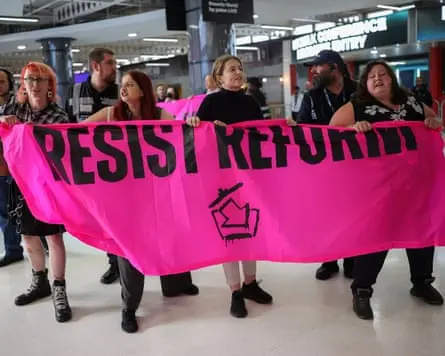
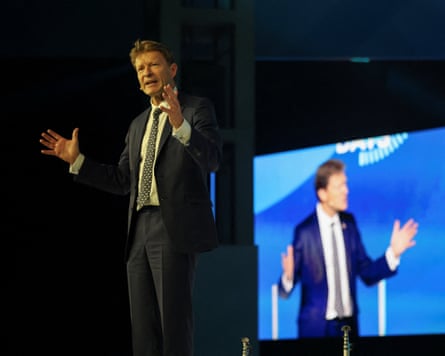
The juxtaposition could hardly have been starker. On the second day of the Reform UK annual conference in Birmingham, against a tumultuous backdrop of undercover investigative reporting alleging that party officials had plotted to circumvent strict political donation laws regarding foreign funding, the party’s deputy leader, Richard Tice, took to the stage to rally the faithful. Within minutes of his opening remarks, a protest banner abruptly unfurled directly behind him, bearing a provocative message: "Collect £5m, burn the planet."
Though the banner was swiftly confiscated by event security, the interlude encapsulated the acute political and ideological friction defining Reform UK’s current trajectory. Tice, who has consistently used his platform to dismiss the severity of climate change—famously urging the British public to “enjoy” a punishing sequence of five consecutive summer heatwaves and record-breaking droughts—simply brushed off the disruption and continued addressing the audience.
Yet, beneath the polished facade of conference stalls offering simulated helicopter rides, gold bullion investments, tattoo artistry, and heavily discounted rum, a deeper, more systemic paradox was laid bare. Interviews with delegates and rank-and-file members revealed an electorate caught in a web of cognitive dissonance. While enthusiastically echoing the leadership’s outright climate scepticism and fierce opposition to "net zero" policies, these same attendees simultaneously excoriated the government for failing to adequately protect them from the tangible, destructive impacts of extreme weather.
This profound policy incoherence—simultaneously dismissing global heating as a manufactured myth while lambasting Westminster for inadequate infrastructure, poorly ventilated housing, and a lack of public air conditioning—highlights a critical vulnerability for the populist right. Furthermore, political analysts and recent empirical polling suggest that this rhetoric exposes a widening chasm between an uncompromising party leadership and a remarkably pragmatic, environmentally conscious voting base.
Detailed Chronology: Unfolding Events at the Birmingham Conference
Day Two Tensions and the Banner Incident
The atmosphere inside the Birmingham conference venue was already electric following explosive media revelations that rocked the party’s upper echelons. Yet, the internal ructions quickly spilled over into the main auditorium during Richard Tice’s keynote address. As Tice castigated mainstream political consensus, activists from the direct-action climate group Climate Resistance managed to breach security protocols to hang their pink "Resist Reform" banner.
The brief visual critique—pointing directly to allegations of illicit fundraising juxtaposed with environmental degradation—sent a momentary ripple of confusion through the delegate seating before security wrestled the material away. Tice, accustomed to weathering political storms, maintained his composure and pivoted back to his populist talking points, lambassing environmental regulations as an unaffordable luxury that shackles British enterprise.
The Floor View: Scepticism Meets Extreme Weather
Out on the bustling conference floor, where commercial vendors vied for the attention of card-carrying members, climate scepticism was not merely a fringe sentiment; it was the dominant cultural orthodoxy.
Jeanette Bowden, a delegate from Bexley, beamed as she recalled the scorching summer months. “I enjoyed the heat this summer,” she remarked, voicing a sentiment echoed by numerous attendees. “I don’t think people need telling to take care of themselves.”
Her partner, James, offered an unscientific rationalisation to validate his rejection of anthropogenic climate change: “Carbon dioxide was much higher in the past, it was 10 times higher than this during the ice ages. It’s not a human problem.”
Other attendees dismissed predictive climate modelling with outright derision. Jim Langford, another conference delegate, scoffed at institutional warnings regarding rising sea levels. “They told us Norwich would be underwater by now and it’s not Atlantis yet,” he declared. Ed Rennie, a former Labour councillor from north London who had defected to the populist fold, bolstered these arguments by citing selective revisions in historical reporting by the Intergovernmental Panel on Climate Change (IPCC).
The Great Grievance: State Inadequacy in the Face of Heat
What makes the worldview of Reform UK’s core activists so striking, however, is the paradoxical transition from climate denial to fierce statist grievance. While these delegates maintain that global heating is either non-existent, natural, or grossly overhyped, they simultaneously exhibit immense fury toward successive UK governments for failing to shield the population from the very meteorological anomalies they downplay.

Jeanette Bowden expressed bitter frustration over modern architectural trends and government building codes. Pointing to new-build housing developments, she complained, "They have really small windows. That might be good in winter, but in summer it must be too hot, you can hardly open them. The government should not force this on people.”
Yvonne, a delegate who declined to provide her surname, launched a scathing attack on administrative inertia during the seasonal heatwaves. "The government were all on their holidays in the summer, not doing their jobs," she fumed. "Government should ensure there is clean water and sewage, but they’re not even doing that."
Echoing these demands for muscular state intervention in infrastructure—ironic for a party rooted in libertarian and small-state philosophies—another anonymous delegate, Nicholas, argued that air conditioning units should be retrofitted as a statutory requirement across all public hospitals, schools, and libraries, alongside heavy subsidies to make domestic air conditioning universally accessible.
Agriculture and workplace safety were similarly cited as areas of catastrophic state failure. Beryl Kingsbury argued that while citizens bear personal responsibility for their well-being during temperature spikes, Britain’s farming community has been systematically abandoned. "They should have more support," she insisted, "but this government seems to hate farmers."
Mark Henderson, a facilities manager whose daily duties require him to monitor three expansive outdoor industrial yards, approached the crisis through the lens of common-sense regulation. Wearing heavy personal protective equipment throughout consecutive heatwaves had proven punishing. "I wear a helmet all the time, which was very hot, but I don’t need it all the time," Henderson explained. "You should be able to relax those rules in hot weather, to make them task-specific."
Supporting Context & Metrics: The Anatomy of a Political Paradox
Expert Analysis: Manufactured Myths and Cognitive Dissonance
To understand the ideological contortions on display in Birmingham, political scientists point to a deliberate strategy engineered by the party’s leadership. Michael Jacobs, an emeritus professor of political economy at the University of Sheffield, argues that the confusion observed among Reform supporters is a direct, predictable outcome of relentless messaging from figures like Tice and Nigel Farage.
According to Jacobs, while voters routinely harbour contradictory political desires—such as demanding world-class public services while flatly rejecting tax increases—the climate debate has been supercharged by right-wing populist factions weaponising environmental policy as a core pillar of the ongoing "culture wars."
"It’s really incoherent to be in favour of adaptation but not [cutting greenhouse gas emissions], but it’s not surprising people think that, given what they’ve been told," Jacobs observed.
"Tice and Farage have claimed net zero would be economically ruinous, which is simply wrong. They try to say the UK is acting alone in cutting emissions, also untrue. These are pernicious myths. They have obscured the scientific fact that net zero is the description of where you need to get to, to stop the climate crisis getting any worse."
The Divergence Between Leadership Rhetoric and Voter Reality
Crucially, empirical data suggests that the hyper-sceptical, anti-environmental rhetoric echoing through the Birmingham conference halls represents the fringe radicalism of activist subcultures rather than the settled consensus of the broader Reform UK electorate.
Extensive polling data from independent research groups and think-tanks—including the Energy and Climate Intelligence Unit (ECIU) and Global Witness—highlights a stark disconnect between the party’s leadership and the millions of working-class voters who cast ballots for them:
- Climate Science Denial: Polls consistently indicate that Reform UK voters are significantly less likely to reject established climate science than the party’s elected officials and prominent spokespeople.
- Renewable Energy Infrastructure: Despite the leadership’s vocal hostility toward solar farms and onshore wind, large majorities of Reform voters express comfort with renewable energy projects being sited in their local communities.
- Net Zero Targets: While the party leadership rails against what they disparagingly term "net stupid zero," roughly a quarter of Reform voters (25%) consistently express support for legally binding carbon reduction targets.
- Fossil Fuel Taxation: Contrary to the party line—which aggressively campaigns for the immediate abolition of the North Sea windfall tax on oil and gas giants—approximately 70% of Reform voters support higher taxation on fossil fuel polluters, according to polling data compiled over the past year.
This empirical reality demonstrates that while the conference floor was dominated by hardened ideologues and committed activists, the wider pool of citizens drawn to Reform UK’s populist appeal often holds nuanced, pragmatic views that defy the rigid orthodoxy dictated from the top.
Official Statements and Political Reactions
The unfolding spectacle in Birmingham has not gone unnoticed by Westminster, drawing sharp rebukes from government ministers seeking to reframe the national conversation around environmental resilience and economic modernization.
Katie White, the government’s climate minister, minced no words when assessing Reform UK’s current positioning, arguing that the party’s leadership has marched itself into an isolated ideological cul-de-sac.
"After the summer we’ve just had, outright climate denial is a pretty lonely corner of British politics," White stated, pointing to substantial government investments in nationwide flood defences, coastal erosion protections, and advanced emergency response frameworks to combat escalating wildfire threats.
Directing a personal appeal across the political divide, White urged moderation and constructive engagement:
"My plea to Reform members, MPs and their leadership is a genuine one: please don’t turn climate change into another culture war. Britain has always been at its best when we lead, invent and build. I want our country developing the technologies the world will need, backing British businesses and innovators, and protecting the people and places we love."
Future Outlook: Cracks in the Facade and the Road Ahead
As the Birmingham conference drew to a close, the underlying tensions exposed during Richard Tice’s address left lingering questions regarding the long-term viability of Reform UK’s environmental platform.
Dissenting voices within the party remain sparse, kept firmly in check by a disciplined command structure and the intoxicating momentum of populist grievance. Yet, occasional cracks in the monolithic facade suggest that internal reckoning may be inevitable.
Amid the sea of veteran activists and unbending ideologues, a quiet counter-current could occasionally be detected. One younger delegate—a 25-year-old candidate standing for local council elections in the north-west of England—offered a refreshingly candid admission that stood in stark contrast to the surrounding certainty. Visibly hesitant to toe the party line on environmental matters, he confessed: "I’m not sure what they should be doing on the climate. But I know I and my generation will have to live with it."
As global temperatures continue to rise, and as the physical and economic costs of extreme weather events mount across the British Isles, the cognitive dissonance displayed by Reform UK’s base will face an increasingly unforgiving test. The party leadership may succeed for now in whipping up conference crowds with theatrical dismissals of scientific consensus. However, as their own voters demand state protection from baking heatwaves and failing infrastructure, the fundamental contradiction of demanding robust government intervention while denying the crisis that necessitates it threatens to catch up with the populist movement.



