

Executive Overview
The global energy storage landscape is facing a profound structural evolution, caught in a high-stakes race between short-duration efficiency and long-duration capacity. At the center of this dynamic sits a novel yet rigorously tested innovation: dense-fluid pumped hydro. Pioneered by energy-storage startup RheEnergise, this technology has officially transitioned from computer-generated renderings and theoretical mathematics to physical reality. By constructing a working demonstrator site in Cornwood, Devon, the company has proven that pushing a proprietary, high-density mineral fluid uphill and recovering electricity through turbines is entirely feasible.
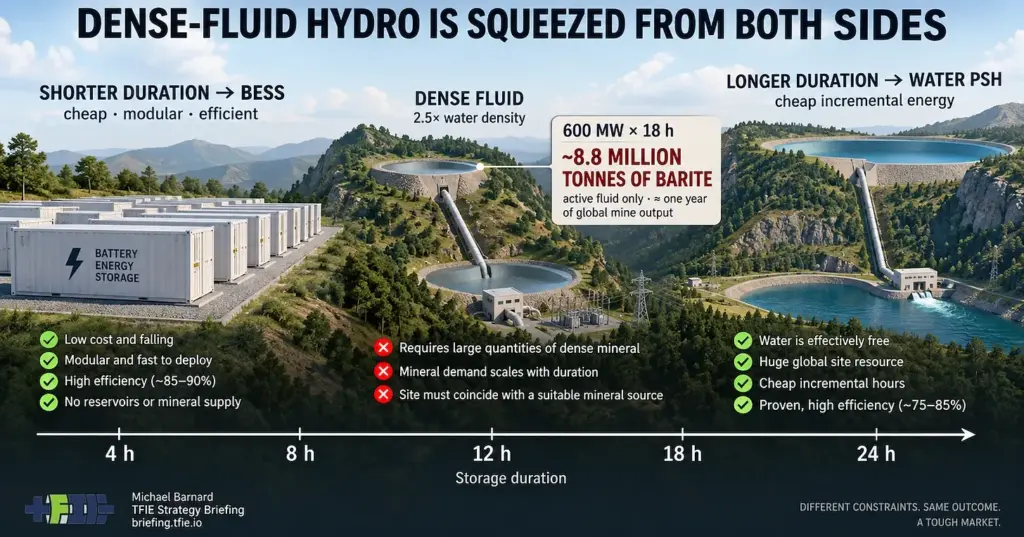
However, proving that a physics-based mechanism works is a distinct milestone from proving that it can scale economically. Dense-fluid pumped hydro is currently caught in a severe strategic squeeze from both sides of the energy-storage spectrum. At shorter durations—typically 4 to 8 hours—the technology faces unrelenting competition from lithium-ion batteries, which continue to enjoy steep price declines and dominant market integration. Conversely, when looking toward true long-duration energy storage (LDES) horizons spanning 12, 18, or 24 hours, the fundamental physics of the technology demand immense quantities of specialized weighting minerals, triggering severe supply-chain constraints and elevating the competitive advantage of conventional, water-based pumped hydro.
This comprehensive review explores the engineering triumphs of the Cornwood demonstrator, the complex mathematics of fluid density and mineral demand, the competitive realities of modern grid storage, and the future outlook for unconventional gravity storage systems.
Detailed Chronology: From Concept to the Cornwood Demonstrator
For years, alternative energy storage startups have promised revolutionary breakthroughs in gravity-based systems, only to stumble during the transition from laboratory benches to industrial-scale implementation. RheEnergise has achieved what few of its peers can claim: it successfully built a physical manifestation of its core technology.
The Cornwood Project Milestone
Located in Devon, the Cornwood demonstrator site represents a major engineering milestone for dense-fluid pumped hydro. The construction project involved building both upper and lower reservoirs, installing specialized high-pressure pumps, extensive piping networks, and generating equipment. Crucially, the company manufactured hundreds of cubic meters of its proprietary high-density fluid—roughly 2.5 times denser than water—pumped that fluid uphill against gravity, and successfully routed it back down through a specialized turbine.
The demonstrator successfully reached its 500-kilowatt (kW) design power rating. This achievement officially removes dense-fluid hydro from the realm of hypothetical technology, theoretical lab claims, or idealized component testing. It is now a functioning, physical energy-storage architecture.
Navigating the Reality of First-of-a-Kind Limitations
Despite this technical victory, the commercial realities of the project highlight the steep gap between functional proof and commercial viability. According to the official UK government demonstrator report, the Cornwood facility was originally engineered around a four-hour operational window at its 500 kW capacity. However, manufacturing challenges related to producing sufficient volumes of acceptable, high-density fluid constrained the available inventory.
Consequently, the completed system achieved roughly 15 minutes of full-power discharge during testing and was not connected to the electrical grid. Furthermore, integrated system tests recorded a round-trip efficiency (RTE) of 59%, a figure that did not yet account for parasitic auxiliary loads.
These results are entirely normal and expected for a first-of-a-kind (FOAK) engineering demonstrator. The primary purpose of such a facility is precisely to uncover unforeseen technical bottlenecks. The months of troubleshooting required to formulate the fluid, manage moisture sensitivity in the barite feedstock, overcome slow mixing times, and handle chemistry variations in replacement additives are textbook engineering lessons. Nevertheless, they underscore that the working fluid cannot be treated as a passive, plug-and-play substitute for water; it is a critical, highly engineered component of the overall generation plant.

Supporting Context & Metrics: The Physics, Siting, and Material Constraints
To understand the core economic and logistical hurdles facing dense-fluid pumped hydro, one must examine the underlying physics and the raw arithmetic of scaling mineral-based storage media.
The Advantage and Cost of Fluid Density
The foundational attraction of RheEnergise’s architecture is rooted in basic gravitational physics. Because the proprietary fluid is approximately 2.5 times denser than water, the same amount of potential gravitational energy can be captured using significantly less fluid volume or lower elevation profiles. This translates directly to a distinct siting advantage: smaller reservoirs or lower hillsides can theoretically be utilized, unlocking geographies that traditional, high-head, water-based pumped hydro could never access economically.
However, density is not a free engineering lunch. Water is an exceptionally difficult storage medium to improve upon. It is abundantly cheap, chemically simple, environmentally stable, and freely available by the millions of tonnes without requiring complex industrial manufacturing. It requires no milling, chemical formulation, homogenization, or reliance on complex mineral supply chains.
Furthermore, the perceived scarcity of conventional pumped hydro sites is often overstated. Comprehensive spatial research conducted by the Australian National University identified approximately 616,000 prospective off-river, closed-loop pumped hydro sites globally, representing an astounding 23,000 terawatt-hours (TWh) of theoretical storage potential. While only a fraction of these will ever be developed, the sheer surplus of topographically viable locations demonstrates that a lack of hills is rarely the primary constraint for modern grid infrastructure, especially when modern high-voltage transmission networks are factored into the equation.
The Mineral Scaling Trap
The central vulnerability of dense-fluid systems emerges as required storage durations increase. At fixed power and head specifications, every incremental hour of storage demands a proportional increase in working fluid volume—and consequently, a massive escalation in weighting minerals.
Consider a hypothetical commercial-scale scenario modeled on long-duration requirements: a 600 MW facility operating for 18 hours. Utilizing the barite-rich (barium sulfate) formulation disclosed in RheEnergise’s foundational patents as a baseline, the active fluid inventory alone would require roughly 8.8 million tonnes of barite. To put this staggering figure into perspective, a single utility-scale storage project would demand mineral quantities equivalent to a substantial share of total annual global mine production, even before accounting for inactive reserves, processing losses, and operational contingency stocks.
Recognizing that purchasing commercial-grade barite on a multi-million-tonne scale is economically and logistically unviable, RheEnergise has increasingly shifted its focus toward industrial brownfield sites, active mines, and quarries where dense mineral waste streams might be sourced locally.
While this strategy has merit—such as pairing a disrupted industrial landscape with an existing hill, a constrained grid connection, and a massive local stockpile of benign mineral waste—it simply relocates rather than eliminates the siting constraint. A project location must now satisfy an even more restrictive set of criteria: topography, geology, reservoirs, transmission access, permitting, and the immediate proximity of an enormous mineral source matching exact density, chemical yield, and particle-handling requirements.
Official Statements and Industry Insights
The tension between niche applicability and broad market dominance is a central theme of recent strategic evaluations within the clean-energy sector.

Industry analysts tracking long-duration energy storage note that RheEnergise’s strategic pivot toward smaller modular blocks—typically 10 to 20 MW capacities configured for 4 to 8 hours of duration—places the company squarely in the crosshairs of rapid advancements in stationary battery technology.
According to market intelligence data from BloombergNEF (BNEF), stationary-storage lithium-ion battery pack prices have fallen precipitously, reaching averages of roughly $70 per kilowatt-hour ($/kWh). While pack prices do not equate directly to fully installed Battery Energy Storage System (BESS) costs, the downward trajectory is relentless. As battery economics improve, the market window for alternative mechanical and fluid-based storage systems at shorter durations narrows significantly.
Conversely, extending storage durations beyond 12 to 18 hours diminishes the immediate threat from lithium-ion batteries due to capital expenditure scaling, but it triggers the opposite problem for dense-fluid systems: the material constraints scale almost linearly. At these longer durations, conventional water-based pumped hydro reasserts its ultimate economic dominance, utilizing an almost-free working fluid where capacity expansion requires merely larger reservoirs rather than millions of tonnes of manufactured mineral suspensions.
Future Outlook: Niche Success vs. Grid-Scale Dominance
As the energy transition accelerates toward deeper decarbonization, what is the ultimate outlook for dense-fluid pumped hydro?
The technical feasibility of the technology is no longer in doubt. The Cornwood demonstrator successfully established that dense fluids can be pumped, stored, and dispatched through turbines to generate electricity. However, the empirical data gathered during testing—including an integrated round-trip efficiency of 59% and months of fluid-formulation troubleshooting—highlights that scaling up will require rigorous engineering optimization.
Rather than emerging as a dominant, ubiquitous winner across the entire energy storage spectrum, dense-fluid pumped hydro is carving out a highly specialized niche. The technology is exceptionally well-suited for specific industrial ecosystems: old mining sites with disturbed land profiles, legacy quarries with ample mineral waste streams, constrained local grid connections, and localized topographic relief.
If RheEnergise and similar innovators successfully execute projects within these tailored environments, they will achieve significant commercial success. However, current techno-economic evidence suggests that dense-fluid systems cannot easily escape the competitive sandwich defined by rapidly cheapening lithium-ion batteries on the short-duration side, and the virtually free, infinitely scalable working fluid of water on the long-duration side. Proving that dense-fluid hydro works was a monumental engineering achievement; navigating the brutal economic math of commercial scaling remains the ultimate test.



