Executive Overview
For years, advocates of the hydrogen economy have pointed to a single, glaring bottleneck as the primary reason clean-fuel infrastructure fails to take off: the chicken-and-egg dilemma of supply versus demand. Energy developers refuse to invest billions in green-hydrogen production facilities without guaranteed off-takers, while municipal authorities and fleet operators refuse to purchase fuel-cell vehicles without a reliable, affordable local fuel supply.
Poland appeared to have decisively solved this conundrum. Through a combination of aggressive national industrial policy, public subsidies for refueling stations, and targeted municipal incentives, the country successfully engineered a thriving demand-side market for hydrogen-powered public transport. By April 2026, Poland boasted 153 registered hydrogen buses—with 140 actively navigating city streets and another 107 formally contracted. This was not a tentative array of experimental science-fair demonstrations; it was a rapidly scaling municipal fleet.
Yet, Poland’s journey has laid bare a deeper, more troubling structural paradox. Subsidizing the purchase of fuel-cell buses does not guarantee that an economical, resilient, and locally sourced green-hydrogen supply ecosystem will naturally materialize around them.
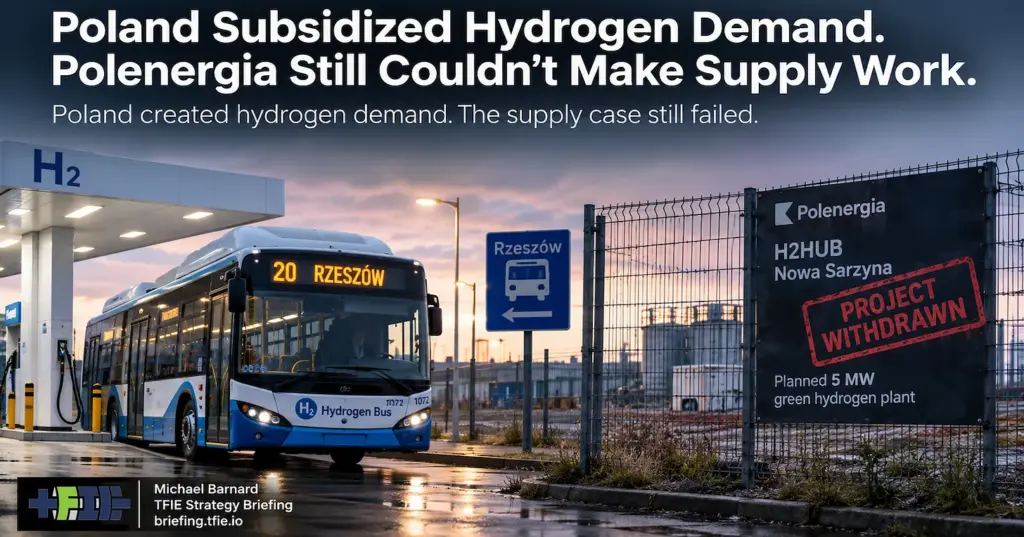
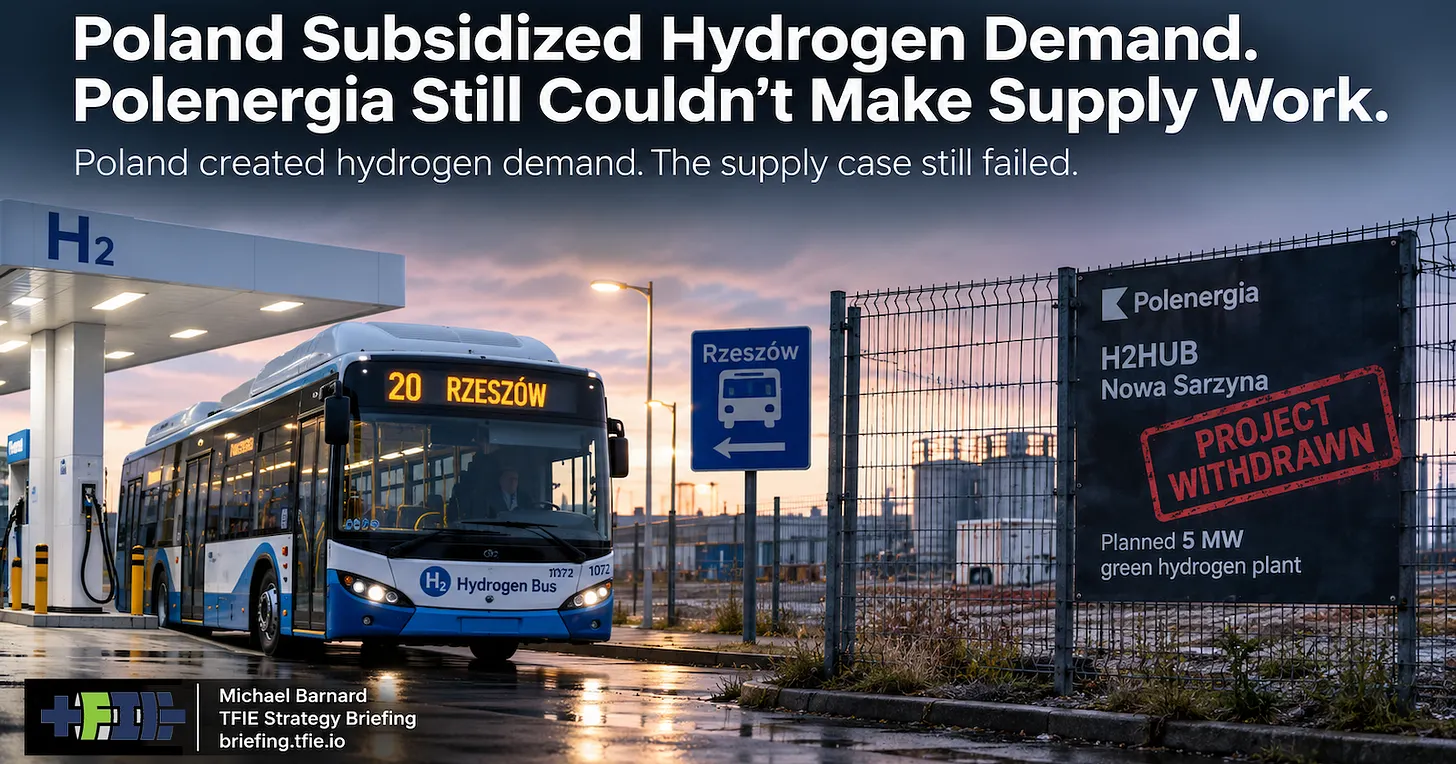
This friction is best illustrated by the high-profile retreat of Polenergia, Poland’s largest private energy group. Polenergia advanced a flagship renewable-hydrogen project—the Nowa Sarzyna initiative—further down the pipeline than almost any comparable European venture. Backed by international development financing, permitted construction documents, factory-tested electrolyzer stacks, and a lucrative 15-year municipal supply contract with the city of Rzeszów, the company stood on the precipice of commercial reality.
Then, in January 2025, Polenergia walked away.
Citing legal complications, delivery timeline risks, and a broader corporate reassessment of transport-sector hydrogen, the energy giant pulled the plug. The collapse of the Nowa Sarzyna agreement exposes the harsh economic realities of the emerging clean-fuel market. It signals that even when governments pull every right policy lever—creating demand, supporting infrastructure, and securing municipal customers—the fundamental risk and narrow margins of green hydrogen can still cause commercial ventures to fracture.
Detailed Chronology: From Blueprint to Breakdown
To understand how a project with seemingly insurmountable momentum collapsed, it is necessary to trace the precise chronology of Poland’s hydrogen push and Polenergia’s strategic retreat.
Phase 1: Engineering the Demand (2022–2024)
Poland’s strategy was rooted in textbook industrial policy. Recognizing that private capital would not deploy green hydrogen without a captive market, Warsaw deployed European and domestic public funds to subsidize municipal purchases of zero-emission transit. Cities like Poznań, Kraków, and Rzeszów seized the grants to overhaul aging diesel fleets.
By aggressively purchasing hydrogen fuel-cell buses, municipal authorities created an artificial yet immediate demand for the molecule. Refueling stations received matching public grants, setting the stage for local energy producers to step in and monetize regional renewable generation through water electrolysis.
Phase 2: The Rise of Nowa Sarzyna (2023–Late 2024)
Polenergia recognized the opening and positioned itself as a pioneer. Its flagship green-hydrogen project in Nowa Sarzyna was designed as a 5-megawatt (MW) renewable-hydrogen production facility. The installation was projected to output approximately 500 tonnes of clean hydrogen annually, paired with localized distribution networks and refueling infrastructure.
The project quickly gained institutional backing. Hystar, a prominent electrolyzer technology provider, was contracted to deliver the core systems. The International Finance Corporation (IFC)—the private-sector arm of the World Bank—stepped in to support development spending and equipment acquisition, while Polish public funds covered the corresponding refueling infrastructure.
The project cleared milestones that typically trap clean-energy ventures in perpetual developmental limbo:
- October 2024: The Nowa Sarzyna facility officially secured its building permit.
- October 2024: All eight electrolyzer stacks successfully completed rigorous factory acceptance testing (FAT).
Crucially, Polenergia secured the missing puzzle piece that most hydrogen projects lack: a guaranteed customer.
Phase 3: The Rzeszów Municipal Tender
In late 2024, the municipal transit operator in Rzeszów sought to procure a long-term hydrogen fuel supply for its fleet of 20 newly acquired fuel-cell buses. Polenergia entered the competitive municipal tender and emerged victorious, securing a landmark 15-year fuel-supply agreement valued at approximately PLN 120 million.
On paper, the ecosystem was complete. The state had subsidized the buses; the developer had permitted and built the production capacity; equipment was manufactured and tested; and a municipal entity was locked in for a decade and a half.
Phase 4: The Unraveling (January 2025)
Despite having crossed nearly every finish line, Polenergia announced in January 2025 that it could not finalize the Rzeszów agreement.
Publicly, the company pointed to specific legal ambiguities within the municipal tender framework and mounting operational risks regarding its ability to guarantee uninterrupted, on-schedule hydrogen deliveries. However, these technical justifications masked a deeper institutional pivot.
Concurrently, Polenergia initiated a sweeping corporate strategy review. Subsequent disclosures revealed a deliberate, phased withdrawal from the hydrogen transportation sector altogether. Citing high project investment risks, a sluggish maturation curve for the broader green-hydrogen market, and severely restricted commercial financing possibilities, Polenergia decided to cut its losses rather than gamble on the long-term viability of transport-sector hydrogen.
Supporting Context & Metrics: The Economics of the Molecule
The Polenergia case study provides critical quantitative and qualitative insights into the current state of Europe’s clean-energy transition.
The Fleet Realities
Poland’s embrace of hydrogen buses is undeniably real. By April 2026, the nation’s registry recorded:
- 153 total hydrogen buses registered nationwide.
- 140 buses fully operational and in service across various municipalities.
- 107 additional buses formally contracted and awaiting delivery.
Yet, this fleet expansion has created an inescapable operational trap for local governments. Once a municipality buys a fleet of fuel-cell buses using capital grants, it commits to a decades-long technological path dependency. The buses demand a continuous supply of hydrogen to remain operational. If the localized, green-hydrogen production ecosystem fails to materialize—as happened when Polenergia withdrew—cities find themselves hostage to imported, trucked-in, or fossil-derived grey hydrogen, severely undermining the environmental rationale of their initial investments.
Industrial Demand vs. Transport Demand
To evaluate Poland’s hydrogen strategy, analysts draw a sharp distinction between industrial demand and transport demand:

- Industrial Demand (Existing & Definitively Green): Poland already consumes massive quantities of hydrogen in heavy industry, chemical manufacturing, and petroleum refining. These sectors rely on carbon-intensive, grey hydrogen produced from unabated natural gas. Replacing this existing feedstock with green hydrogen represents an immediate, high-impact decarbonization target. The molecule is already required at scale, eliminating the risk of building demand from scratch.
- Transport Demand (Speculative & Competitive): Hydrogen buses, conversely, occupy a segment where a mature, highly efficient alternative already exists: direct electrification via battery-electric vehicles (BEVs) and overhead trolley-bus networks. Battery-electric transit has lower capital costs, higher well-to-wheel energy efficiency, and simpler fueling logistics. Forcing hydrogen into urban transit requires artificial market creation through heavy subsidies, which—as the Polenergia collapse demonstrates—does not translate into a self-sustaining commercial ecosystem.
Official Statements & Industry Perspectives
The sudden withdrawal of Poland’s leading private energy group from a flagship state-supported project sent shockwaves through the Central European clean-tech sector.
Industry analysts tracking the TFIE Strategy Briefing noted that Polenergia’s retreat was not a knee-jerk reaction to short-term market noise, but a calculated defense of corporate balance sheets against structural headwinds.
"Polenergia got much farther than the typical hydrogen project before it walked away," noted energy market observers. "This was not a vague memorandum of understanding attached to a distant, hypothetical 2030 target. Building permits were in hand, electrolyzers were factory-tested, and a 15-year municipal contract was signed. If a project with this level of institutional alignment fails on economic grounds, policymakers must fundamentally re-evaluate the risk profile of transport-sector hydrogen."
Municipal leaders in Rzeszów, suddenly left without their contracted local fuel supplier, faced immediate logistical scrambles to secure alternative hydrogen deliveries to keep their public transit networks running. While municipal operators managed to source stopgap fuel arrangements, the episode exposed the vulnerability of cities relying on nascent energy supply chains.
Financial institutions, meanwhile, have grown increasingly conservative regarding merchant risk in green-hydrogen ventures. While development banks like the IFC are willing to underwrite capital expenditures during early-stage mandates, private equity and commercial lenders are growing wary of long-term off-take risks, particularly when competing directly with rapidly maturing battery-electric technologies.
Future Outlook: What’s Next for Poland’s Energy Transition?
The cautionary tale of Polenergia and the Polish hydrogen bus market offers a profound lesson for European industrial policy. Creating artificial demand through targeted subsidies is an effective tool for jump-starting clean-tech deployment, but it is only the first step of a multi-layered marathon.
1. A Shift Toward Hard-to-Abate Sectors
Moving forward, Polish energy strategy is likely to pivot away from speculative consumer and municipal applications—such as passenger cars and urban buses—and refocus capital toward sectors where hydrogen has no direct electrification alternative. Steelmaking, high-heat industrial processes, chemical synthesis, and large-scale maritime or heavy freight transport represent markets where the molecule’s unique chemical properties are truly indispensable.
2. Pragmatism in Municipal Fleets
For cities that have already invested in fuel-cell bus fleets, the immediate future will involve securing reliable, long-term supply contracts that are insulated from local merchant risk. Municipalities may increasingly favor hybrid procurement models or push for battery-electric retrofits as their current generation of fuel-cell vehicles reaches end-of-life.
3. Reassessing Project Risk and Subsidies
The European clean-tech sector must reckon with the reality that capital expenditure grants for production facilities are insufficient if the operational expenditure (OPEX) economics do not pencil out. Without sustained, long-term operational price supports or much lower renewable electricity costs, projects like Nowa Sarzyna will continue to face commercial abandonment, regardless of how many building permits they secure or how many electrolyzers successfully pass factory tests.
Ultimately, Poland’s bold experiment has proven that governments can successfully manufacture demand for clean energy. But until the underlying production economics achieve true parity with direct electrification, the bridge between a subsidized bus on the street and a profitable green-hydrogen plant on the drawing board will remain fraught with peril.