

Executive Overview
For generations, the definition of wealth was deceptively straightforward. To be rich meant to accumulate vast amounts of capital—enough to live extravagantly, acquire luxury assets at will, and remain permanently insulated from the volatile cost of living. However, in an era defined by compounding economic instability, skyrocketing inflation, widening inequality, and a worsening climate crisis, the conversation surrounding wealth has fundamentally shifted.
The concentration of unprecedented fortunes in the hands of a tiny fraction of the global population is no longer viewed merely as an economic disparity; it is increasingly recognized as a systemic barrier to planetary survival. As governments worldwide struggle to secure the fiscal resources required to mount adequate disaster responses, fund a rapid green transition, and shore up fraying public services, the question of extreme wealth has intersected directly with climate justice.
Enter the Fair Share for People and Planet campaign—a global mobilization spearheaded by Greenpeace to demand equitable global tax rules. Having recently surpassed a major milestone of 200,000 signatories on its "Tax the Super-Rich" petition, the campaign represents more than a policy recommendation. It is a fundamental questioning of modern economic orthodoxies, arguing that the financial resources needed to save the planet and protect vulnerable populations already exist; they are simply trapped in the wrong hands.
Detailed Chronology: Escalating the Fight for Tax Justice
The momentum behind the global tax justice movement has not unfolded in parliamentary committee rooms alone. Over the past several years, activists, environmentalists, and workers have taken the fight to the streets, global economic summits, and international waterways.

2025: Taking the Message to the Elite
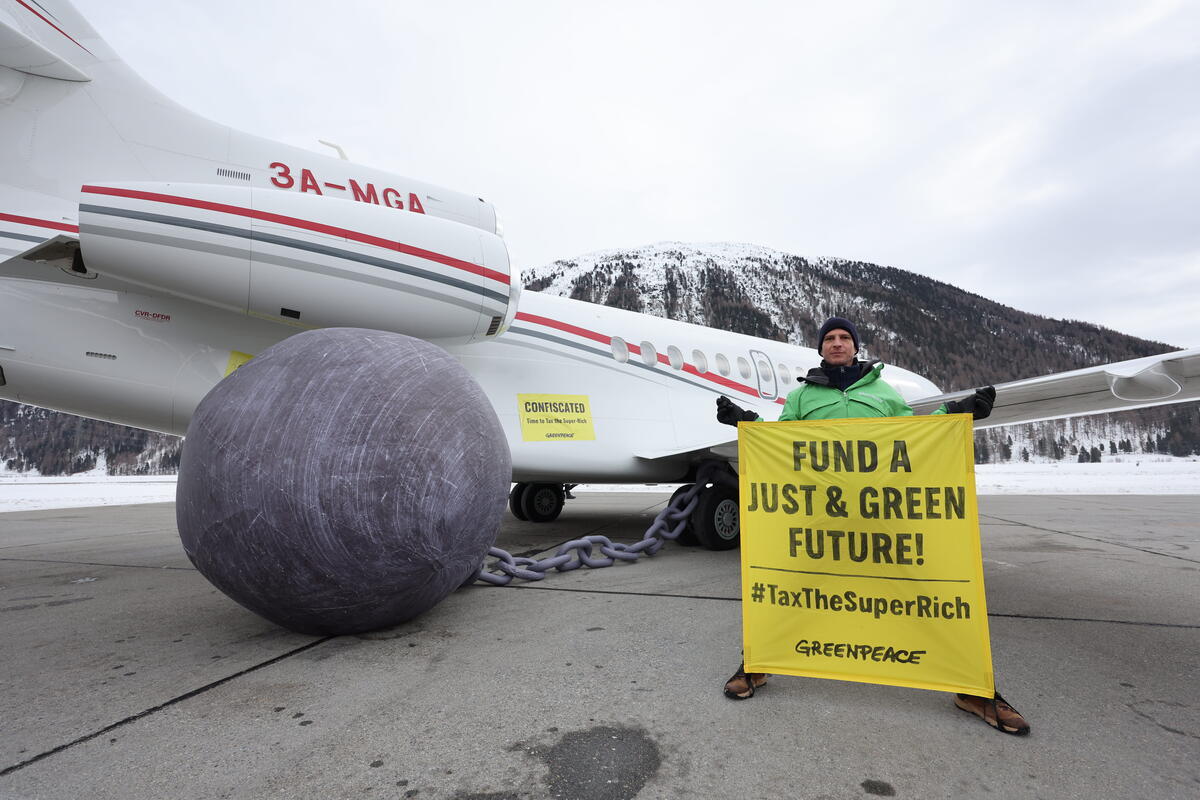
- January 2025 (Davos, Switzerland): As global elites descended upon the World Economic Forum (WEF), Greenpeace International activists staged a high-profile, peaceful intervention at Engadin airport in Samedan. Protesters symbolically "confiscated" private jets used by participants—who represent the wealthiest 1% of the global population—demanding that governments redirect tax revenues toward green housing, public transport, and climate resilience.
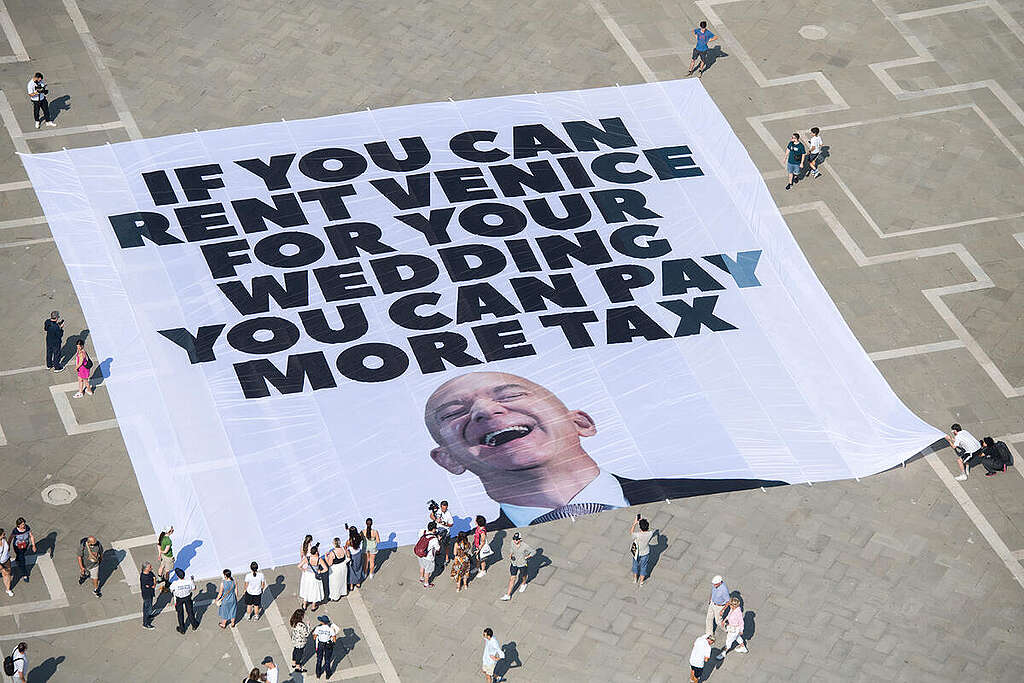
- June 2025 (Venice, Italy): Amid high-profile celebrations in the lagoon city, activists from UK action group Everyone Hates Elon and Greenpeace Italy dropped a massive 20×20-meter banner in Piazza San Marco reading: “If you can rent Venice for your wedding, you can pay more tax.” The visual protest, targeting billionaire luxury spending, went viral, racking up over 35 million views on social media and triggering international debates on wealth inequality.
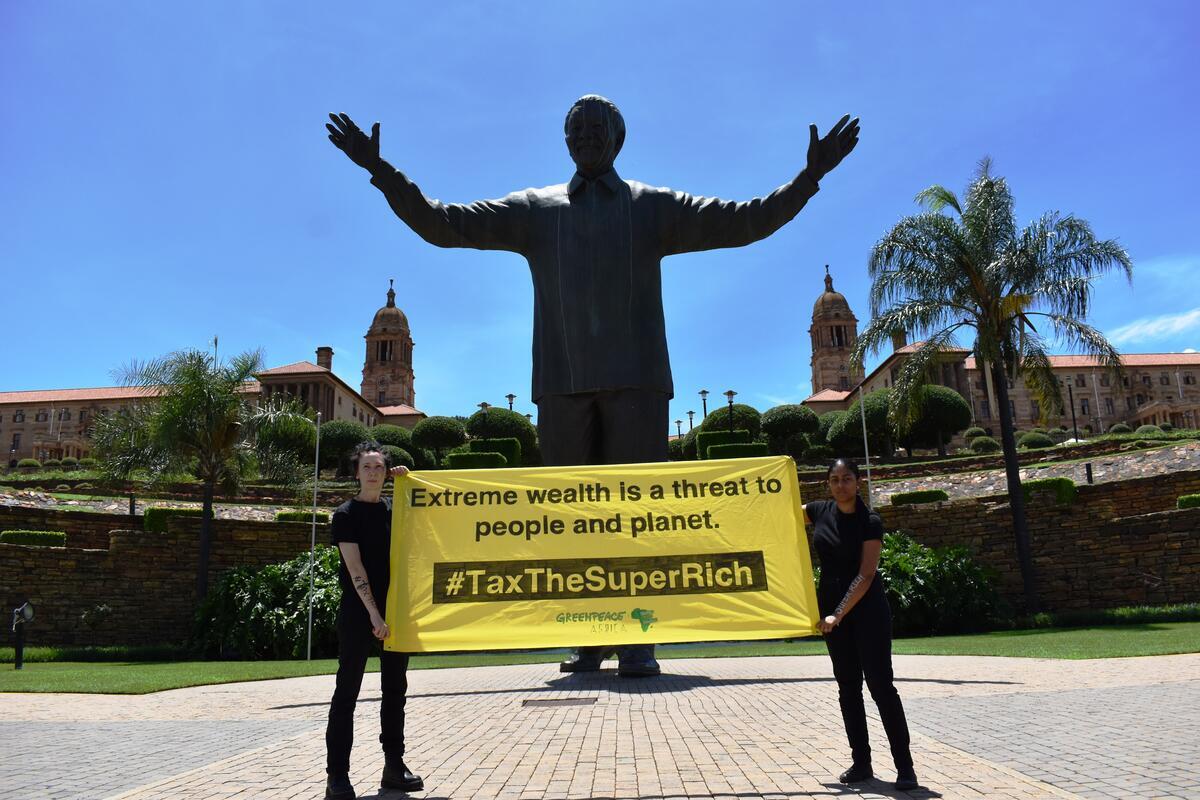
- July 2025 (Cape Town & Johannesburg, South Africa): Greenpeace Africa took the demand straight to the G20 Finance Ministers. Grounded in the African philosophy of Ubuntu—the belief that "I am because you are"—activists demanded that world leaders implement a coordinated wealth tax to combat deepening regional climate crises.
Late 2025 to 2026: Institutionalizing the Demand
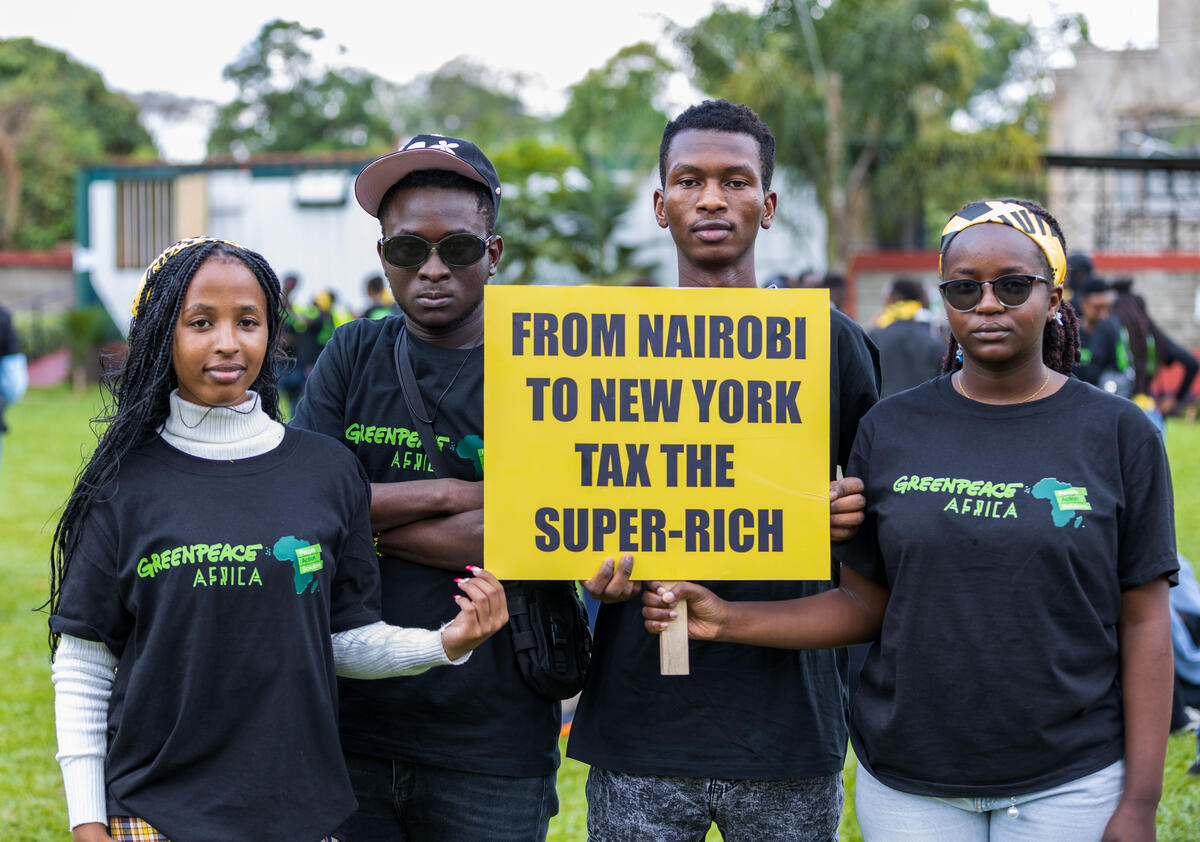
- November 2025 (Nairobi, Kenya): Ahead of critical negotiations for the UN Framework Convention on International Tax Cooperation (UN Tax Convention / UNTC), 500 Greenpeace Africa volunteers gathered in a powerful display of civil disobedience. They formed a human banner outlining the African continent alongside the slogan: “Tax the Super-Rich for People and Planet.”
- September 2026 (Seville, Spain): On the eve of the 4th International Conference on Financing for Development (FfD4), Greenpeace Spain unveiled a towering, four-meter-long doll of a baby Elon Musk wielding a chainsaw. The striking artwork served as a warning against corporate deregulation and billionaire-driven ecological destruction, calling on world leaders to commit to ambitious global tax and debt reforms.
- May 2026 (Jakarta, Indonesia): Commemorating International Workers’ Day (May Day), Greenpeace Indonesia joined forces with the Labor Movement with the People (GEBRAK). Together, they linked basic workers’ rights to the overlapping crises of economic instability, soaring living costs, and climate shocks, reinforcing the baseline truth: Workers Deserve Better.
Supporting Context & Metrics: The Intersection of Economic and Climate Injustice
Extreme wealth does not exist in a vacuum. The mechanisms through which astronomical fortunes are accumulated, sheltered from taxation, and distributed wield profound consequences for global societies and ecosystems.
The Cost of Living Versus Corporate Hoarding
While everyday citizens face what economists term "fossilflation"—surging costs driven by fossil fuel price shocks and climate-induced agricultural failures—multinational corporations and billionaires continue to record staggering windfalls. The disparity has severely strained public budgets. Governments find themselves cash-strapped precisely when they need fiscal space to adapt to accelerating environmental catastrophes.
Climate Inequality in Action
The impacts of climate change are inherently unequal. When a drought devastates food supplies in southern Africa, when unprecedented wildfire seasons devastate regions of Chile—where burned areas surged nearly 200% above previous averages—or when catastrophic floods sweep through urban centers, the burdens are not distributed democratically.
The capacity to endure these shocks depends entirely on economic standing:

- Who has accumulated savings to fall back on?
- Who holds comprehensive property insurance?
- Who possesses the resources to relocate away from hazard-prone zones?
- Who can access immediate healthcare and institutional support?
These are undeniably climate adaptation inquiries, but at their core, they are structural economic questions. Without robust public safety nets funded by equitable taxation, climate disasters act as catastrophic reset buttons that permanently strip working-class families of their livelihoods while billionaires remain insulated by their immense liquidity.
Official Statements and Policy Solutions
Greenpeace’s advocacy is not built merely on moral outrage; it is rooted in pragmatic economic restructuring. The organization, alongside a growing coalition of international economists and civil rights groups, is pressing for sweeping structural reforms.

The Push for a UN Global Tax Treaty
At the heart of the international advocacy strategy is the push for an ambitious UN Global Tax Treaty. Current global tax architectures often favor tax havens and multinational tax avoidance, depriving developing nations of billions in lost revenue. By establishing binding, inclusive international rules under the United Nations rather than exclusive clubs like the OECD, the global community can crack down on tax evasion and ensure high-net-worth individuals contribute proportionally.
As noted in recent policy briefs and supported by progressive fiscal analysts in institutions across Europe and the Global South, wealth taxes are not radical impossibilities; they are essential corrections. A well-designed wealth tax on the top 1% could unlock trillions of dollars annually.

Rather than relying on the precarious and often self-serving nature of billionaire philanthropy—where the ultra-wealthy dictate which causes receive funding—fair taxation restores democratic oversight. It provides predictable, legally mandated streams of revenue to fund universal healthcare, public education, clean water infrastructure, sustainable social housing, and large-scale renewable energy transitions.
Future Outlook: Redefining What It Means to Be "Rich"
As the Greenpeace "Tax the Super-Rich" petition crosses the monumental threshold of 200,000 verified signatures, the campaign enters a crucial new phase. This milestone is not an endpoint, but a springboard for broader societal reflection.
The movement forces a fundamental reconsideration of a cultural touchstone: What does it actually mean to be rich?
For too long, society has viewed wealth through rose-tinted, dollar-sign glasses. Yet, as ecological collapse looms closer, material hoarding pales in comparison to the true metrics of human flourishing—safety, community connection, and a stable environment. True wealth in the 21st century must be redefined as:
- The ability to breathe clean air and drink uncontaminated water.
- Food security and sustainable local agriculture.
- The guarantee of systemic support systems when personal or communal hardships strike.
- The assurance that a sudden flood, heatwave, or wildfire will not erase generations of labor and community building.
No amount of private capital can construct a separate biosphere. Jeff Bezos, Elon Musk, and other ultra-high-net-worth individuals ultimately rely on the same atmosphere, the same water tables, and the same functioning planetary systems as every other human being.
The 200,000 voices demanding tax justice signal a profound ideological pivot. Citizens around the globe are rejecting the notion that massive private fortunes should be prioritized over public wellbeing. Fair taxation is transitioning from a niche policy debate into a mainstream moral imperative.
The path forward requires holding governments accountable to their highest ideals—such as South Africa’s guiding philosophy of Ubuntu ("I am because you are"). By compelling the super-rich to pay their fair share, nations can unlock the necessary funding to build resilient, equitable societies. Being rich in life should never mean having more than one could ever spend while millions suffer under the weight of manufactured crises. Ultimately, a truly civilized global economy is one where no one is left behind, and everyone has enough.
Authored by Naeemah Dudan, Digital Specialist for Greenpeace Africa, based in South Africa.



