

Executive Overview
For the millions of researchers, historians, and biodiversity enthusiasts who rely on the Biodiversity Heritage Library (BHL) every day, the digital repository often feels like an instantaneous, boundless resource. A few clicks allow a student in Tokyo, a conservationist in Nairobi, or a taxonomist in London to unearth centuries-old natural history texts, rare illustrations, and foundational scientific papers.
Yet, behind every digitized page lies a complex tapestry of human persistence, cross-continental coordination, and painstaking institutional labor. As the BHL celebrates its milestone 20th anniversary through its ongoing series, BHL at 20: Treasures from the Biodiversity Heritage Library, it is vital to look beyond the digital outputs and examine the infrastructure that makes them possible.
This is the story of one such monumental effort: the digitization of the historical volumes of the Journal of The Asiatic Society and its legacy publications. Spanning 11 years, 9 global institutions, 19 dedicated individuals, dozens of tracking tickets, and thousands of hours of decentralized labor, this project exemplifies the true lifeblood of the BHL. It is a testament to what a distributed, community-driven consortium can achieve without centralized grant funding or dedicated, full-time digitization departments—and a stark reminder of the fragile, yet resilient, ecosystem that sustains the world’s largest open-access digital library for biodiversity literature.
Detailed Chronology: A Decade-Long Archival Journey
The genesis of the Journal of The Asiatic Society dates back to January 15, 1784, when Sir William Jones founded the Asiatick Society under the auspices of British India’s highest court in Kolkata. Established with the grand, interdisciplinary mandate to study the "History, Civil and Natural, the Antiquities, Arts, Sciences, and Literature of Asia," the organization laid the groundwork for modern academic inquiry in South Asia. More than 240 years later, The Asiatic Society stands as a premier Institution of National Importance, recognized by the Indian government as the country’s oldest surviving publishing house. Its publications, running continuously from 1788 to the present day, capture a staggering breadth of human knowledge, encompassing cultural studies, medicine, literature, and the natural sciences.
Bringing these brittle, historical volumes into the twenty-first century was no small feat. In June 2010, founding institutions within the BHL consortium initiated a targeted, highly collaborative digitization workflow centered on the myriad title variations of the Journal of The Asiatic Society.

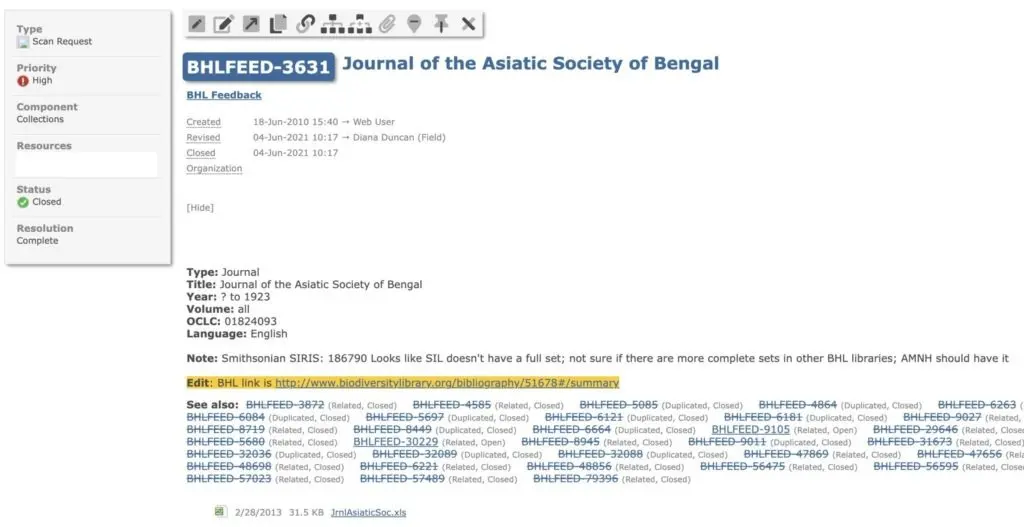
What followed was an 11-year marathon of logistical challenges. Because the work relied entirely on the sporadic, volunteer-adjacent allocation of staff and resources from participating institutions, progress ebbed and flowed with institutional budgets, equipment availability, and shifting staffing priorities. Tasks were meticulously opened, tracked, debated, and resolved across BHL’s internal issue-tracking architecture.
It was not until June 2021—over a decade after the first scan requests were logged—that the BHL could officially declare the digitization of all public-domain volumes within the Journal series "complete" to the best of its collective ability. Today, the BHL proudly provides open access to an extensive family of historical titles, including foundational early runs like Asiatic Researches; or, Transactions of the Society Instituted in Bengal, alongside subsequent iterations, the Memoirs, and numerous specialized Asiatic Society monographs.
Supporting Context & Metrics: The Mechanics of Distributed Labor
To understand how an 11-year project involving nine separate institutions could remain cohesive, one must examine the operational backbone of the BHL: its internal communication and task management systems.
Lacking the massive, centralized endowments of corporate-backed digital archives or state-funded national libraries, the BHL operates on a distributed labor model. Content acquisition, scanning, metadata creation, and curation are handled organically by consortium partners who contribute resources when and where they can. Managing this diffuse workforce requires robust logistical tools. For the Asiatic Society project, this meant utilizing Gemini, an issue-tracking system that has served for decades as the single source of truth for BHL’s technical operations, website maintenance, and collection-building initiatives.
The metrics surrounding the Asiatic Society project reveal the intimate scale of this massive undertaking:

- Duration: 11 years (June 2010 – June 2021).
- Consortium Footprint: 9 distinct participating institutions contributing localized scanning and cataloging resources.
- Human Capital: 19 individual contributors actively engaging across international borders.
- Tracking & Curation: 40 formal issue-tracking tickets and over 82 collaborative comments navigating complex gap identifications, physical item conditions, and cataloging anomalies.
This decentralized framework allows partner organizations to "come as they are," participating autonomously when institutional time and budgets permit. However, this flexibility is a double-edged sword. While it fosters a profound sense of shared ownership and resilience, it also introduces significant vulnerabilities.
When major foundational grant funding—such as the BHL’s historic support from the MacArthur Foundation—concluded in 2013, consortium partners immediately felt the pinch. Fluctuating institutional support, hiring freezes, equipment degradation, software bugs, and the complexities of harmonizing legacy catalog records across international standards frequently impeded progress. The completion of the Asiatic Society archive stands not because the path was easy, but because the community’s commitment to open access refused to wane.
Official Perspectives: Reflections from BHL Leadership
Bianca Crowley, Digital Collections Manager for the Biodiversity Heritage Library, has spent years observing the intricate machinery that powers the consortium. For Crowley, the true "treasures" of the BHL are not merely the rare calfskin bindings, hand-colored plates, or centuries-old scientific descriptions tucked away in its virtual stacks—they are the people.
In reflections on the Asiatic Society legacy project, Crowley emphasizes that the completion of these volumes highlights the indispensable value of administrative tools and human persistence. "Managing the back-and-forth among 19 people over 11 years would not have been possible without an issue tracking system," Crowley notes, pointing to the unglamorous yet essential work of configuring task management architectures, resolving metadata disputes, and harmonizing institutional workflows.
This sentiment echoes through the broader BHL community as the organization navigates a major historical transition. Moving toward an increasingly autonomous, globally distributed shared-ownership model independent of any single host institution, the BHL is doubling down on its foundational ethos. The lessons learned from the grueling, decade-long digitization of the Journal of The Asiatic Society are directly informing how the consortium evaluates its core priorities: increasing access, usability, discovery, and the overall breadth of its collections.

Future Outlook: Streamlining the Path Forward for Biodiversity Literature
As the BHL reflects upon its first two decades of operation, leadership is acutely aware that an 11-year timeline for a single journal series, while a triumph of persistence, is ultimately unsustainable in a rapidly accelerating digital research landscape. If the library is to meet the demands of twenty-first-century biodiversity science, the processes of discovery, digitization, and integration must become more agile and efficient.
Looking toward its next chapter, the BHL is actively leveraging its Guiding Principles for the Transition to modernize its platforms, forge new strategic partnerships, and refine its operational pipelines. Digital Collections Manager Bianca Crowley and her colleagues have outlined several critical imperatives for the organization’s future:
- Accelerated Workflow Automation: Developing smarter integrations between scanning hardware, metadata repositories, and tracking systems to reduce manual friction.
- Enhanced Cross-Institutional Training: Standardizing documentation and onboarding to minimize the friction points that delay partner contributions.
- Targeted Gap Analysis: Utilizing advanced data tools to proactively identify missing volumes in historical runs before lengthy manual investigations are required.
- Securing Sustainable Financial Models: Transitioning away from purely ad-hoc contributions by actively seeking recurring donations, endowments, and long-term funding sources to support centralized processing and curation staff.
Sustainability, for the BHL, means much more than keeping a website server online. It requires actively maintaining, expanding, and safeguarding a living archive of human knowledge against the ravages of time, physical decay, and institutional shifts.
The successful rescue of the Journal of The Asiatic Society proves that when global communities unite around a shared vision of open access, no archive is too distant, and no timeline is too daunting. As the BHL embarks on its next twenty years, the lessons of this 11-year endeavor will serve as both a blueprint and an inspiration for the work yet to come.



