

Executive Overview
As the Biodiversity Heritage Library (BHL) marks its momentous 20th anniversary, a retrospective spotlight falls upon the foundational architects of American ecology and entomology: Stephen A. Forbes and Charles Robertson. Through a collaborative archival initiative helmed by the University of Illinois Urbana-Champaign Library, rare historical publications, personal correspondence, and meticulous specimen logs belonging to these two scientific trailblazers have been integrated into the BHL digital repository. This digital preservation initiative bridges more than a century of natural history, connecting nineteenth-century field notes with twenty-first-century computational ecology, climate studies, and conservation frameworks.
Forbes and Robertson operated during a formative era when natural history transitioned from a pursuit of purely descriptive taxonomy into an empirical, systems-oriented science. Forbes pioneered aquatic ecology, environmental economics, and the holistic study of food webs, establishing the bedrock for modern ecosystem management. Simultaneously, Robertson dedicated decades to untangling the complex co-evolutionary tapestries binding flowering plants to their insect pollinators, producing datasets so robust they now serve as ground-zero baselines for measuring contemporary biodiversity collapse.
By rendering these historical documents universally accessible, the BHL and the University of Illinois are not merely archiving relics of the past; they are equipping modern researchers with irreplaceable empirical data. This article explores the lives, methodologies, and enduring scientific legacies of Forbes and Robertson, evaluating how their nineteenth-century observations continue to inform modern ecological science, environmental policy, and data-driven conservation.
Detailed Chronology: The Parallel Lives of Two Illinois Naturalists
Stephen A. Forbes: The Architect of Aquatic Ecology (1844–1930)
Born on May 29, 1844, Stephen Alfred Forbes emerged as a towering figure in American zoology and entomology. His early life was disrupted by the American Civil War, during which he served as a captain in the 67th Illinois Volunteer Infantry. Following the conflict, Forbes pursued medicine before turning his inquisitive mind toward the natural sciences—a shift that would permanently alter the trajectory of ecological research in the United States.

At the University of Illinois Urbana-Champaign, Forbes assumed the mantle of professor of zoology and entomology, exercising leadership across the natural sciences. His intellectual curiosity refused to stay confined within narrow disciplinary boundaries; he investigated insects, crustaceans, fishes, and birds, consistently asking how these organisms interacted with one another and their environment. His holistic worldview recognized that nature could not be understood by studying isolated species; rather, it required mapping the intricate webs connecting life forms to their physical habitats.
- 1886: Forbes’s international reputation was cemented when he received the first-class medal of the Société d’Acclimation de France for his groundbreaking scientific publications.
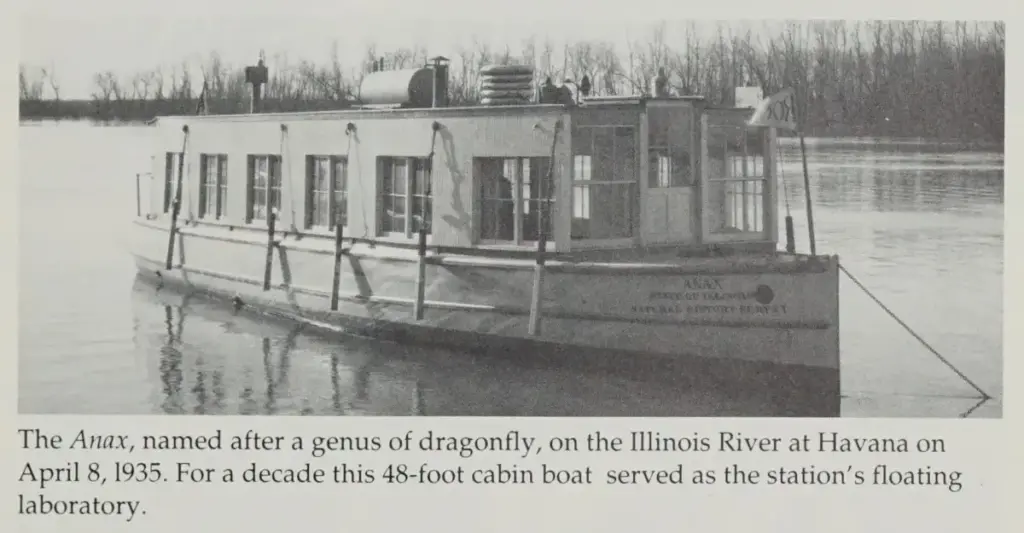
- 1894: Recognizing the need for continuous, localized aquatic research, Forbes established the Forbes Biological Station on the Illinois River in Havana, Illinois. Two years later, in 1896, he directed the construction of a pioneering 48-foot floating biological laboratory at the site.
- 1908: Forbes published his magnum opus, The Fishes of Illinois, a monumental work documenting over 150 fish species backed by more than 200,000 specimens gathered across all 102 counties of Illinois. The publication featured exquisite color illustrations by artists Lydia M. (Hart) Green and Charlotte M. Pinkerton, alongside meticulous distribution maps.
- 1917: Appointed as the director of the Natural History Survey Division, Forbes steered the organization with visionary leadership until his death on March 13, 1930, in Urbana, Illinois.
Charles Robertson: The Quiet Observer of Floral Networks (1858–1935)
Fourteen years after Forbes’s birth, Charles Robertson was born on June 12, 1858, in Carlinville, Illinois. Robertson’s life stood in stark geographical contrast to the administrative prominence of Forbes. Choosing a quieter, deeply localized existence, Robertson spent the vast majority of his life in his hometown, anchoring his existence in the very ecosystems he studied.
Robertson began his formal education at Blackburn College in Carlinville before refining his expertise in botany and zoology at Harvard University. Returning to his roots, he served as a professor of biology and Greek at Blackburn College. While his academic title spanned the humanities and sciences, his true life’s work unfolded out in the fields, prairies, and woodlands of Macoupin County.
- Decades of Observation: For more than twenty years, Robertson maintained a rigorous, solitary observational regimen. He recorded every insect visitor to local flora, meticulously documenting relationships between plants and pollinators. By the time his fieldwork concluded, he had cataloged 1,429 pollinating insect species—encompassing flies, beetles, butterflies, and bees—interacting with 456 plant species.
- 1928: Robertson published Flowers and Insects, an intensive monograph detailing the flower-visiting insects of Carlinville. To this day, it stands as one of the most comprehensive, localized studies of plant-pollinator networks ever compiled.
- 1935: Demonstrating an unflagging dedication to his craft, Robertson was actively collecting insect specimens in Florida mere months before his death on June 1, 1935, in Carlinville.
Supporting Context & Metrics: Data, Archives, and Modern Relevance
The preservation of Forbes’s and Robertson’s works within the Biodiversity Heritage Library sheds light on the sheer scale of their empirical output. These collections are far more than historical curiosities; they represent high-resolution ecological datasets utilized by contemporary researchers tracking global environmental crises.

Quantifying the Collections
| Naturalist | Primary Geographic Focus | Key Publication / Asset | Volume / Scale of Data | Modern Significance |
|---|---|---|---|---|
| Stephen A. Forbes | Statewide (Illinois) & Illinois River Valley | The Fishes of Illinois (1908); Forbes Biological Station archives | Over 150 species; 200,000+ specimens across 102 counties | Baseline for freshwater conservation, fisheries management, and watershed policy. |
| Charles Robertson | Carlinville & Macoupin County, Illinois | Flowers and Insects (1928); Specimen Collection Logs (1877–1935) | 1,429 insect species and 456 plant species documented over decades | Indispensable baseline for measuring insect pollinator decline and climate-induced phenological shifts. |
The Power of Robertson’s Logs in the 21st Century
Charles Robertson’s meticulous collection logs—encompassing five ledgers, a dedicated data book on bee research, extensive correspondence, and academic reprints housed in the University of Illinois Archives—have taken on urgent contemporary relevance. Because Robertson recorded exact plant-insect associations, modern scientists possess a precise baseline of a nineteenth-century prairie ecosystem before the widespread onset of industrial agriculture, habitat fragmentation, and climate change.
In a landmark study published in Ecology & Society, researcher John Marlin (an affiliate of the Illinois Sustainable Technology Center and the INHS) utilized Robertson’s historical records to evaluate species decline in Carlinville. Marlin’s team discovered that a significant portion of the specialized bee species Robertson documented a century prior had vanished from the locality, providing empirical proof of localized insect pollinator crises.
Furthermore, a quantitative analysis published in the Data Science Journal further unlocked the computational potential of Robertson’s papers and logs. By digitizing these records and integrating them into modern ecological databases, data scientists can cross-reference historical floral visitations with current climate trends, offering critical insights into how warming temperatures disrupt plant-pollinator synchrony.
Forbes’s Living Legacy in Field Stations
Stephen A. Forbes’s institutional footprint remains equally robust. The Forbes Biological Station in Havana, Illinois, has evolved into a premier hub for wetland and waterfowl research. It houses the Frank C. Bellrose Waterfowl Research Center, which guides contemporary wetland conservation and marsh bird management along the Mississippi Flyway.

The Forbes Station is joined by six other specialized field stations operated by the Illinois Natural History Survey:
- Great Rivers Field Station
- Illinois River Biological Station
- Kaskaskia Biological Station
- Lake Michigan Biological Station
- Ridge Lake Biological Station
- Sam Parr Biological Station
These facilities continue to support cutting-edge field research for scholars from the University of Illinois Urbana-Champaign and academic institutions worldwide, proving that Forbes’s physical infrastructure investments were designed with multi-generational utility in mind.
Official Statements & Institutional Perspectives
The integration of these rare materials into the Biodiversity Heritage Library has drawn praise from academic leaders, librarians, and historians who view the project as a triumph of open-access digital curation.
Reflecting on the character and impact of Stephen A. Forbes, the University Senate captured his profound standing within the academy and the public sphere in an official memorial resolution:

"The Senate knew him as Professor of Zoology and Entomology and Dean of the College of Science; it admired his sagacity and patience as chairman of its Committee on Educational Policy; its members loved him for his simplicity, sincerity and broad human interests. The University and the State are immeasurably indebted to him as one of their most useful and eminent laborers for the common good."
Archivists and information scientists emphasize that the value of the BHL extends beyond raw scientific data into the human dimensions of discovery. Abubakari Ssemwogerere, a graduate assistant at the Funk ACES and Veterinary Medicine Libraries at the University of Illinois Urbana-Champaign, notes that digital libraries offer an essential bridge between historical context and contemporary investigation:
"Archival documents such as these reveal the values, culture, and identity that shaped the Illinois Natural History Survey and science in Illinois. Being able to trace the legacy of scientific research and lives of those behind these discoveries provides richer context and understanding for future scientific research."
Ssemwogerere underscores that the BHL achieves a unique synthesis: it juxtaposes the deeply human, lived experience of conducting nineteenth-century science—revealed through handwritten logs, personal letters, and field journals—with the formal, peer-reviewed scientific record preserved in monographs and academic papers. Together, these materials construct a transparent, inclusive narrative of scientific progression.

Future Outlook: Connecting Past Discoveries with 21st-Century Conservation
As the Biodiversity Heritage Library celebrates its twentieth year of operations, the inclusion of the Forbes and Robertson archives points toward an increasingly collaborative, data-rich future for biodiversity science.
Modern conservation biology faces unprecedented hurdles, from accelerating habitat loss and chemical pesticide exposure to shifting climate zones that alter seasonal cues. To forecast how ecosystems will respond to these compounding pressures, scientists require historical benchmarks. Without historical baselines like Robertson’s pollinator logs or Forbes’s freshwater fish distribution maps, modern conservationists risk operating within a "shifting baseline syndrome"—failing to recognize the true magnitude of ecological degradation because they lack historical perspective.
Initiatives led by academic libraries, museums, and digital consortia are actively breaking down institutional silos. By transcribing handwritten collection logs, geo-referencing nineteenth-century specimen data, and opening these assets to global research networks through platforms like the BHL, the scientific community is transforming static archive boxes into dynamic, predictive tools.
Ultimately, the enduring legacies of Stephen A. Forbes and Charles Robertson serve as an eloquent reminder that rigorous observation, patience, and a holistic appreciation for the natural world remain the bedrock of scientific discovery. Through open-access preservation, their life’s work continues to inspire students, educators, historians, and field biologists, ensuring that the wisdom of nineteenth-century naturalists remains a guiding light for twenty-first-century environmental stewardship.



