

Executive Overview
In the realm of natural history, the architecture of taxonomy and biogeography was not built overnight. It emerged from a turbulent sea of exploration, shifting classification systems, and intense scholarly debate. A compelling chapter of this history has recently been brought to light through the collaborative efforts of the Field Museum’s Marie Louise Rosenthal Library and the Biodiversity Heritage Library (BHL).
Marking the 20th anniversary of BHL—a monumental global initiative dedicated to preserving and providing open access to the literature of biodiversity—the Rosenthal Library successfully acquired, digitized, and integrated a foundational masterpiece of animal geography: Eberhard August Wilhelm von Zimmermann’s three-volume Geographische Geschichte des Menschen, und der allgemein verbreiteten vierfüßigen Thiere, nebst einer hieher gehörigen Zoologischen Weltcharte, published between 1778 and 1783.
This acquisition is far more than a routine addition to a rare book collection. It represents a vital historical link involving the International Commission on Zoological Nomenclature (ICZN), legendary 18th-century explorers like Captain James Cook, and key figures at the Field Museum itself, such as Wilfred H. Osgood and Philip Hershkovitz. By tracing the journey of Zimmermann’s work—from its initial rejection by modern nomenclature standards to its ultimate vindication—scholars now have unprecedented digital access to the birth pangs of modern zoological geography.
Detailed Chronology: The Evolution of Zimmermann’s Masterpiece
To understand the weight of this literary acquisition, one must journey back to the late 18th century, an era when European naturalists were racing to catalog an expanding world.
1777: The Latin Prototype and Its Flaws
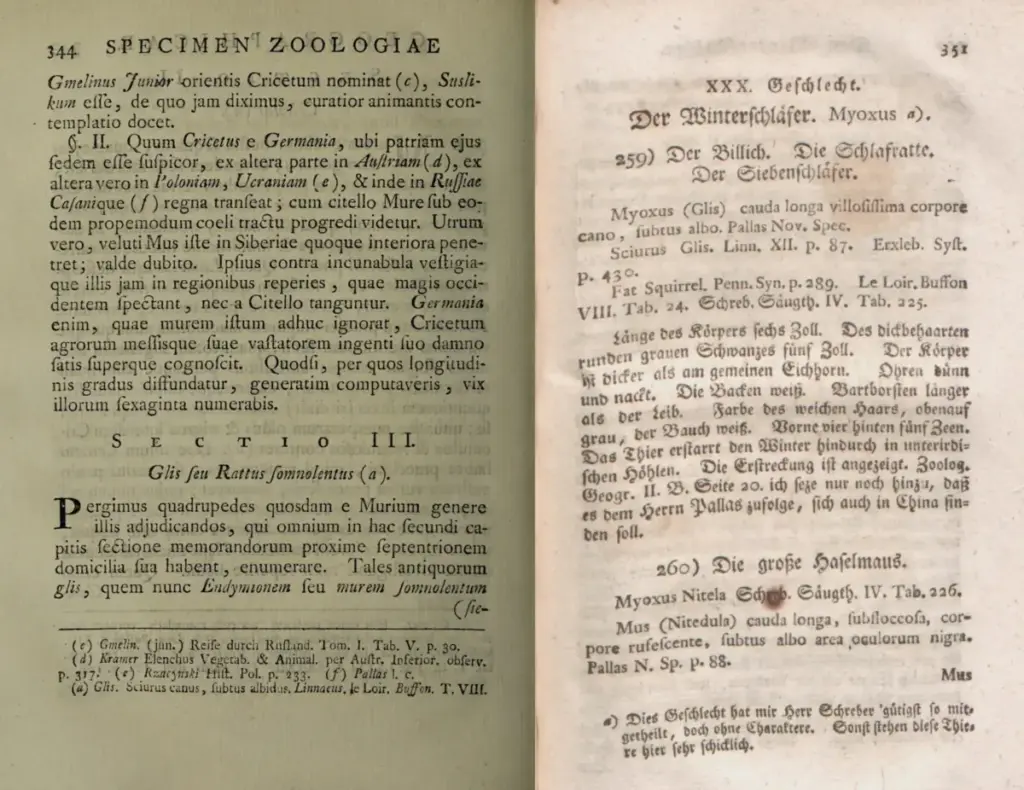
In 1777, German geographer, zoologist, and mathematician Eberhard August Wilhelm von Zimmermann published Specimen zoologiae geographicae, quadrupedum domicilia et migrationes sistens in Latin. While intended to map the global distribution of quadrupeds, the work suffered from a fatal taxonomic flaw: Zimmermann failed to apply binomial nomenclature consistently. Instead of utilizing the rigid two-part naming system (Genus and species) established by Carl Linnaeus, Zimmermann frequently relied on a haphazard mix of generic identifiers, descriptive phrases, and common names. For example, he referred to a species of dormouse not by a strict binomial, but as Glis seu Rattus somnolentus.
1778–1783: The German Revision and Expansion
Recognizing the limitations of his earlier Latin text, Zimmermann heavily revised, expanded, and translated his ideas into German. Published in three volumes between 1778 and 1783, Geographische Geschichte des Menschen, und der allgemein verbreiteten vierfüßigen Thiere marked a profound leap forward. In this definitive edition, Zimmermann adopted consistent binomial nomenclature.

Within these pages, he debuted several binomial names that remain valid and are still attributed to him today, including:
- Cervus muntjak (muntjac deer)
- Lutra minima (historically significant, now recognized as Chironectes minimus, the water opossum)
- Canis zerda (now classified as Vulpes zerda, the fennec fox)
Simultaneously, Zimmermann transitioned from older descriptive labels to true binomials; for instance, his 1777 dormouse designation was corrected to the binomial Myoxus glis in volume two (1780) of the German edition—a species known today as Glis glis.
1954: The ICZN Ruling and Field Museum Involvement
The distinction between Zimmermann’s 1777 Latin work and his 1778–1783 German masterwork came to a head in the mid-20th century. The International Commission on Zoological Nomenclature (ICZN) was tasked with sorting out the validity of early scientific literature.
Through Opinion 257, rendered in 1954, the ICZN formally rejected the 1777 Specimen zoologiae geographicae for "nomenclatorial purposes" because it failed to meet the strict requirements of Article 25 of the Règles internationales de la nomenclature zoologique. Consequently, the 1777 text was placed on the "Official Index of Rejected and Invalid Works in Zoological Nomenclature."
Crucially, this ruling was not born in a vacuum; it was directly influenced by institutional advocacy from the Field Museum. Historical correspondence reveals that Francis Hemming, Secretary of the Commission, actively consulted Field Museum zoologists. Wilfred H. Osgood championed the formal recognition of Zimmermann’s 1778–1783 Geographische Geschichte, backed by Philip Hershkovitz, then Curator of Mammals at the Field Museum. Their expert insights helped convince the Commission that Zimmermann’s later German publication successfully applied binomial nomenclature, earning it a coveted spot on the "Official List of Works Approved as Available for Zoological Nomenclature."
Modern Era: Digital Preservation and BHL at 20
Fast forward to the present day. Thanks to the Rosenthal Library’s rare book fund, a physical copy of the rare three-volume German edition was secured for the Field Museum. Recognizing its immense historical value and its absence from the digital ether, the text was digitized and uploaded to the Biodiversity Heritage Library. Today, researchers anywhere in the world can examine both the rejected 1777 Latin edition and the validated 1778–1783 German volumes side-by-side on BHL.

Supporting Context & Metrics: Cartography, Exploration, and the Global Spread of Mammals
Zimmermann’s Geographische Geschichte is celebrated not only for its taxonomy, but also for its groundbreaking cartography. Bound within the work is the Tabula Mundi Geographico Zoologica sistens Quadrupedes hucusque notos sedibus suis adscriptos edidit, widely regarded as the first true world map of zoological geography.
Cartographic Evolution Inspired by Cook’s Voyages
Between the 1777 edition and the 1783 completion of the German volumes, global geography underwent a paradigm shift, driven largely by the maritime explorations of Captain James Cook and his crew aboard the HMS Endeavour and subsequent voyages.
Zimmermann rapidly integrated these fresh empirical discoveries into the updated Tabula mundi fold-out map accompanying the 1783 German text. Notable updates include:
- The Sandwich Islands (Hawaii): Reflecting Cook’s historic contact with the Hawaiian archipelago.
- North America’s West Coast: Offering a significantly more accurate and complete rendering of the Pacific coastline.
- The Seychelles: Placed explicitly east of mainland Africa, acknowledging the French colonial settlement established there just thirteen years prior.
Mapping the Quadrupedes
On the fold-out map, Zimmermann plotted the names of various quadrupeds directly across their native geographic ranges. His labeling approach on the map is a fascinating hybrid: sometimes using a genus alone, sometimes a species epithet, occasionally a full binomial, and frequently a vernacular common name.
For instance:
- Castor (Beaver) and Bison are splashed boldly across the expansive wilderness of northern North America.
- Tigris (Tiger) dominates the landscapes of Asia.
- Kanguro (Kangaroo) makes a historic appearance in New Holland (Australia)—marking one of the earliest integrations of this marsupial into European scientific consciousness, following its initial collection by botanist Daniel Solander aboard Cook’s HMS Endeavour.
Official Statements & Institutional Perspectives
The acquisition and subsequent digital preservation of Zimmermann’s work underscore the vital role that specialized museum libraries play in safeguarding the foundations of modern science.

Library staff at the Field Museum’s Marie Louise Rosenthal Library evaluate potential rare book acquisitions through a stringent matrix:
- Alignment with natural history collecting scopes.
- Intrinsic historical and scientific value.
- Rarity and institutional holding distribution.
- Digital availability within repositories like the Biodiversity Heritage Library.
The integration of Zimmermann’s German edition into BHL offers a pristine case study in the evolution of scientific standards. As highlighted by the historical trajectory of Opinion 257, 18th-century scientific literature is not static; it is subject to ongoing re-evaluation by modern regulatory bodies. Works published over two centuries ago continue to actively shape current taxonomic consensus, nomenclature stability, and historical biogeography.
Future Outlook: The Ongoing Legacy of Open-Access Biodiversity Literature
As the Biodiversity Heritage Library celebrates its landmark 20th anniversary, accomplishments like the digitization of Zimmermann’s Geographische Geschichte illustrate the enduring power of collaborative, open-access science.
By rescuing rare volumes from obscurity and transforming them into globally accessible digital resources, BHL bridges the gap between historical archives and cutting-edge research. Scholars studying mammalian phylogenetics, historical biogeography, and the history of science no longer need to travel across continents to consult fragile 18th-century bindings.
Looking forward, the preservation of texts like Zimmermann’s ensures that the trials, errors, and triumphs of early naturalists remain transparent. It reminds the scientific community that nomenclature is a dynamic human construct—one refined over centuries through rigorous debate, international cooperation, and institutional dedication. With continued support, initiatives like BHL will continue to unearth texts whose scientific significance is still being rediscovered, ensuring that our collective understanding of the natural world remains anchored in its rich historical past.



