

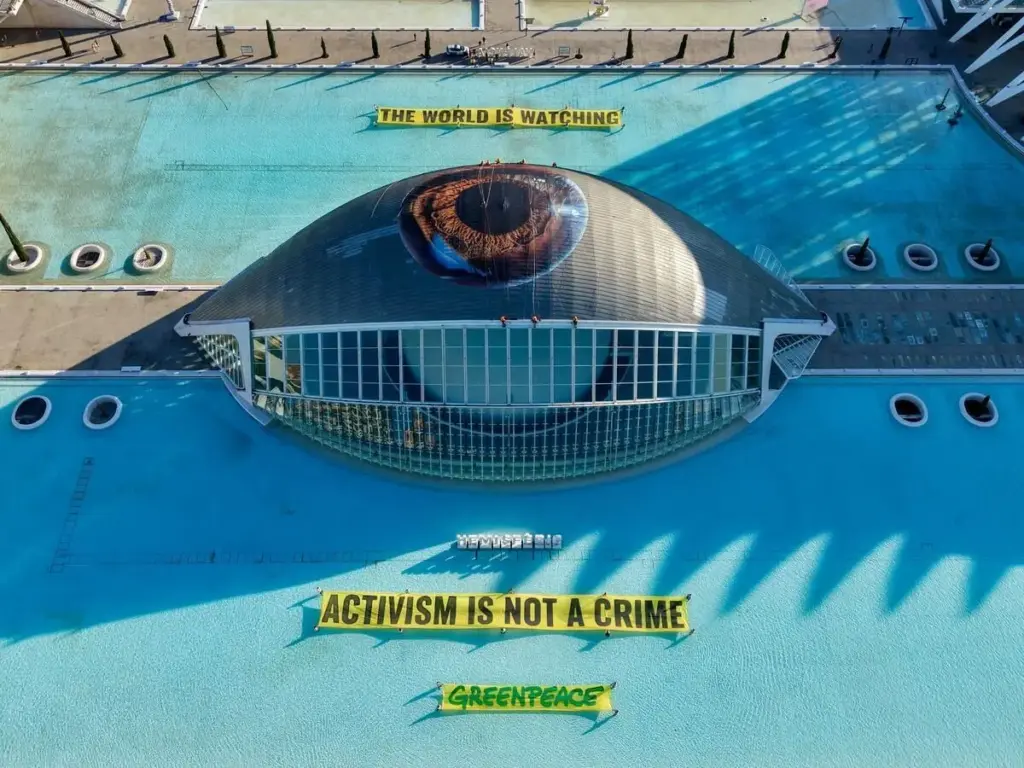
VALENCIA, Spain — In a landmark decision for freedom of expression and the rights of climate campaigners, a court in Valencia has fully acquitted 11 Greenpeace activists who faced severe criminal charges over a peaceful 2021 direct-action protest against a fossil gas shipment at the Port of Sagunto.
The ruling brings to a close a high-stakes legal battle that attracted international condemnation and caught the attention of United Nations human rights monitors. The prosecution had originally sought an extraordinary five-year prison sentence for each defendant—a penalty that legal experts warned was among the harshest ever demanded in Europe for peaceful environmental protest. Although the state later reduced its demand to two and a half years during the trial, today’s verdict completely rejects the core charge of aggravated public disorder.
The presiding court found that the prosecution failed to present any credible evidence that the activists had engaged in violence, intimidation, or any actions capable of disrupting the public peace. Yet, while the legal vindication has been celebrated by environmental advocates globally, civil liberties groups caution that the ordeal highlights an escalating, dangerous trend of criminalizing climate dissent across Europe and beyond.
Executive Overview
The acquittal of the "Sagunto 11" marks a major watershed moment in the intersection of environmental activism and penal law. In October 2021, amid rising global concerns over energy security and climate change, activists from 18 different nationalities boarded and intercepted a liquefied natural gas (LNG) tanker originating from the United States at the Port of Sagunto. Operating from the iconic Greenpeace vessel MY Esperanza, the peaceful blockade lasted 12 hours and aimed to spotlight Europe’s dangerous reliance on fossil gas imports and the urgent imperative to transition to renewable energy.
Despite the demonstration being entirely non-violent, local and national authorities moved aggressively against the participants. The invocation of "aggravated public disorder" charges—carrying potential prison sentences usually reserved for violent offenders—signaled an increasingly punitive approach by European states toward civil disobedience.
The trial itself became a focal point for global debates surrounding civic space. High-profile international observers, including United Nations Special Rapporteurs, attended the proceedings to monitor what they termed a chilling abuse of judicial systems to deter public participation.
While the court’s decision is an undeniable legal victory for the defendants, human rights advocates emphasize that the verdict does not erase the psychological toll, mounting legal expenditures, and operational disruption experienced by the activists over years of litigation. Furthermore, the Spanish government continues to pursue heavy administrative fines totaling €160,000, ensuring that the legal cloud hanging over Greenpeace Spain has not entirely dissipated.
Detailed Chronology: From the Port of Sagunto to the Courtroom
October 2021: The Direct Action at Sagunto
The roots of the legal saga stretch back to late autumn 2021. On October 14, 2021, Greenpeace Spain executed a coordinated, high-visibility protest at the Port of Sagunto, near Valencia. Deploying from the MY Esperanza, 11 activists managed to delay a commercial tanker carrying U.S. liquefied natural gas for 12 hours.
Equipped with banners and demanding an immediate cessation of Europe’s dependency on imported fossil fuels in favor of localized renewable energy networks, the demonstrators maintained respectful and communicative channels with maritime authorities, port officials, and law enforcement throughout the operation. Crucially, independent journalists, maritime workers, and law enforcement officers later testified that no injuries occurred, no property was structurally damaged, and general port traffic was not fundamentally compromised.
The Escalation: State Prosecution and Charges
Despite the peaceful nature of the demonstration, the Spanish state responded with extraordinary judicial force. Rather than treating the incident as a standard administrative infraction—which is customary for port-side trespass or minor maritime disruptions—prosecutors elected to file criminal indictments for aggravated public disorder.
Initially, the Public Prosecutor’s Office demanded an unprecedented five-year prison sentence for each of the 11 activists. In legal circles across Europe, a five-year custodial sentence for a peaceful environmental protest was viewed as disproportionate, draconian, and designed to establish a deterrent precedent. As the case proceeded toward trial, intense public scrutiny and international pressure prompted the prosecution to lower its demand to two and a half years per defendant; however, the insistence on prison time remained a glaring threat to the accused individuals.
The Prelude: "The World is Watching"
As the trial date approached, Greenpeace Spain amplified its public awareness campaign to counter the criminalization of their colleagues. In a striking visual demonstration, activists unfurled a massive, 530-square-meter art installation on the roof of Valencia’s iconic Hemisfèric building. The display featured a giant eye alongside bold messaging: "The world is watching" and "Activism is not a crime." This public mobilization sought to frame the courtroom drama not merely as a localized trial regarding port regulations, but as a referendum on the fundamental right to protest ecological collapse.
The Trial and Today’s Acquittal
During the court proceedings, a wide array of witnesses—encompassing maritime authorities, port security personnel, and independent observers—reiterated that the 2021 action was devoid of violence or malicious intent.
In today’s judgment, the Valencia court validated these testimonies, explicitly ruling that the prosecution had failed to establish the legal threshold for aggravated public disorder. By confirming that the activists’ actions did not constitute a threat to public peace, the court delivered a definitive legal rejection of the state’s aggressive sentencing demands.
Supporting Context & Metrics: The Shrinking Civic Space
The Sagunto trial cannot be viewed in isolation. It forms a critical case study within a broader, international phenomenon often described by human rights organizations as the "shrinking civic space." Across democratic and authoritarian regimes alike, governments are increasingly utilizing sophisticated legal mechanisms, punitive fines, anti-protest legislation, and criminal indictments to suppress climate and environmental activism.
Metrics of Pressure
- 12 Hours: The duration of the peaceful blockade at the Port of Sagunto, which catalyzed years of subsequent legal battles.
- 18 Nationalities: The diverse, international makeup of the 11 activists who participated in the action aboard the MY Esperanza.
- 5 Years to 2.5 Years: The trajectory of the prison sentences initially sought by the Public Prosecutor’s Office before being reduced under intense public and legal scrutiny.
- €160,000: The total sum of administrative fines already levied by the Spanish government against the organizers and participants—penalties that remain under active legal appeal.
- 35 Years: The extensive career span of defense attorney Jose Manuel Marraco, who has dedicated decades to defending environmental defenders in Spanish courts.
Legal analysts point out that even when acquittals are ultimately secured, the procedural journey itself functions as a form of punishment. The "chilling effect" deters ordinary citizens from participating in civil disobedience or publicly voicing dissent against corporate and state policies that exacerbate climate change.
Official Statements and Expert Perspectives
The verdict has elicited strong reactions from international legal experts, human rights defenders, and organizational leaders.
Greenpeace International
Daniel Simons, Senior Legal Counsel for Strategic Defence at Greenpeace International, hailed the ruling while issuing a stern warning regarding the systemic costs borne by activists:
"This is a win for freedom of expression, and a rebuke to the attempt to repress peaceful climate activism. But an acquittal does not erase the years of anxiety, legal costs, and disruption to activists’ lives. This charge never should have been brought in the first place. The only threat to public order here was Europe’s continued reliance on fossil gas imports. We hope the prosecution does not appeal, and turns its attention towards those endangering, not defending life on this planet."
United Nations Human Rights Monitors
The disproportionate legal pressure applied in the Sagunto case drew direct intervention from senior United Nations officials, underscoring the global ramifications of Spain’s judicial strategy.
Gina Romero, United Nations Special Rapporteur on the Rights to Freedom of Peaceful Assembly and of Association, emphasized the systemic danger highlighted by the trial:
"The Sagunto case demonstrates how easily the legal system can be used to deter people from exercising a fundamental right, even when the law agrees in the end they did nothing wrong. It’s part of a broader, global pattern of using the legal system, criminal charges, punitive fines, and restrictive laws to shrink civic space. I will continue to raise the alarm and raise my voice to ensure that peaceful protest is not treated as a crime — in Spain or anywhere else."
Legal Defense Perspective
Jose Manuel Marraco, the veteran Spanish attorney who represented the 11 activists, reflected on his decades-long career defending environmental advocates:
"I have been defending Greenpeace activists for 35 years, and it is an honour to do so. When people put themselves on the line to protect our planet, it is a generous act, not a criminal offence. The State should avoid the chilling effect that criminalisation and long-running proceedings have."
Future Outlook: Implications for Climate Activism in Europe
As the legal dust settles in Valencia, civil rights organizations and environmental networks are assessing the broader implications of the Sagunto verdict for future climate mobilizations.
While the court’s refusal to validate the aggravated public disorder charges sets a positive precedent protecting the boundaries of peaceful direct action, significant hurdles remain. The lingering administrative fines, which total €160,000, represent a formidable financial weapon that state authorities can deploy to penalize dissent without securing criminal convictions. The ongoing appeals regarding these financial penalties will serve as the next crucial legal battleground for Greenpeace Spain.
Furthermore, environmental lawyers and civil liberties advocates are maintaining pressure on European legislatures to repeal or modify vague public safety laws that are frequently weaponized against climate defenders. With extreme weather events intensifying and global carbon emissions remaining at critical levels, experts predict that civil disobedience will likely increase as citizens seek to compel governmental action.
Whether European judicial systems will continue down the path of criminalization—as attempted in the Sagunto case—or align more closely with international human rights standards protecting freedom of peaceful assembly remains one of the defining legal questions of the decade. For now, the acquittal of the Sagunto 11 stands as a vital judicial checkpoint, affirming that standing up for the planetary climate is an exercise of fundamental democratic rights, not a criminal enterprise.



